What Helps When Sweet Cravings Keep Coming Back?
A craving is a cue to check what you need, not a verdict on your willpower.
Start with the situation rather than trying to eliminate the craving. If you missed a meal, eat something satisfying. If you want dessert, you can have it without changing the rest of your day around it. If cravings arrive with sudden shaking and you take medicine that can lower blood sugar, follow your diabetes low-blood-sugar plan instead. 1 A recurring premenstrual pattern deserves a different look. 26
Match the response to the moment
Frequent sweet cravings don't all call for the same response. The most useful first question is concrete: What was happening before this one? A missed lunch, a dessert you simply want, and a sudden shaky feeling while taking diabetes medicine are different situations.
If you haven't eaten enough today, start with food, not a rule about avoiding sweets. For example, after a missed lunch, you might have the meal you missed. If you're between meals, an apple with cheese, yogurt with fruit, or vegetables with hummus are practical snack options that combine foods from different food groups. These are ways to feed yourself, not proven methods for switching off a craving. 5
If you've eaten and still want something sweet, it's okay to choose it. You don't have to turn dessert into a test of whether you're “really hungry,” or skip your next meal to make up for it. Notice whether the craving is enjoyable, inconvenient, or part of a pattern you want to understand. The goal is a useful response, not a promise that cravings will disappear.
When the day has been difficult
If cravings tend to show up after a short night or a stressful day, make the next step manageable. You could eat if you're hungry, have the sweet food if you want it, and make room to rest when you can. Don't assume poor sleep explains every craving. Trouble sleeping and appetite changes can occur together among premenstrual symptoms, but that doesn't tell you the cause of an individual craving. 6
If you're wondering whether sleep is part of a recurring pattern, compare short nights with better-rested days when your meals have been similar. If the craving shows up regardless, a short night may be less useful as an explanation. This is a way to look at your own circumstances, not a test that can identify the cause of a craving.
For a pattern that keeps repeating, compare the circumstances rather than judging the food: Are you routinely missing a meal? Does the craving come on days when eating has been irregular? Does it cluster before your period? That gives you a more useful choice next time, such as making lunch possible on a busy day or planning a satisfying snack for the stretch between work and dinner. Neither choice is a guaranteed craving treatment.
If it happens before your period
Food cravings and appetite changes can be part of premenstrual symptoms. But “it's hormones” is too broad an answer for every sweet craving. In a questionnaire study of 150 young women, those reporting PMS had higher scores for pleasure-driven interest in food than those without PMS; the study did not find that those scores changed across menstrual-cycle phases for participants overall. That makes a personal pattern more informative than a claim that everyone craves sweets at a particular point in the cycle. 2
If your appetite shifts before your period, a balanced eating pattern may be more helpful to try than tighter restriction. Some people with PMS find smaller, more frequent meals useful; this is an option for managing symptoms, not evidence that eating on a particular schedule eliminates cravings. 6 If cravings come with mood changes, sleep problems, or other symptoms that disrupt daily life, bring up the whole recurring pattern with a clinician. Marked appetite changes or specific food cravings can be part of a more severe premenstrual disorder, which is assessed by its timing and impact, not by a craving alone. 36
Pregnancy is a different context, not another phase of a menstrual-cycle pattern. Food cravings are commonly reported during pregnancy, but that alone doesn't explain why you want a particular food. 4
Know when this isn't an ordinary craving
Low blood sugar can cause symptoms that come on quickly, including shaking. It is particularly relevant if you have diabetes and use insulin or another medicine that can lower blood glucose. If a sweet craving arrives with that kind of sudden symptom, use the blood-glucose check and treatment plan you've been given rather than treating it as a routine appetite question. Severe low blood sugar can cause someone to pass out and needs emergency help. People without diabetes can also have low blood sugar, though it's rare; repeated episodes need an assessment of the cause. 1
You don't need to solve every craving. A useful next move is to address what's clear in the moment, then pay attention to a pattern only if it keeps affecting your day.
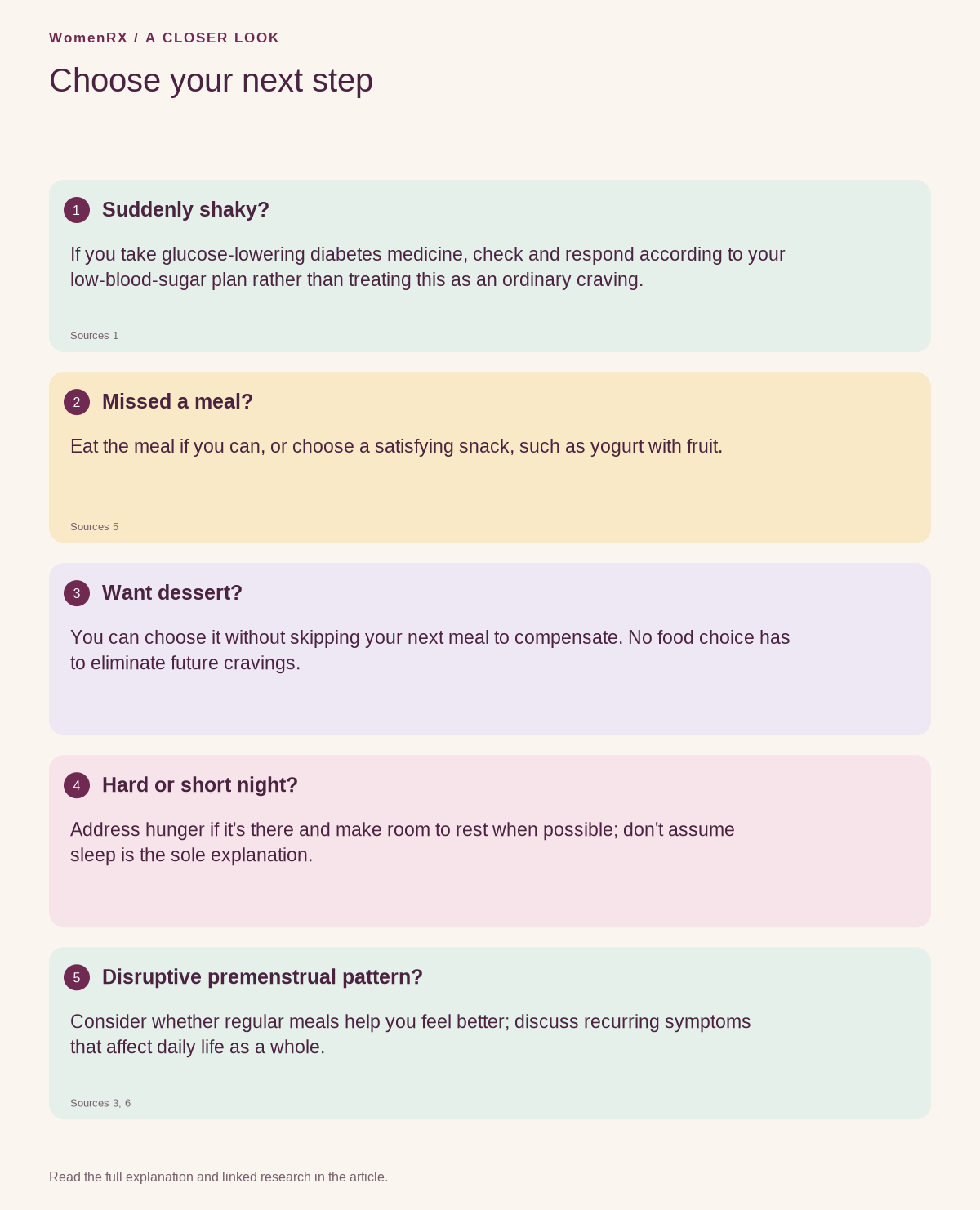
Choose your next step
Suddenly shaky?: If you take glucose-lowering diabetes medicine, check and respond according to your low-blood-sugar plan rather than treating this as an ordinary craving.1
Missed a meal?: Eat the meal if you can, or choose a satisfying snack, such as yogurt with fruit.5
Want dessert?: You can choose it without skipping your next meal to compensate. No food choice has to eliminate future cravings.
Hard or short night?: Address hunger if it's there and make room to rest when possible; don't assume sleep is the sole explanation.
Disruptive premenstrual pattern?: Consider whether regular meals help you feel better; discuss recurring symptoms that affect daily life as a whole.36
Read the figure as text
Start with the circumstance that best matches this craving; the branches aren't a diagnostic test.- Suddenly shaky?: If you take glucose-lowering diabetes medicine, check and respond according to your low-blood-sugar plan rather than treating this as an ordinary craving.1
- Missed a meal?: Eat the meal if you can, or choose a satisfying snack, such as yogurt with fruit.5
- Want dessert?: You can choose it without skipping your next meal to compensate. No food choice has to eliminate future cravings.
- Hard or short night?: Address hunger if it's there and make room to rest when possible; don't assume sleep is the sole explanation.
- Disruptive premenstrual pattern?: Consider whether regular meals help you feel better; discuss recurring symptoms that affect daily life as a whole.36
Sources you can check
- Hypoglycemia: MedlinePlusAccessed 2026-09-25Return to first citation
- The role of premenstrual syndrome in hedonic hunger and food craving during the menstrual cycle.Candan E, Metin ZE, Tengilimoglu-Metin MM. · Journal of nutritional science · 2025Return to first citation
- Premenstrual DisordersMiller C, Carlson K. · 2026Return to first citation
- Military-Related Weight Stigma Prospectively Predicts Dietary Restraint During Pregnancy in US Military Active-Duty Service Members: A Longitudinal Observational Study.Thompson KA, Bauman V, Schrag R, White MA, Mains A, Rioux S, Spinner H, Thorstad I, Thomas V, Klein D, Haigney M, Tanofsky-Kraff M, Lavender JM. · Journal of the Academy of Nutrition and Dietetics · 2025Return to first citation
- MedlinePlus: Managing weight with healthy eatingAccessed 2026-09-25Return to first citation
- PMS (premenstrual syndrome) - NHSAccessed 2026-09-25Return to first citation