What Helps You Keep Muscle After 40?
Resistance training has direct support in studies of older women, while extra protein has produced mixed results.
Make resistance exercise the anchor: trials in older women found gains in strength and muscle measures. 56 Separately, a review of exercise interventions in postmenopausal women with sarcopenia found improvements in strength and physical function. 2 Eat enough overall and include protein-containing foods you enjoy, but don’t assume more protein or one particular food will add to your training results. 156 Leave room to repeat the routine; these studies don’t establish a best recovery schedule. 56
Start with what you want your muscles to do
Keeping muscle isn’t only about a body-composition number. Strength and everyday function matter too: getting up from a chair, carrying groceries, or feeling steadier on your feet. In a review of 17 randomized trials involving 744 postmenopausal women with sarcopenia, exercise interventions improved measures of muscle mass, grip and knee-extension strength, and physical performance compared with control conditions. Those participants had an identified muscle condition, so the results don’t tell us exactly how much benefit a healthy woman in her 40s should expect. 2 Taken alongside trials in older women that found strength gains with resistance training but mixed results from adding food or protein, exercise looks like a more solid starting point than a food or supplement promising to preserve muscle on its own. 56
A change in weight can’t tell you whether your strength has changed. In a cross-sectional study of Korean adults, including women, muscle mass and grip strength did not always line up. That study cannot tell us which habit caused the difference, but it’s a useful reason to pay attention to what you can do, not just what you weigh. 4
Give your muscles something to work against
Resistance exercise means working against a load, such as a machine, a weight, or an elastic band. If you’re choosing a starting point, pick a form you can repeat and adjust rather than searching for a uniquely effective piece of equipment. For example, that might mean supervised machines if you want help learning the movements, or bands if they fit your space. A review in postmenopausal women with sarcopenia found that exercise interventions improved strength and physical function, while effects on muscle mass were less consistent. 2
A routine can focus on movements that matter outside the workout, such as standing up from a chair and pushing or pulling against resistance. Choose a version you can do consistently. In one randomized trial that assigned 49 older women to dietary groups, participants did resistance training three times a week for 12 weeks; quadriceps strength and volume increased across the dietary groups. That schedule shows what was studied, not a minimum you must meet. 6
Prefer an active hobby? A small, nonrandomized study of 20 women aged 50 or older who were at risk of sarcopenia tested gardening tasks with a progressively adjusted workload. Strength and muscle measures improved in the intervention group. It’s an encouraging example of how resistance can be built into an activity, not proof that ordinary gardening replaces a structured strength program. 3
Feed the routine, without chasing a magic protein target
Food supplies both energy and nutrients, including protein. A workable eating pattern also has to fit your preferences, traditions, and budget. In practice, you might look across your usual meals for ways to include protein that fit your preferences and budget, rather than buying a product because it’s advertised for muscle. 1
Protein research in older women gives a more useful answer than either “eat as much as possible” or “protein doesn’t matter.” In a 12-week randomized feeding trial, women around age 66 all did resistance training. Groups eating 1.4 grams of protein per kilogram of body weight daily, from mixed foods or with an emphasis on lean beef, did not gain more quadriceps strength or volume than a group eating 0.8 grams per kilogram daily. These were study comparisons, not personal targets. 6
Another 12-week randomized trial in women aged 59 to 79 compared resistance training and chicken intake in several combinations. The group combining training with chicken had a greater increase in whole-body lean mass than the training-plus-placebo group; both training groups gained more maximal strength than the sedentary groups. The two trials tested different diets and outcomes, so together they don’t establish that chicken or beef is necessary, or that extra protein helps everyone who lifts. They do put training and a sufficient, realistic eating pattern in the same picture. 56
If you avoid certain foods or have been given a limit on protein, don’t borrow an intake from a trial as your target. A more useful question for a dietitian or your care team is: How can I meet my nutrition needs while doing strength exercise within my dietary limits? 16
Make space to come back to it
Recovery belongs in the plan because the plan has to be repeatable. As a practical example, you could place strength sessions on separate days and use the other days for activities you enjoy or for rest. The cited programs ran over weeks but do not establish a best recovery schedule. 56
If you’re dealing with pain, limited mobility, or a health condition that changes what exercise or food is realistic, the useful adjustment is specific to that constraint. Ask which resistance movements fit your limits and whether your current eating pattern supports the work. The exercise review concerns postmenopausal women with sarcopenia, while the dietary trials concern older women. These studies do not establish a menopause-specific routine or show which approach works best across menopause status. 256
Which muscle habits have the clearest support?
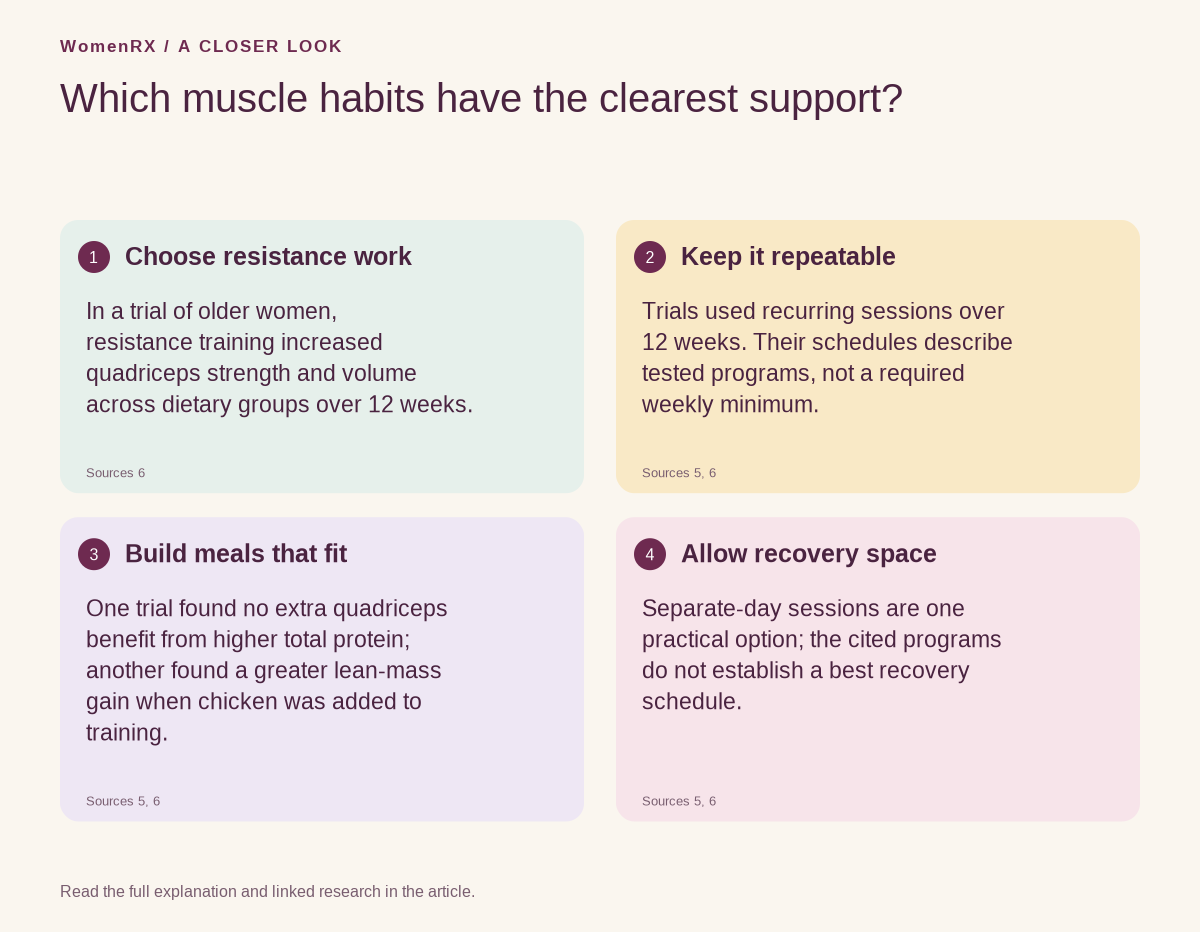
Choose resistance work: In a trial of older women, resistance training increased quadriceps strength and volume across dietary groups over 12 weeks.6
Keep it repeatable: Trials used recurring sessions over 12 weeks. Their schedules describe tested programs, not a required weekly minimum.56
Build meals that fit: One trial found no extra quadriceps benefit from higher total protein; another found a greater lean-mass gain when chicken was added to training.56
Allow recovery space: Separate-day sessions are one practical option; the cited programs do not establish a best recovery schedule.56
Read the figure as text
Compare a realistic choice with what studies in older women actually tested; these are options to consider, not a scored plan.- Choose resistance work: In a trial of older women, resistance training increased quadriceps strength and volume across dietary groups over 12 weeks.6
- Keep it repeatable: Trials used recurring sessions over 12 weeks. Their schedules describe tested programs, not a required weekly minimum.56
- Build meals that fit: One trial found no extra quadriceps benefit from higher total protein; another found a greater lean-mass gain when chicken was added to training.56
- Allow recovery space: Separate-day sessions are one practical option; the cited programs do not establish a best recovery schedule.56
More questions, answered
Do I need to track muscle mass to know whether my routine is helping?
Not necessarily. You can also notice whether a familiar task, such as rising from a chair, feels easier or whether you can handle more resistance in a movement you practice. Strength and muscle-mass measures don’t always match, and exercise trials in postmenopausal women have measured both strength and physical function alongside muscle mass. 42
Is a protein supplement necessary after a strength workout?
The studies here don’t establish that it is. One trial found no additional quadriceps benefit from higher-protein diets during training, while another found a greater lean-mass gain when chicken was added to training. Neither result means you need a particular product or must eat protein at an exact time after exercise. 65
Sources you can check
- Nutrition: MedlinePlusAccessed 2026-09-25Return to first citation
- Effectiveness of exercise intervention on muscle mass, muscle strength, and physical function among postmenopausal women with sarcopenia: a systematic review and meta-analysis.Deng Y, Xu L, Martin-Payo R, Deng K, Huang L, Yang Y, Xie Z, Qiu M, Li C, Zhang F. · Frontiers in public health · 2026Return to first citation
- Structured Horticultural Therapy Enhances Muscle Strength and Mass in Aging Women at Risk of Sarcopenia.Wu CF, Fungfoo P, Hsu YS, Liu TY, Chou LW. · QJM : monthly journal of the Association of Physicians · 2026Return to first citation
- Identifying Individuals at Risk of Functional Decline Despite Preserved Muscle Mass: Insights from Appendicular Skeletal Muscle Mass and Handgrip Strength Discordance.Nguyen VT, Jeong Y, Lee T. · Journal of clinical medicine · 2026Return to first citation
- Effect of resistance training and chicken meat on muscle strength and mass and the gut microbiome of older women: A randomized controlled trial.Uchida M, Park J, Fujie S, Hosomi K, Horii N, Watanabe K, Sanada K, Shinohara Y, Mizuguchi K, Kunisawa J, Iemitsu M, Miyachi M. · Physiological reports · 2024Return to first citation
- Greater Protein Intake Emphasizing Lean Beef Does Not Affect Resistance Training-Induced Adaptations in Skeletal Muscle and Tendon of Older Women: A Randomized Controlled Feeding Trial.Carroll CC, Campbell NW, Lewis RL, Preston SE, Garrett CM, Winstone HM, Barker AC, Vanos JM, Stouder LS, Reyes C, Fortino MA, Goergen CJ, Hass ZJ, Campbell WW. · The Journal of nutrition · 2024Return to first citation