How Much Protein Helps You Build Muscle?
Your daily protein target depends on your body size, resistance training, usual diet, and health, not a single number for every woman.
If you’re regularly resistance training, 1.4-2.0 grams of protein per kilogram of body weight per day is a commonly cited range. A strength-focused analysis found gains rose with total intake up to about 1.5 g/kg/day, with no further gains observed above that point in its model. Neither finding makes one number a proven muscle-growth target for every woman. Count protein from food and supplements together. 89
Start with your daily total
Protein gives your body material to build and maintain muscle, while resistance training provides the stimulus to adapt. In a meta-analysis of randomized trials, added protein improved strength gains when paired with resistance training, but not when training was absent. Strength isn’t the same outcome as muscle size, so that finding helps put protein in context rather than promising a particular amount of growth. 79
For someone who trains regularly and wants a practical estimate, the 1.4-2.0 g/kg/day range cited in a review of resistance-training research is a place to start planning. A separate dose-response analysis of strength found gains rose as total daily intake increased up to about 1.5 g/kg/day, with no further gains observed above that point in its model. That makes roughly 1.5 g/kg/day a reasonable reference point for a calculation, not a requirement or a reason to push to the top of the range. The strength analysis included women and men; it did not establish a separate daily target for women. 89
Here’s the math. Divide your weight in pounds by 2.2 to estimate kilograms, then multiply by the grams-per-kilogram figure you’re considering. For example, at 150 pounds, your weight is about 68 kg. At 1.5 g/kg/day, the estimate is about 102 grams of protein across the day. Using 1.4-2.0 g/kg/day instead gives a planning range of about 95-136 grams. Those numbers illustrate the calculation, not a prescription for every 150-pound woman. 89
Check what your meals already provide
The daily total includes protein in meals, snacks, and any supplement. Meat, fish, eggs, dairy, soy foods such as tofu, beans, lentils, nuts, and seeds can all contribute. If you eat mostly plant foods, variety across the day helps provide the amino acids your body needs. Check the label for a particular food’s protein per serving rather than assuming every tofu, yogurt, or protein powder contains the same amount. 67
Try adding up a usual day before deciding you need anything extra. For example, if food labels and portions show that your breakfast, lunch, dinner, and snacks already bring you near your chosen daily estimate, a shake isn’t an additional muscle-building requirement. Research comparing protein supplements during resistance training doesn’t show that every woman needs a supplement regardless of what she already eats. One supplement review could not consistently account for participants’ habitual protein intake, a key limit when applying its results to someone whose meals already provide plenty. 8
Does protein timing change the plan?
Make the daily total your first calculation. You can then fit protein-containing foods into eating occasions that work for you; there’s no need to treat a single post-workout meal as the whole plan. In a nine-day controlled-feeding trial, 40 physically active young adults, including 12 women, did resistance exercise while eating either a more balanced or more uneven protein pattern. Researchers found no difference between patterns in daily muscle-protein synthesis, the process they measured. The trial did not test whether those patterns produced the same muscle growth over months, and it did not report a separate result for women. 2
Protein source deserves a similarly practical view. That short trial found comparable muscle-protein synthesis on vegan and omnivorous diets at the protein intakes studied. It doesn’t prove that every version of those diets performs identically; in this small, nine-day trial, the diets studied produced similar measured daily muscle-protein synthesis. 2
When the estimate needs adjusting
Age and health can change what’s sensible. In a review of trials involving postmenopausal women aged 55 and older, whey supplementation alongside resistance training improved certain measures of strength and lower-limb lean mass compared with controls; without resistance training, it showed no significant benefit for strength or lean mass. That supports pairing nutrition with training, but it doesn’t establish a distinct daily protein requirement for all postmenopausal women. Evidence is particularly limited for older adults living with multiple long-term conditions. 53
If you’re 65 or older and have nondialysis chronic kidney disease, don’t assume a general muscle-building range is your personal target. Kidney disease affects how your kidneys filter waste, and a review of community-dwelling older adults found insufficient evidence to settle how protein intake affects kidney function in people with and without nondialysis CKD. That makes your kidney health and broader nutrition needs relevant to the decision. 14
The training findings discussed here don’t establish muscle-building protein targets during pregnancy or breastfeeding. 29
The useful order is simple: keep resistance training in the picture, estimate a daily total from body weight if the general range fits your circumstances, then see how much your usual food already supplies. Let that comparison, rather than workout timing or a supplement label, tell you whether there’s a gap to fill. 689
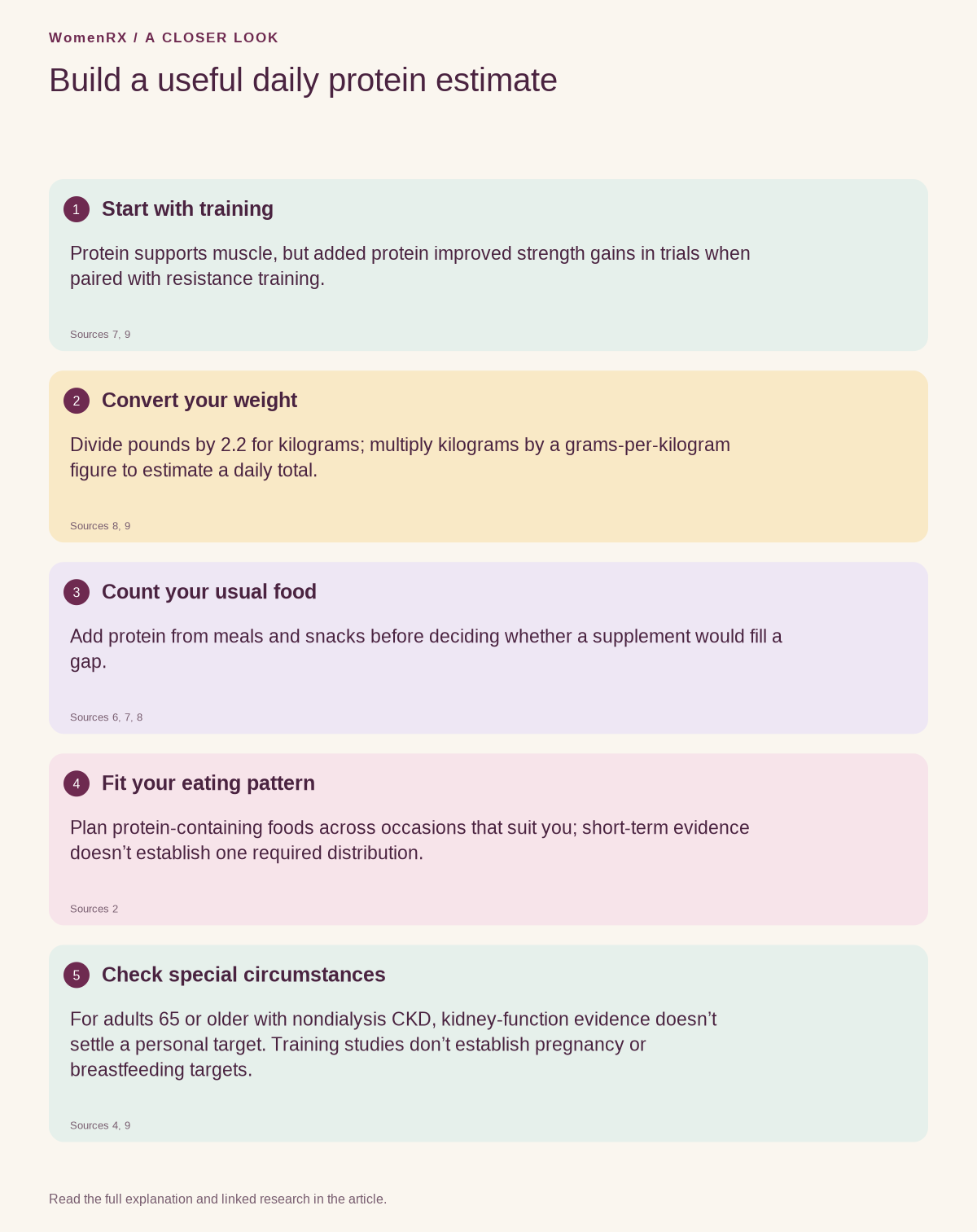
Build a useful daily protein estimate
Start with training: Protein supports muscle, but added protein improved strength gains in trials when paired with resistance training.79
Convert your weight: Divide pounds by 2.2 for kilograms; multiply kilograms by a grams-per-kilogram figure to estimate a daily total.89
Count your usual food: Add protein from meals and snacks before deciding whether a supplement would fill a gap.678
Fit your eating pattern: Plan protein-containing foods across occasions that suit you; short-term evidence doesn’t establish one required distribution.2
Check special circumstances: For adults 65 or older with nondialysis CKD, kidney-function evidence doesn’t settle a personal target. Training studies don’t establish pregnancy or breastfeeding targets.49
Read the figure as text
Use this as a planning sequence, not a diagnostic score or a target that fits everyone.- Start with training: Protein supports muscle, but added protein improved strength gains in trials when paired with resistance training.79
- Convert your weight: Divide pounds by 2.2 for kilograms; multiply kilograms by a grams-per-kilogram figure to estimate a daily total.89
- Count your usual food: Add protein from meals and snacks before deciding whether a supplement would fill a gap.678
- Fit your eating pattern: Plan protein-containing foods across occasions that suit you; short-term evidence doesn’t establish one required distribution.2
- Check special circumstances: For adults 65 or older with nondialysis CKD, kidney-function evidence doesn’t settle a personal target. Training studies don’t establish pregnancy or breastfeeding targets.49
Sources you can check
- Chronic Kidney Disease | Kidney Disease | CKD | MedlineplusAccessed 2026-09-25Return to first citation
- Impact of Vegan Diets on Resistance Exercise-Mediated Myofibrillar Protein Synthesis in Healthy Young Males and Females: A Randomized Controlled Trial.Askow AT, Barnes TM, Zupancic Z, Deutz MT, Paulussen KJM, McKenna CF, Salvador AF, Ulanov AV, Paluska SA, Willard JW, Petruzzello SJ, Burd NA. · Medicine and science in sports and exercise · 2025Return to first citation
- Evidence on protein intake on lean body mass and function in community-dwelling adults aged 50 years and over living with multiple long-term conditions: Systematic review.Ahmed S, MacKenzie A, Eost-Telling C, French C, Christie RA, Karami A, Todd C, Vardy E, Burden S, Money A. · Clinical nutrition ESPEN · 2026Return to first citation
- Association Between Dietary Protein Intake and Kidney Function in Community-Dwelling Older Adults: A Systematic Review.Al Qannas F, Nurgozhina M, Owen A, Gasevic D, Polkinghorne KR, Bongetti E, Chen Y, Wild H. · Nutrition reviews · 2026Return to first citation
- Effect of Whey Protein Supplementation in Postmenopausal Women: A Systematic Review and Meta-Analysis.Kuo YY, Chang HY, Huang YC, Liu CW. · Nutrients · 2022Return to first citation
- MedlinePlus: Protein in diet, including tofu and other plant sourcesAccessed 2026-09-25Return to first citation
- Dietary Proteins: MedlinePlusAccessed 2026-09-25Return to first citation
- Dose-structure-population interactions of protein supplementation combined with resistance training on body composition: a Bayesian network meta-analysis with dose-response modeling.Li Y, Qin G, Wang Z, Zhang J. · Frontiers in nutrition · 2026Return to first citation
- Synergistic Effect of Increased Total Protein Intake and Strength Training on Muscle Strength: A Dose-Response Meta-analysis of Randomized Controlled Trials.Tagawa R, Watanabe D, Ito K, Otsuyama T, Nakayama K, Sanbongi C, Miyachi M. · Sports medicine - open · 2022Return to first citation