How Much Protein Do You Need as Life Changes?
Your protein starting point depends on your life stage, while training and health needs may call for a different target.
For a healthy adult, the protein Recommended Dietary Allowance is 0.8 grams per kilogram of body weight per day; the reference table lists 46 grams for adult women using a reference body weight. Pregnancy and lactation each have a 71-gram daily RDA. Older adults and athletes may consider higher targets, but those aren’t a new minimum for every woman. 658
Start with the number that answers your question
If you’re wondering whether you get enough protein, first identify which kind of number you’re comparing your meals with. The Recommended Dietary Allowance (RDA) is an intake intended to meet the needs of nearly all healthy people in a defined group. For adults, its weight-based basis is 0.8 grams per kilogram of body weight per day. The National Academies’ table lists 46 grams a day for women ages 19 and older, including those over 70, but that gram figure uses a reference body weight. It isn’t a personalized target for every woman. 6
For example, at 150 pounds, you weigh about 68 kilograms. Multiplying 68 by 0.8 gives a starting comparison of about 54 grams a day, rather than the table’s 46 grams. That calculation is most useful when you’re a healthy adult who isn’t pregnant or lactating. It doesn’t account for every training goal or health condition. 68
You may also see a higher number in the Dietary Guidelines for Americans, 2025-2030: a protein food goal of 1.2 to 1.6 grams per kilogram per day, adjusted for individual calorie needs. That is current federal dietary guidance, while 0.8 g/kg is the established adult RDA. They answer different questions: one is a broader food-pattern goal, and the other is a reference intake designed to cover nearly all healthy adults’ requirements. Don’t read the higher range as proof that an intake meeting the RDA is deficient, or as a personal prescription. 76
Pregnancy and breastfeeding have their own reference intake
The protein RDA rises to 71 grams a day during pregnancy and is also 71 grams a day during lactation, compared with 46 grams for nonpregnant adult women at the reference body weight. These are life-stage reference values, not amounts to add on top of your usual intake. If you’re pregnant or breastfeeding, compare your food intake with the relevant life-stage figure rather than relying on the nonpregnant adult table entry. 6
An RDA is useful, but it doesn’t settle every individual question. A systematic review of human protein-requirement research found relatively few studies in pregnancy and particularly limited research across lactation. If eating has become difficult during pregnancy, or you’re unsure how to meet your needs while breastfeeding, a dietitian or your pregnancy or postpartum care team can help assess your overall diet. 4
Older age and serious training change the conversation
The adult RDA doesn’t increase automatically at a particular birthday. Still, maintaining muscle and eating enough nutrient-dense food can become more pressing with age. An expert recommendation described in a systematic review suggests 1.0 to 1.2 g/kg/day for healthy older adults, above the adult RDA. That’s a suggested goal for this population, not a replacement for the National Academies’ reference value or proof that every older woman needs exactly that amount. The current Dietary Guidelines likewise note that some older adults need fewer calories while requiring equal or greater amounts of nutrients, including protein. 657
This distinction matters in everyday life. In a cross-sectional study of 5,732 older women in the Women’s Health Initiative Long Life Study analytic sample, 56% met the protein RDA of 0.8 g/kg/day. The study describes reported intake; it doesn’t show that a higher target would improve an individual woman’s strength or health. 1
For athletes, an NIH exercise-and-performance reference describes 1.2 to 2.0 g/kg/day to support training adaptations and recovery. That range comes from sports-nutrition guidance, not a rule that applies just because you take walks or exercise occasionally. Much of the supplement research discussed in that reference involves conditioned athletes, so its findings don’t necessarily carry over to recreational activity. 8
If you have a chronic disease or a nutrition plan for a medical condition, a general population range may not fit. That’s a reason to use the target developed for your situation rather than choosing the highest number on a chart. 7
See what your usual food adds up to
You don’t need a protein powder to do a first-pass check. Pick a fairly typical day and add the protein from your usual portions, including foods that contribute modest amounts. MedlinePlus gives rough equivalents of about 7 grams from one large egg, ½ cup of cooked beans or lentils, or ¼ cup of tofu. USDA reference data put one cup of cooked quinoa at about 8 grams. Portions and products vary, so use a food label when you have one. 23
As an example of the arithmetic, two eggs contribute about 14 grams, one cup of cooked lentils about 14 grams, and one cup of cooked quinoa about 8 grams: roughly 36 grams across those foods, before counting anything else eaten that day. This isn’t a proposed menu or a complete day’s intake. It shows why counting only the obvious main protein at dinner can miss part of the picture. 23
Plant foods count, too. Soy foods, beans, lentils, nuts and some grains supply protein; you don’t need animal products to meet your protein needs. MedlinePlus notes that the balance of essential amino acids across the day matters more than getting every one at each meal. 2
Once you’ve estimated a typical day, compare it with the reference that actually fits your situation. If your intake looks below it, look at the meals where adding a protein-containing food would work for you. If you’re already meeting it, a larger number on a fitness post alone isn’t evidence that your diet needs fixing.
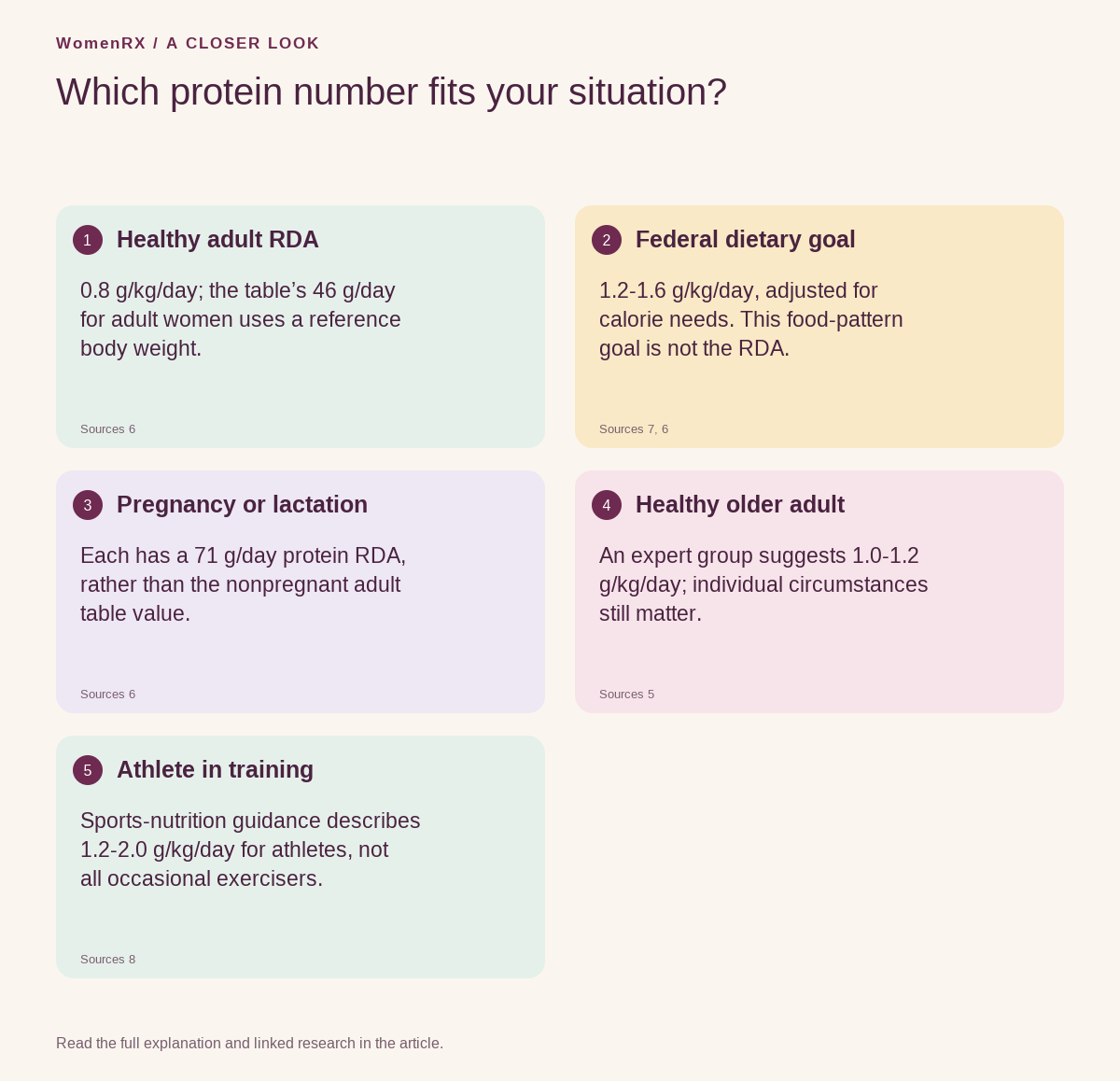
Which protein number fits your situation?
Healthy adult RDA: 0.8 g/kg/day; the table’s 46 g/day for adult women uses a reference body weight.6
Federal dietary goal: 1.2-1.6 g/kg/day, adjusted for calorie needs. This food-pattern goal is not the RDA.76
Pregnancy or lactation: Each has a 71 g/day protein RDA, rather than the nonpregnant adult table value.6
Healthy older adult: An expert group suggests 1.0-1.2 g/kg/day; individual circumstances still matter.5
Athlete in training: Sports-nutrition guidance describes 1.2-2.0 g/kg/day for athletes, not all occasional exercisers.8
Read the figure as text
These figures serve different purposes. Choose the comparison that matches your life stage or activity before assessing your usual intake.- Healthy adult RDA: 0.8 g/kg/day; the table’s 46 g/day for adult women uses a reference body weight.6
- Federal dietary goal: 1.2-1.6 g/kg/day, adjusted for calorie needs. This food-pattern goal is not the RDA.76
- Pregnancy or lactation: Each has a 71 g/day protein RDA, rather than the nonpregnant adult table value.6
- Healthy older adult: An expert group suggests 1.0-1.2 g/kg/day; individual circumstances still matter.5
- Athlete in training: Sports-nutrition guidance describes 1.2-2.0 g/kg/day for athletes, not all occasional exercisers.8
More questions, answered
Do I need to eat protein right after a workout?
You don’t need to treat the hour after exercise as your only chance. The NIH exercise-and-performance reference reports that a meta-analysis of randomized trials did not find a significant improvement in muscle strength or size from having protein within an hour before or after exercise. Adequate overall intake still matters for training and recovery. 8
Sources you can check
- Dietary Intakes of Women's Health Initiative Long Life Study Participants Falls Short of the Dietary Reference Intakes.Beasley JM, Rillamas-Sun E, Tinker LF, Wylie-Rosett J, Mossavar-Rahmani Y, Datta M, Caan BJ, LaCroix AZ. · Journal of the Academy of Nutrition and Dietetics · 2020Return to first citation
- MedlinePlus: Protein in diet, including tofu and other plant sourcesAccessed 2026-09-25Return to first citation
- USDA SR Legacy reference composition: quinoaAccessed 2026-09-25Return to first citation
- Evaluation of dietary protein and amino acid requirements: a systematic review.Burstad KM, Lamina T, Erickson A, Gholizadeh E, Namigga H, Claussen AM, Slavin JL, Teigen L, Hill Gallant KM, Stang J, Steffen LM, Harindhanavudhi T, Kouri A, Duval S, Butler M. · The American journal of clinical nutrition · 2025Return to first citation
- Protein or Amino Acid Intake at Breakfast for Muscle Mass Gain in Older Adults: A Systematic Review and Meta-Analysis.Ikeda T, Tashiro N, Ohtsuka H, Yamaji N, Matoba M, Noma H, Ota E, Hasegawa T. · Food science & nutrition · 2026Return to first citation
- National Academies DRI summary table: total water and macronutrientsAccessed 2026-09-25Return to first citation
- Dietary Guidelines for Americans, 2025-2030Accessed 2026-09-25Return to first citation
- Dietary Supplements for Exercise and Athletic Performance - Health Professional Fact SheetAccessed 2026-09-25Return to first citation