What to Eat When You’re Training to Build Muscle
A protein-containing meal you can repeat matters more than finding a single “best” muscle-building food.
Strength training provides the stimulus for muscle growth; food helps support the response. Aim to get enough protein and overall food across your day rather than relying on a superfood or a precisely timed shake. A practical research-based protein starting point is about 1.6 grams per kilogram of body weight per day, adjusted to your circumstances. 37
Start with the training, then build meals around it
No food builds muscle on its own. Resistance training provides the stimulus, while protein supplies amino acids your body uses to build and maintain muscle. A review identifies sufficient mechanical tension and effective muscle-fiber recruitment as important for growth. 17 Eating enough overall also matters: a diet that makes it hard to fuel your training is a poor fit for a muscle-growth goal, even if it includes plenty of protein. 17
You don’t need to pick one supposedly superior food. Ten choices you can rotate through are eggs, skyr, tuna, meat, tofu, tempeh, beans, lentils, nuts, and quinoa. These aren’t equal-protein swaps: what each contributes depends on the food and your portion. 158910 If you eat only plant foods, variety across the day helps you get the amino acids you need; animal foods aren’t required. 15
Turn a daily protein goal into meals
About 1.6 grams of protein per kilogram of body weight per day is a useful starting point drawn from resistance-training research, not a rule every woman must hit exactly. For example, at 70 kilograms (about 154 pounds), that works out to about 112 grams in a day. Divided across four eating occasions, it’s about 28 grams each time. A narrative review describes roughly three to four protein-containing meals as a practical distribution strategy, but the arithmetic is a planning aid, not a requirement to eat identical meals. 37
Here’s what portions can contribute. One 5.3-ounce cup of a specific plain skyr product lists 16 grams of protein, so two cups would provide 32 grams. In USDA reference data, 3 ounces of cooked bluefin tuna provides about 25 grams, and 1 cup of cooked quinoa provides about 8 grams. Tuna with that cup of quinoa would therefore provide about 33 grams before counting anything else on the plate. Quinoa can contribute protein, but the cup in this example supplies much less than the tuna portion. 8910
For one possible training day, that could mean two skyr cups with breakfast (32 grams), the tuna-and-quinoa lunch (about 33 grams), one skyr cup later (16 grams), and tofu with a cup of quinoa at dinner. The dinner amount depends on the tofu: if your label says 14 grams of protein per 100 grams, a 200-gram portion plus the quinoa would provide about 36 grams. Those listed foods would add up to about 117 grams for the day if the tofu label matched the example. It’s an illustration of portions adding up, not a menu you need to copy or a verified protein value for tofu. 258910
You can use the same approach without dairy or fish. Build meals from tofu, tempeh, beans, lentils and other foods you eat, then use the protein amount for your actual portions to see how the day adds up. For example, a bean-and-grain bowl can replace the tuna lunch, while a soy food can take the place of the skyr snack. Protein amounts vary by product and portion, so check a package label when there is one; the 16-gram skyr serving and the hypothetical tofu calculation aren’t values to assign to every yogurt or tofu. 12510
Don’t let protein crowd out enough food
If your meals are getting smaller while your training gets harder, think beyond protein. Carbohydrate-containing foods can help support training workload, and your overall energy intake is part of the picture. A large calorie surplus isn’t a proven prerequisite for everyone: a review describes muscle growth during an energy deficit in otherwise healthy, overweight people responding to a novel resistance-training stimulus. It notes that this response is less evident in highly trained people who train regularly. When a 2019 review was published, its authors reported that rigorous long-term studies had not directly tested how an energy surplus affects muscle growth from resistance training. 67
That leaves a more useful question than “What food should I add?”: Am I eating enough regular meals to support the training I’m doing? For example, if a protein snack is replacing lunch rather than adding to an otherwise sparse day, a fuller lunch may better address what’s missing. This is a way to assess your routine, not a prescribed calorie target. 67
How much does timing matter?
You can arrange meals around your schedule. In an eight-week randomized trial, 40 resistance-trained women were included in the intention-to-treat analysis. Groups eating within different daily time windows had similar energy and protein intakes, averaging about 1.6 grams of protein per kilogram per day, and showed comparable muscle-growth and performance improvements during supervised training. Everyone also received whey protein, so the study doesn’t show that a restricted eating window is better, or that a supplement is necessary. It does show that one particular daily eating schedule wasn’t essential to the gains observed in this group. 3
That trial doesn’t answer nutrition needs during pregnancy or a postpartum return to training. Nor should its results be assumed to apply unchanged to older adults: research in older people shows that responses to resistance training vary, but it doesn’t establish a separate food or protein rule for older women from the findings described here. Start with the same practical distinction: training is the stimulus; meals need to make enough protein and overall food feasible for your life. 347
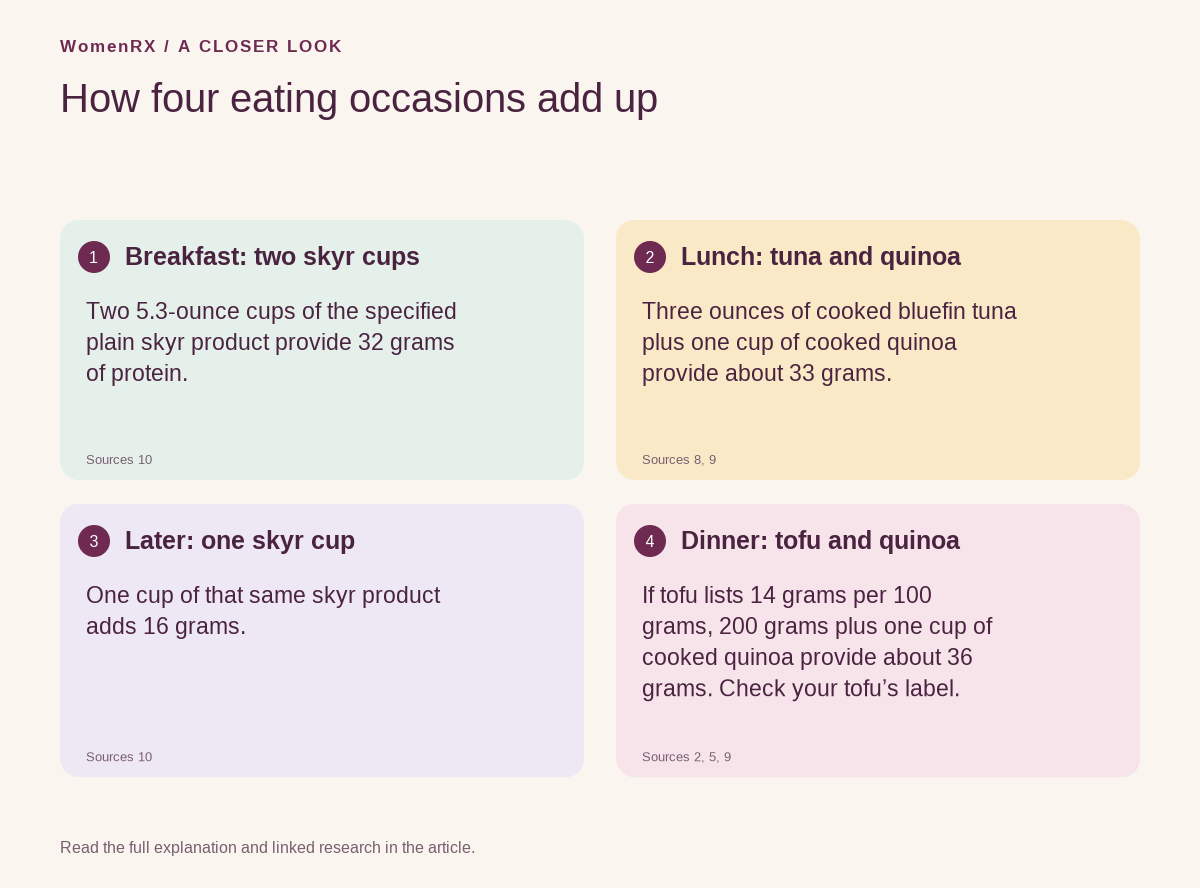
How four eating occasions add up
Breakfast: two skyr cups: Two 5.3-ounce cups of the specified plain skyr product provide 32 grams of protein.10
Lunch: tuna and quinoa: Three ounces of cooked bluefin tuna plus one cup of cooked quinoa provide about 33 grams.89
Later: one skyr cup: One cup of that same skyr product adds 16 grams.10
Dinner: tofu and quinoa: If tofu lists 14 grams per 100 grams, 200 grams plus one cup of cooked quinoa provide about 36 grams. Check your tofu’s label.259
Read the figure as text
A serving-based example for a training day, not a required menu. The dinner and daily totals depend on the tofu label matching the stated example.- Breakfast: two skyr cups: Two 5.3-ounce cups of the specified plain skyr product provide 32 grams of protein.10
- Lunch: tuna and quinoa: Three ounces of cooked bluefin tuna plus one cup of cooked quinoa provide about 33 grams.89
- Later: one skyr cup: One cup of that same skyr product adds 16 grams.10
- Dinner: tofu and quinoa: If tofu lists 14 grams per 100 grams, 200 grams plus one cup of cooked quinoa provide about 36 grams. Check your tofu’s label.259
More questions, answered
Do I need protein powder to build muscle?
Not necessarily. Meat, fish, eggs, dairy, soy foods, beans and lentils are all food sources of protein. The women’s training trial used whey to help participants reach their protein intake, so it cannot tell us whether whey worked better than meeting that intake with food. 35
Sources you can check
- Dietary Proteins: MedlinePlusAccessed 2026-09-25Return to first citation
- Relationship between the chemical composition, textural attributes, and sensory acceptability of Tofu as influenced by different coagulants.Awoyale W, Williams-Ngegba MSE, Laoye CI, Sanni LO, Maziya-Dixon B. · Frontiers in nutrition · 2025Return to first citation
- Time-restricted feeding plus resistance training in active females: a randomized trial.Tinsley GM, Moore ML, Graybeal AJ, Paoli A, Kim Y, Gonzales JU, Harry JR, VanDusseldorp TA, Kennedy DN, Cruz MR. · The American journal of clinical nutrition · 2019Return to first citation
- Molecular signatures underlying heterogenous hypertrophy responsiveness to resistance training in older men and women: a within-subject design.Lixandrao ME, Bamman M, Lavin KM, Longobardi I, Telles G, Vechin FC, Damas F, Drummer DJ, McAdam JS, Riani Costa LA, Libardi CA, Gualano B, Roschel H. · Journal of applied physiology (Bethesda, Md. : 1985) · 2025Return to first citation
- MedlinePlus: Protein in diet, including tofu and other plant sourcesAccessed 2026-09-25Return to first citation
- Is an Energy Surplus Required to Maximize Skeletal Muscle Hypertrophy Associated With Resistance Training.Slater GJ, Dieter BP, Marsh DJ, Helms ER, Shaw G, Iraki J. · Frontiers in nutrition · 2019Return to first citation
- Molecular Basis and Practical Applications of Training, Nutrition and Recovery for Maximum Gains in Lean Muscle Mass: A Narrative Review for Optimizing Muscular Hypertrophy.Vergara Nieto ÁA, Halabi Diaz A, Hernández Millán M, Sagredo Oyarzo D. · Sports health · 2026Return to first citation
- USDA SR Legacy reference composition: tunaAccessed 2026-09-25Return to first citation
- USDA SR Legacy reference composition: quinoaAccessed 2026-09-25Return to first citation
- Plain Nonfat Skyr Yogurt 5.3oz - High Protein - siggi'sAccessed 2026-09-25Return to first citation