Do You Need 100 Grams of Protein a Day?
One hundred grams may fit your needs, but it isn’t a protein requirement for all women.
For healthy adults, the protein Recommended Dietary Allowance is 0.8 grams per kilogram of body weight per day. That makes 100 grams more than the RDA for many women, though the RDA isn’t necessarily the right target for every goal or circumstance. Age, health and activity matter too. 13
Compare 100 grams with your own starting point
A fixed number can sound reassuringly simple. Protein needs aren’t fixed, though. The adult Recommended Dietary Allowance (RDA) is 0.8 grams per kilogram of body weight per day. For example, at about 150 pounds (68 kilograms), that works out to roughly 54 grams. At about 200 pounds (91 kilograms), it’s roughly 73 grams. These are illustrations of the RDA calculation, not personalized targets. 3
The RDA is a useful reference point, not a ceiling. A 100-gram day would be above either example’s RDA, but that alone doesn’t tell you whether it suits your activity, health or eating goals. It also isn’t a requirement for weight loss. Protein needs vary with age, health and physical activity, and guidance allows flexibility beyond the RDA when planning an overall diet. 13
What changes the comparison?
If you’re active: Activity is one reason your needs may differ from a basic RDA calculation. That doesn’t mean every workout calls for 100 grams; the number has to make sense alongside your body size and the rest of what you eat. 13
If you’re older: Getting enough protein deserves attention, but age alone doesn’t turn 100 grams into a universal target. In a cross-sectional analysis of 5,732 participants in the Women’s Health Initiative Long Life Study, whose mean age was 79, 56% met the protein RDA of 0.8 grams per kilogram per day. That describes intake in this group, not the ideal amount for every older woman. 2
If you’re pregnant or breastfeeding: Don’t assume a target chosen for a nonpregnant adult fits these stages. Protein supports growth during pregnancy, and research reviewing requirements across life stages found limited studies, particularly for pregnancy and lactation. That review doesn’t establish 100 grams as the right target for either stage. 54
If a health condition affects your diet: A general menu example can’t replace protein guidance tailored to that condition. Health is one of the factors that changes protein needs. 1
What a food-based day can look like
You don’t need a powder to see how protein adds up. Here are two versions of the same example day: one totals about 73 grams, and three food additions bring it to about 103 grams. They’re arithmetic examples, not meal plans or promises about results. MedlinePlus estimates about 7 grams of protein in an egg, an ounce of most protein-rich foods, or a half-cup of cooked beans or lentils. USDA reference data put a cup of cooked quinoa at about 8 grams; the specific plain skyr used here lists 16 grams per cup. Actual foods and labels can vary. 567
| Meal | About 73 grams for the day | About 103 grams for the day |
|---|---|---|
| Breakfast | One 5.3-ounce cup of plain skyr: 16 g | The same skyr plus an egg: 23 g |
| Lunch | Three ounces of chicken and a half-cup of cooked beans: 28 g | Same lunch: 28 g |
| Dinner | Three ounces of fish and a cup of cooked quinoa: 29 g | The same dinner plus a half-cup of cooked beans: 36 g |
| Snack | No protein food counted | One more 5.3-ounce cup of plain skyr: 16 g |
The estimates use the cited food portions and the protein amount on that skyr’s label. The table counts only the foods shown, so other parts of a meal could change the daily total. 567
Notice the practical difference: moving from roughly 73 to roughly 103 grams takes an egg, another serving of beans and a protein-rich snack. If 100 grams is a sensible target for you, spreading food across meals may feel simpler than trying to make dinner do all the work. If the lower-total day already fits your needs, there’s no reason to add food just to reach a round number.
Plant foods count, too. Soy foods, beans, legumes, nut butters and some grains supply protein, and you don’t have to eat animal products to get enough. Essential amino acids don’t all have to appear at every meal; the balance across the day matters more. 5
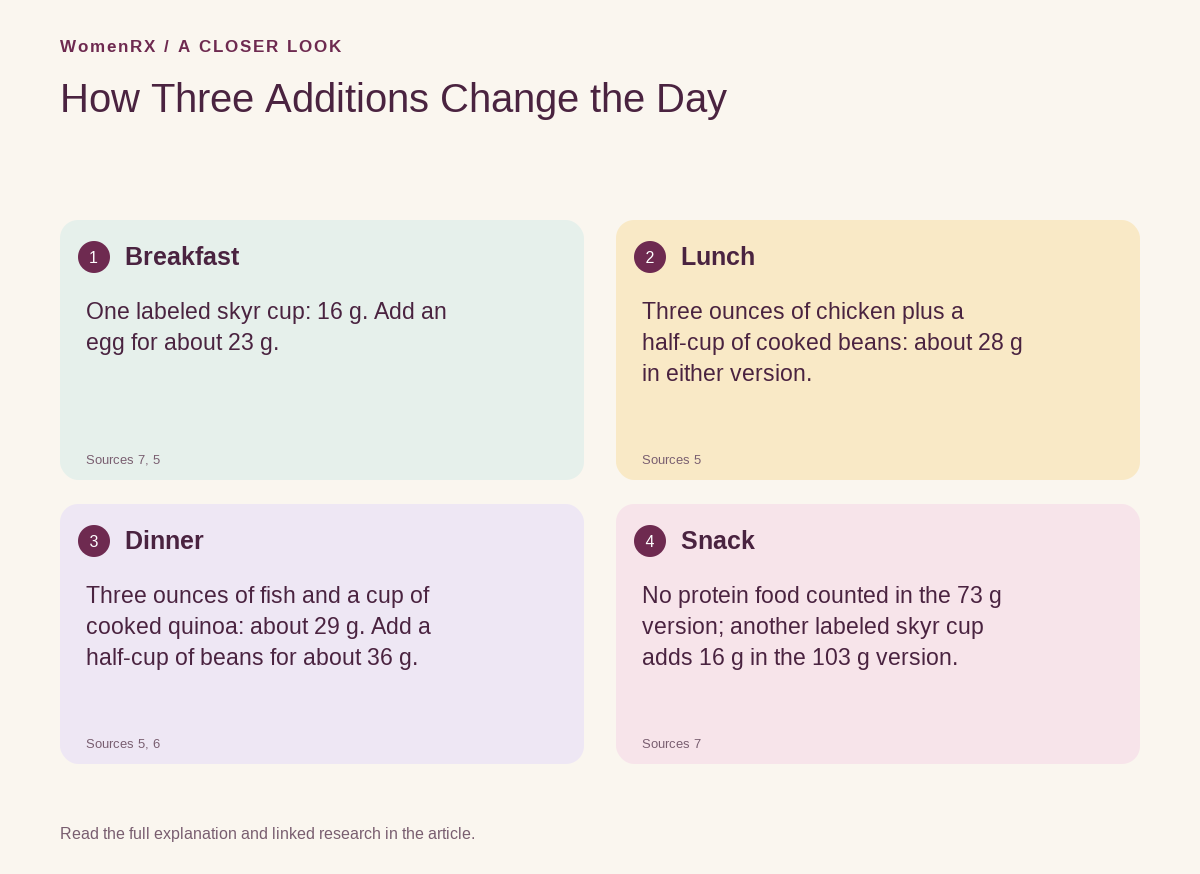
How Three Additions Change the Day
Breakfast: One labeled skyr cup: 16 g. Add an egg for about 23 g.75
Lunch: Three ounces of chicken plus a half-cup of cooked beans: about 28 g in either version.5
Dinner: Three ounces of fish and a cup of cooked quinoa: about 29 g. Add a half-cup of beans for about 36 g.56
Snack: No protein food counted in the 73 g version; another labeled skyr cup adds 16 g in the 103 g version.7
Read the figure as text
The same example meals add up to about 73 grams, or about 103 grams with an egg, more beans and a skyr snack.- Breakfast: One labeled skyr cup: 16 g. Add an egg for about 23 g.75
- Lunch: Three ounces of chicken plus a half-cup of cooked beans: about 28 g in either version.5
- Dinner: Three ounces of fish and a cup of cooked quinoa: about 29 g. Add a half-cup of beans for about 36 g.56
- Snack: No protein food counted in the 73 g version; another labeled skyr cup adds 16 g in the 103 g version.7
More questions, answered
Is 100 grams of protein too much?
The number alone can’t answer that. As a share of calories, 100 grams supplies 400 calories from protein, or 20% of a 2,000-calorie diet. MedlinePlus gives 10% to 35% of total calories as the recommended protein range for healthy adults. Whether 100 grams fits you also depends on your calorie needs and health. 51
Sources you can check
- Dietary Proteins: MedlinePlusAccessed 2026-09-25Return to first citation
- Dietary Intakes of Women's Health Initiative Long Life Study Participants Falls Short of the Dietary Reference Intakes.Beasley JM, Rillamas-Sun E, Tinker LF, Wylie-Rosett J, Mossavar-Rahmani Y, Datta M, Caan BJ, LaCroix AZ. · Journal of the Academy of Nutrition and Dietetics · 2020Return to first citation
- Effective translation of current dietary guidance: understanding and communicating the concepts of minimal and optimal levels of dietary protein.Rodriguez NR, Miller SL. · The American journal of clinical nutrition · 2015Return to first citation
- Evaluation of dietary protein and amino acid requirements: a systematic review.Burstad KM, Lamina T, Erickson A, Gholizadeh E, Namigga H, Claussen AM, Slavin JL, Teigen L, Hill Gallant KM, Stang J, Steffen LM, Harindhanavudhi T, Kouri A, Duval S, Butler M. · The American journal of clinical nutrition · 2025Return to first citation
- MedlinePlus: Protein in diet, including tofu and other plant sourcesAccessed 2026-09-25Return to first citation
- USDA SR Legacy reference composition: quinoaAccessed 2026-09-25Return to first citation
- Plain Nonfat Skyr Yogurt 5.3oz - High Protein - siggi'sAccessed 2026-09-25Return to first citation