How Much Protein Do You Need for Weight Management?
A protein target is easier to use when you can see what familiar portions contribute and what eating more protein may, and may not, do for weight loss.
For healthy adults, the recommended protein allowance is based on 0.8 grams per kilogram of reference body weight per day. Applying 0.8 to an illustrative 150 pounds (about 68 kilograms) gives about 54 grams, but that is not a personalized allowance. It is a way to understand the calculation, not a weight-loss target. Current US dietary guidance suggests a higher range within a healthy eating pattern, but longer-term trials haven’t shown a consistent weight-loss advantage for higher-protein diets.121311
Start with a daily amount, not a “high-protein” label
If you’re trying to manage your weight, you don’t need to declare every meal high-protein. First, get a sense of what enough protein looks like. The adult recommended allowance uses 0.8 grams per kilogram of reference body weight each day. Applying 0.8 to an illustrative 150 pounds (about 68 kilograms) gives roughly 54 grams a day, but that isn’t an individualized allowance. The National Academies table instead lists 46 grams a day for adult women who aren’t pregnant or lactating, using a reference body weight. The allowance is intended to meet the needs of nearly all healthy adults in a group; it isn’t a promise that eating more will change your weight.12
You may also see the 1.2-1.6 grams per kilogram per day protein-food goal in the current Dietary Guidelines for Americans. That is guidance for a healthy eating pattern, adjusted for individual calorie needs. It’s different from the recommended allowance, which is a reference point for meeting nutrient needs. Neither number is a personal weight-loss prescription. At 150 pounds, the guidelines’ range works out to roughly 82-109 grams a day, compared with the illustrative 54-gram calculation above, not the reference-weight-based table amount.1213
Your circumstances matter more than a label on a meal plan. Protein needs depend in part on age, health, and physical activity. Sports nutrition recommendations for athletes can be higher than the general adult allowance, although a review notes a real distinction between the amount required to meet basic needs and an amount proposed to support training. A recreational workout alone doesn’t tell you to adopt an athlete’s target.2414
What higher protein may change, and what it may not
Protein foods can be part of a meal you find satisfying. But feeling fuller after eating and losing more weight over months are different outcomes. A systematic review of eight adult randomized trials lasting at least 24 weeks found that the long-term weight-loss advantage of higher-protein diets was neither consistent nor conclusive. Three of the four longest studies found no statistically significant difference in weight loss. The review discussed satiety as a reason these diets might help, not as proof that adding protein independently causes fat loss.11
That leaves you room to choose a pattern you can actually eat. If a protein food makes lunch more satisfying, that may be useful even without treating it as a fat-loss tool. For long-term weight loss, the broader eating pattern, calorie intake, and physical activity still matter.111
Put portions into a day of meals
Food portions make the daily number less abstract. USDA reference data put a 3-ounce portion of cooked bluefin tuna at about 25 grams of protein, a cup of cooked quinoa at about 8 grams, a cup of cooked white rice at about 4 grams, and a medium banana at about 1 gram. Those estimates apply to the specified foods and weights, not every tuna dish, grain bowl, or piece of fruit.8910
The comparison shows why the kind of food matters as much as the size of the serving. In this example, 3 ounces of the specified tuna and a cup of cooked quinoa contribute about 33 grams together. Against the illustrative 54-gram calculation for 150 pounds, that leaves about 21 grams to come from other foods during the day. It’s protein arithmetic, not a suggestion to eat tuna daily or a personal target. The guidelines’ higher range of roughly 82-109 grams at that weight would leave considerably more to account for; reaching it isn’t a condition for weight loss.89121311
To turn that into meals, you might, for example, have quinoa with yogurt and fruit at breakfast, tuna with rice and vegetables at lunch, and beans with quinoa and vegetables at dinner. The specified cup of quinoa at breakfast contributes about 8 grams; the specified 3 ounces of cooked bluefin tuna and cup of rice at lunch contribute about 30 grams; another cup of quinoa at dinner contributes about 8 grams. That’s about 46 grams from those counted portions, not the protein total for the day: the yogurt, beans, vegetables, and any other foods add amounts that depend on what and how much you choose. Check the portions you actually eat rather than assuming a serving of beans or yogurt is interchangeable with 3 ounces of tuna.8913
You can change the meals without changing the approach. Eggs, dairy, poultry, seafood, beans, lentils, nuts, seeds, and soy foods are all options. If you mainly eat plant foods, variety over the day helps supply the amino acids your body needs.213
When the starting point needs another look
The 0.8-gram-per-kilogram healthy-adult calculation isn’t a pregnancy-specific target. The National Academies reference table lists 46 grams a day for adult women who aren’t pregnant or lactating, based on a reference body weight, and 71 grams a day during both pregnancy and lactation. These table amounts aren’t individualized weight-loss goals. A study of pregnant women in Canada cites a pregnancy allowance of 1.1 grams per kilogram per day and reports what its participants ate, but their intakes shouldn’t be mistaken for a target for everyone. Research assessing requirements across life stages finds limited evidence in pregnancy and lactation.1275
Later in life, keeping muscle and strength matters for health, separately from any goal to change weight. The reference table still lists 46 grams a day for women over 70, while current dietary guidance notes that some older adults need fewer calories but equal or greater amounts of key nutrients, including protein. In practical terms, leaving out protein-rich foods as meals get smaller may be less useful than making room for them. That doesn’t establish one higher-protein target for every older woman. A mixed-sex US observational study of middle-aged adults did not find a consistent association between protein intake above the allowance, activity, and its measured muscle outcomes; it cannot settle what older women need.312136
If you have kidney disease, don’t assume either the healthy-adult calculation or the general higher-protein range fits you. Protein needs can depend on health, and general dietary guidance may need adapting for chronic disease. A protein target in that situation needs individual guidance.213
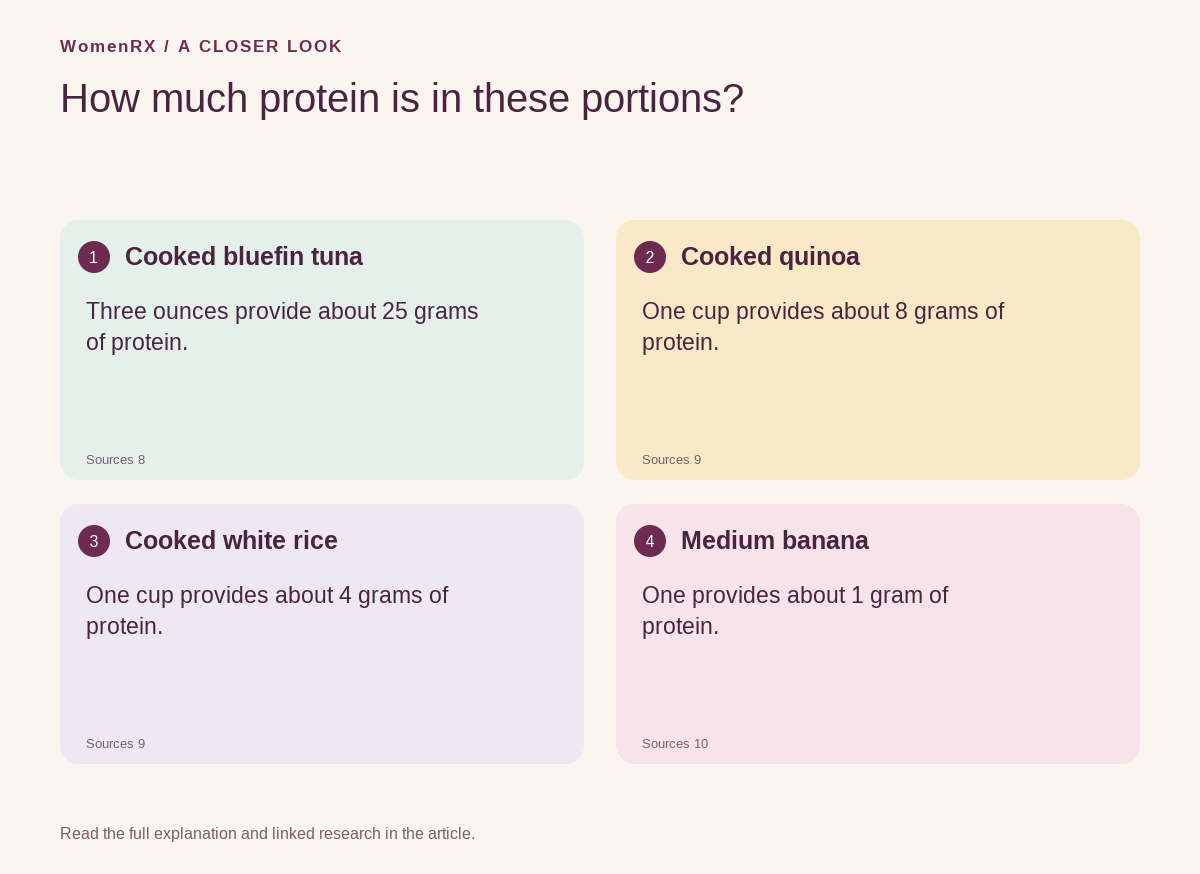
How much protein is in these portions?
Cooked bluefin tuna: Three ounces provide about 25 grams of protein.8
Cooked quinoa: One cup provides about 8 grams of protein.9
Cooked white rice: One cup provides about 4 grams of protein.9
Medium banana: One provides about 1 gram of protein.10
Read the figure as text
These specified USDA portions show why a food’s contribution depends on both what it is and how much you serve. They are examples, not a prescribed meal plan.Sources you can check
- Dietary Supplements for Weight Loss - Health Professional Fact SheetAccessed 2026-09-25Return to first citation
- Dietary Proteins: MedlinePlusAccessed 2026-09-25Return to first citation
- Body Weight: MedlinePlusAccessed 2026-09-25Return to first citation
- A critical examination of dietary protein requirements, benefits, and excesses in athletes.Phillips SM, Moore DR, Tang JE. · International journal of sport nutrition and exercise metabolism · 2007Return to first citation
- Evaluation of dietary protein and amino acid requirements: a systematic review.Burstad KM, Lamina T, Erickson A, Gholizadeh E, Namigga H, Claussen AM, Slavin JL, Teigen L, Hill Gallant KM, Stang J, Steffen LM, Harindhanavudhi T, Kouri A, Duval S, Butler M. · The American journal of clinical nutrition · 2025Return to first citation
- Protein intake, physical activity, and skeletal muscle outcomes in middle-aged adults: an observational study from the US.Prokopidis K, Stubbs B, Veronese N, Cacciatore S, Piaggi P, Prado CM, Batsis JA, Schlögl M. · Journal of nutritional science · 2026Return to first citation
- Healthy pregnant women in Canada are consuming more dietary protein at 16- and 36-week gestation than currently recommended by the Dietary Reference Intakes, primarily from dairy food sources.Stephens TV, Woo H, Innis SM, Elango R. · Nutrition research (New York, N.Y.) · 2014Return to first citation
- USDA SR Legacy reference composition: tunaAccessed 2026-09-25Return to first citation
- USDA SR Legacy reference composition: quinoaAccessed 2026-09-25Return to first citation
- USDA SR Legacy reference composition: bananaAccessed 2026-09-25Return to first citation
- Long-term efficacy of high-protein diets: a systematic review.Lepe M, Bacardí Gascón M, Jiménez Cruz A. · Nutricion hospitalaria · 2011Return to first citation
- National Academies DRI summary table: total water and macronutrientsAccessed 2026-09-25Return to first citation
- Dietary Guidelines for Americans, 2025-2030Accessed 2026-09-25Return to first citation
- Dietary Supplements for Exercise and Athletic Performance - Health Professional Fact SheetAccessed 2026-09-25Return to first citation