How Much Exercise Supports Weight Management?
For general health, aim for 150-300 minutes of moderate activity a week; weight change is more variable, and some people need more activity alongside changes to eating habits.
A useful starting target for most adults is 150 minutes of moderate-intensity aerobic activity each week, building toward 150-300 minutes if it feels manageable. That’s a general adult activity recommendation, not a guaranteed weight-loss dose. In trials of adults with overweight or obesity, more aerobic exercise was linked with greater average reductions in weight and waist size, but exercise and eating habits both matter. 1 3
Two targets, serving different purposes
The familiar recommendation of 150-300 minutes of moderate-intensity aerobic activity a week, or 75-150 minutes of vigorous activity, is a general health target for adults. It’s a sound place to start if you’re building a routine. Adults are also advised to include muscle-strengthening activities on two or more days a week. These recommendations aren’t a promise that a particular amount will make the scale move. 1
Weight change has its own, less predictable relationship with exercise dose. A 2024 systematic review and dose-response meta-analysis combined 116 randomized trials of supervised aerobic exercise lasting at least eight weeks. The 6,880 participants were adults with overweight or obesity; 61% were women. On average, more weekly exercise was associated with reductions in weight, waist circumference, and body fat, with improvements continuing as activity increased up to 300 minutes per week. The authors found that 150 minutes weekly at moderate-to-vigorous intensity was associated with reductions in waist circumference and body fat they considered clinically important. They also noted that more than 150 minutes may be needed for clinically important changes. 3
Those are averages across trials, not a personal forecast. The meta-analysis doesn’t mean that adding each 30 minutes to your own week will produce a fixed amount of weight loss. It describes a dose-response pattern across study groups, not a guaranteed result for an individual. 3
A practical way to set your own target
If you’re not active now, start with an amount you can repeat and increase gradually. You can split activity into shorter sessions across the week; it doesn’t have to happen in long blocks. Brisk walking, cycling, and swimming are examples of aerobic activity. For moderate intensity, a simple guide is that you can say a few words but not comfortably sing. 1
For example, you might begin with several short walks during the week, then add time as they become part of your routine. If you already meet the general activity target and weight management is your goal, gradually working toward more than 150 minutes may be reasonable if it suits your health, schedule, and recovery. The research suggests that weight and body-fat changes can continue with higher volumes, up to 300 minutes weekly, but it doesn’t establish one ideal target for every person. 1 3
Strengthening activity has a place in the routine too. The general recommendation is two or more days per week, but that recommendation is for overall health, not a separate guarantee of weight loss. 1
Why exercise isn’t the whole weight-management plan
Activity increases the energy your body uses, but the scale reflects more than exercise alone. MedlinePlus describes weight loss as requiring more energy used than taken in through food and drink, and says people trying to lose weight may need both more physical activity and changes to eating habits. 1 2
Research reviews also find that programs combining physical activity and dietary changes generally reduce weight more than programs using just one of those approaches. In an overview of 32 systematic reviews, the authors reported that combined programs generally outperformed diet-only or activity-only comparisons in adults with overweight or obesity. But the review quality varied: 31% of included reviews were rated high quality, while 69% were low or critically low quality. That supports treating activity as one part of a broader approach, not assuming it will have the same effect on its own. 4
Exercise can still be worthwhile even when weight changes little. Regular activity supports fitness and can benefit health beyond the number on the scale. A routine you can sustain may be more useful than an ambitious target that quickly becomes hard to maintain. 1 2
What the research says about women
Women made up 61% of participants in the large exercise meta-analysis, so its overall findings weren’t based only on men. But the analysis doesn’t establish whether exercise dose and weight change differ by sex. It also doesn’t report separate findings or targets for pregnancy, postpartum, perimenopause, or postmenopause. 3
Pregnancy is a distinct consideration: the general adult target shouldn’t be assumed to fit every pregnant person. MedlinePlus advises pregnant women to check what amount and type of physical activity are appropriate for them. 1
**** For most adults, the general activity recommendation is a useful reference point. Build up at a pace you can maintain, and consider increasing activity beyond 150 minutes if weight change is a goal and the added time works for you. If you’re pregnant, ask what amount and type of activity are appropriate rather than assuming the general adult target fits. Pairing activity with changes to eating habits may support more weight change than relying on exercise alone. Neither approach guarantees a particular result. 1 4
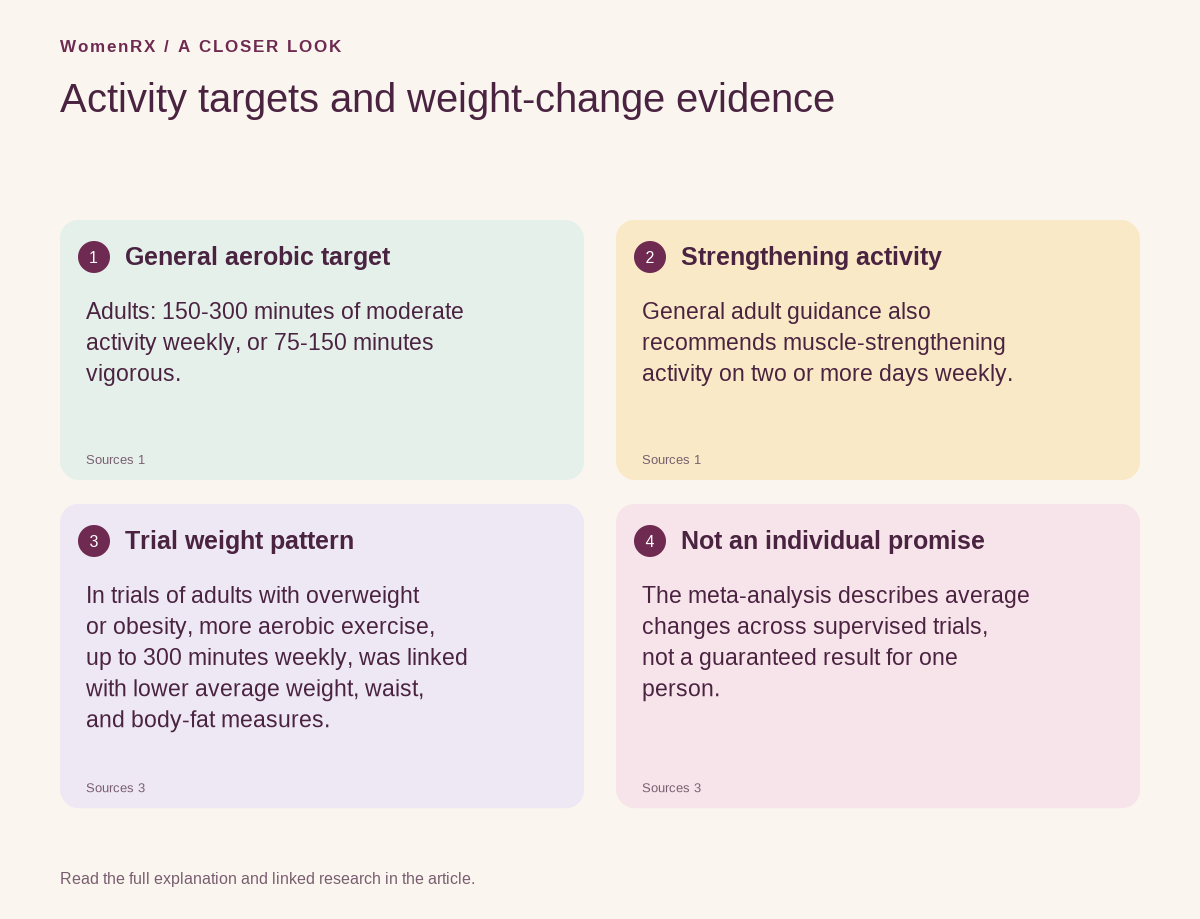
Activity targets and weight-change evidence
General aerobic target: Adults: 150-300 minutes of moderate activity weekly, or 75-150 minutes vigorous.1
Strengthening activity: General adult guidance also recommends muscle-strengthening activity on two or more days weekly.1
Trial weight pattern: In trials of adults with overweight or obesity, more aerobic exercise, up to 300 minutes weekly, was linked with lower average weight, waist, and body-fat measures.3
Not an individual promise: The meta-analysis describes average changes across supervised trials, not a guaranteed result for one person.3
Read the figure as text
These are related but different reference points: general activity recommendations support health, while exercise trials in adults with overweight or obesity describe how aerobic-exercise volume relates to weight and body-fat measures.- General aerobic target: Adults: 150-300 minutes of moderate activity weekly, or 75-150 minutes vigorous.1
- Strengthening activity: General adult guidance also recommends muscle-strengthening activity on two or more days weekly.1
- Trial weight pattern: In trials of adults with overweight or obesity, more aerobic exercise, up to 300 minutes weekly, was linked with lower average weight, waist, and body-fat measures.3
- Not an individual promise: The meta-analysis describes average changes across supervised trials, not a guaranteed result for one person.3
More questions, answered
Does every minute of exercise count toward the weekly target?
Short sessions can add up, so you don’t need one long workout. To count toward the stated aerobic target, activity should be at moderate or vigorous intensity; for moderate activity, you can say a few words but not sing. Even smaller amounts of activity can still be helpful. 1
Should I focus on aerobic exercise or strength training?
The general adult guidance includes both: weekly aerobic activity and muscle-strengthening activity on two or more days. The weight-loss dose-response evidence summarized here studied aerobic exercise, so it doesn’t establish a separate strength-training dose for weight change. 1 3
Sources you can check
- How Much Exercise Do I Need?: MedlinePlusAccessed 2026-09-25Return to first citation
- Benefits of Exercise: MedlinePlusAccessed 2026-09-25Return to first citation
- Aerobic Exercise and Weight Loss in Adults: A Systematic Review and Dose-Response Meta-Analysis.Jayedi A, Soltani S, Emadi A, Zargar MS, Najafi A. · JAMA network open · 2024Return to first citation
- Combined diet and physical activity effects on health-related outcomes in people with overweight or obesity: an overview of systematic reviews.Salem A, Ammar A, Trabelsi K, Boukhris O, Heydenreich J, Ghazzawi HA, Amawi AT, Grosso G, Zmijewski P, Jahrami H, Husain W, Chtourou H, Schöllhorn WI. · Frontiers in nutrition · 2026Return to first citation