Can Aquatic Exercise Support Weight Management in Menopause?
Studies of varied pool-based exercise show possible fitness and body-composition benefits, but not reliable weight loss or menopause-specific results.
Aquatic exercise may be a practical way to stay active, but the research doesn’t establish water aerobics classes as a weight-loss method during menopause. A review of varied aquatic exercise programs in older adults found improvements in some fitness and body-fat measures, but not body weight or BMI. These findings weren’t specific to menopause or to water-aerobics classes. 3
The scale may not tell the whole story
Aquatic exercise may support health and fitness during menopause, but it’s not a dependable stand-alone weight-loss method. The research here concerns varied aquatic exercise programs, not necessarily standard water-aerobics classes. In a review of 19 randomized trials involving 866 older adults, aquatic exercise improved strength, flexibility, and functional mobility, and reduced body-fat percentage. It did not significantly change body weight or BMI. The studies weren’t conducted in a defined menopause group, so these findings can’t tell us exactly what to expect during perimenopause or menopause. 3
That difference between the scale and body composition matters. In one small trial, 32 overweight adults, both women and men, with an average age of about 72 were assigned to either a 28-week aquatic program combining aerobic and resistance exercise or a control group. Nineteen were assigned to the exercise group and 13 to control. The exercise group lost body fat and had smaller waist and leg measurements, yet their body mass increased. This doesn’t show that aquatic exercise causes weight loss; it shows why weight alone may miss changes in body composition. The study didn’t report menopause-specific results. 5
What aquatic exercise may offer instead
The clearest case for aquatic exercise is as a way to keep moving and work on fitness, strength, or function. Water can reduce the weight pressure on joints compared with land-based movement, which may make activity feel more manageable for some people. That’s an advantage to consider, not a promise that it will be comfortable or appropriate for every joint or health condition. 5
A randomized study enrolled 102 overweight women aged 40 to 50 with chronic Achilles tendon pain. After four weeks, participants in an aquatic neuromuscular rehabilitation program had improvements in pain and function. This wasn’t a study of a standard water-aerobics class. Because it focused on a specific tendon problem and a short rehabilitation program, it doesn’t establish that water aerobics will relieve other kinds of joint pain or be suitable for everyone. 4
For weight management, the broader point is that exercise is one part of the picture. MedlinePlus describes exercise, alongside diet, as part of maintaining a healthy weight, and explains that weight loss requires using more energy than you take in. A water class may help you be more active, but it can’t guarantee that change by itself. 1
How to decide if it fits your routine
Think of a water-aerobics class as one possible activity to choose for its fit with your life, not as a special menopause treatment or a format directly tested by these studies. For example, if walking or a land-based class feels uncomfortable, you might try a pool class and see whether you enjoy the movement and can attend regularly. If you prefer land exercise or don’t have comfortable access to a pool, these findings don’t show that aquatic exercise is necessary for weight management.
If your main goal is a lower number on the scale, keep expectations realistic: the older-adult trials don’t show a reliable weight or BMI benefit from aquatic exercise alone. If your goals also include fitness, strength, mobility, or changes in body composition, varied aquatic programs may still be worthwhile even if the scale barely changes. Body weight includes more than body fat, so a single number can’t describe every change. 2 3
Menopause-specific evidence is the main gap in applying these findings. The larger review studied older adults, while the study of 102 women involved people with Achilles tendinopathy and a rehabilitation program rather than a menopause-focused weight-management program. So the practical answer is: try a water-aerobics class if it feels like a sustainable way for you to move, but don’t count on it as a proven menopause weight-loss treatment.
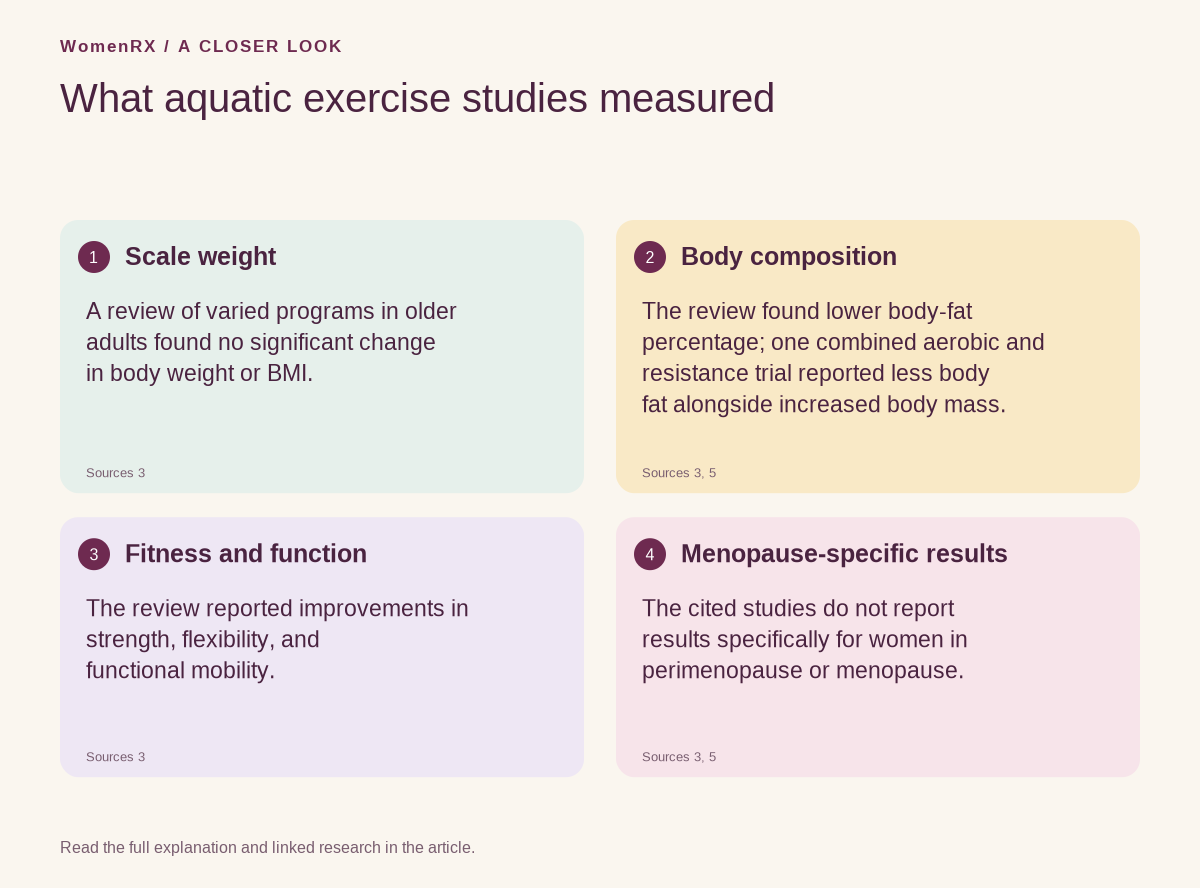
What aquatic exercise studies measured
Scale weight: A review of varied programs in older adults found no significant change in body weight or BMI.3
Body composition: The review found lower body-fat percentage; one combined aerobic and resistance trial reported less body fat alongside increased body mass.35
Fitness and function: The review reported improvements in strength, flexibility, and functional mobility.3
Menopause-specific results: The cited studies do not report results specifically for women in perimenopause or menopause.35
Read the figure as text
These studies cover varied pool-based programs, not necessarily water-aerobics classes; results differ for fitness, body composition, and scale weight.- Scale weight: A review of varied programs in older adults found no significant change in body weight or BMI.3
- Body composition: The review found lower body-fat percentage; one combined aerobic and resistance trial reported less body fat alongside increased body mass.35
- Fitness and function: The review reported improvements in strength, flexibility, and functional mobility.3
- Menopause-specific results: The cited studies do not report results specifically for women in perimenopause or menopause.35
More questions, answered
Can I benefit from a water-aerobics class if my weight doesn’t change?
Possibly. Trials of varied aquatic exercise programs in older adults found improvements in some measures of strength, flexibility, mobility, and body fat even though they did not significantly change weight or BMI. Those results aren’t specific to menopause, and they don’t establish the effects of water-aerobics classes in particular. 3
Sources you can check
- Benefits of Exercise: MedlinePlusAccessed 2026-09-25Return to first citation
- Body Weight: MedlinePlusAccessed 2026-09-25Return to first citation
- Effects of aquatic exercise on improving body composition and muscle strength in the older adults: a systematic review and meta-analysis of randomized controlled trials.Gao Y, Deng W, Zeng Q, Liu Y, Tang X, Fang S, Hao L, Li H. · Frontiers in public health · 2025Return to first citation
- The Effect of an Aquatic Neuromuscular Exercise Program on Pain Alleviation and Functional Performance in Cases of Chronic Achilles Tendinopathy Among Overweight Middle-Aged Women.Aphale S, Shinde S, Kale HY, Ambali MP. · Cureus · 2025Return to first citation
- The Effects of Combined Aquatic Exercise on Physical Performance and Metabolic Indices in Overweight Healthy Older Adults.Nosrani SE, Tartibian B, Eslami R, Farinha C, Serrano J, Ferreira JP, Texeira AM. · International journal of exercise science · 2023Return to first citation