Can Tai Chi Support Weight Management During Menopause?
Tai Chi may be a worthwhile way to move, but current studies don’t show that it reliably reduces weight during menopause.
Tai Chi can be part of a weight-management plan if you enjoy it, but it isn’t a proven menopause-specific weight-loss method. The small studies available don’t establish a reliable effect on body weight or waist size in perimenopausal or postmenopausal women. One small study in overweight adults found improvements in some measures beyond BMI, but it can’t tell us what to expect during menopause. 4
The short version: movement, not a weight-loss guarantee
Tai Chi is a gentle, mind-body form of movement. You might choose it because you enjoy the practice or find it easier to keep up than other exercise. But if your main question is whether it will reliably lower the number on the scale during menopause, the evidence doesn’t support a confident yes.
That’s not the same as saying Tai Chi has no place in your plan. It means its role is better understood as one option for being active, rather than a stand-alone weight-loss treatment.
What the weight studies actually tell us
A randomized trial compared Tai Chi with aerobic exercise in 238 adults aged 60 or older who had depressive symptoms. After 12 weeks, the reported weight and BMI outcomes in the Tai Chi group were 2.0 kg and 0.77 kg/m² higher, respectively, than in the aerobic-exercise group. The study does not establish that Tai Chi causes weight loss, and it does not report menopause-stage results. Its participants were selected for age and depressive symptoms, so the findings may not translate to someone in perimenopause or early postmenopause. 2
A much smaller randomized study enrolled 20 adults with overweight or obesity and compared two Tai Chi styles. After eight weeks, the standard-style group had a significant decrease in BMI. With only 10 participants in each group, and no reported menopause-stage analysis, this exploratory result can’t establish a dependable weight effect for women in menopause. BMI also isn’t the same as waist size or body-fat change. 4
The distinction matters: a finding about BMI in a small sample of overweight or obese adults isn’t evidence that Tai Chi reduces weight or abdominal fat during the menopause transition. The cited studies don’t establish an effect on waist measurements in menopausal women, or whether results differ between perimenopause and postmenopause.
Other outcomes aren’t weight outcomes
In the 20-person study, researchers also assessed exercise capacity, wellbeing, and sleep quality. Some of those measures improved in the standard Tai Chi group. Those are separate outcomes: a change in sleep or exercise capacity doesn’t demonstrate weight loss. Because the study was small and did not report menopause-stage findings, it also can’t show that Tai Chi treats menopause-related sleep problems. 4
A trial specifically involving 132 early postmenopausal women studied Tai Chi and bone mineral density, not weight loss. It offers menopause-specific information about a different outcome, but it can’t fill the gap in evidence about body weight or waist size. 3
Where Tai Chi might fit in your plan
If Tai Chi feels accessible and enjoyable, it can be one part of how you stay active. For weight management, don’t rely on it alone to produce a predictable change: the available studies don’t establish that result for women in menopause. General weight guidance supports combining physical activity with good nutrition, rather than treating one type of movement as the whole plan. 1
If you’re choosing between Tai Chi and aerobic exercise specifically for weight outcomes, the older-adult trial did not show Tai Chi outperforming aerobic exercise. That comparison doesn’t settle what will work best for you, but it’s a reason not to assume the two produce the same weight effects. You can judge Tai Chi by whether you like it and can make it part of your activity, while keeping your expectations about weight modest.
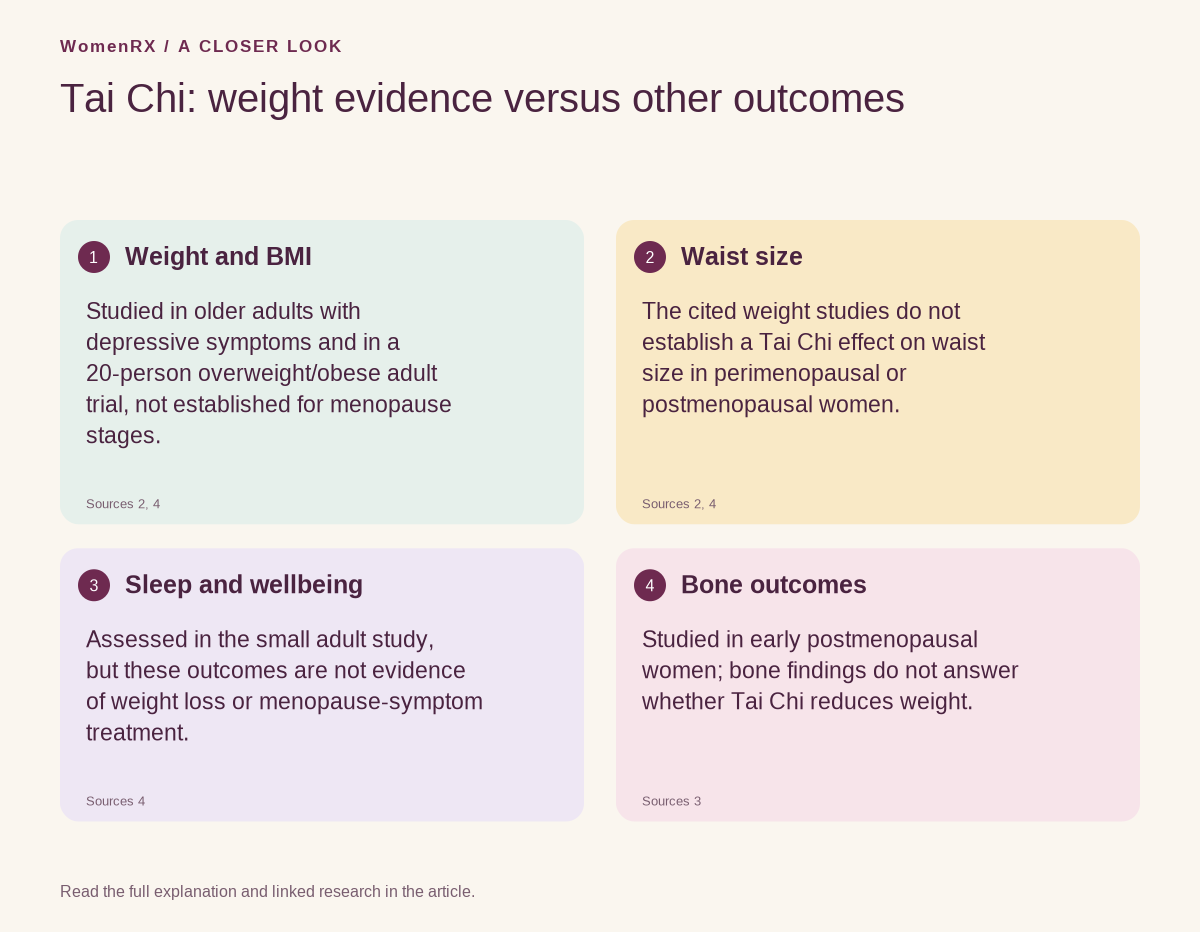
Tai Chi: weight evidence versus other outcomes
Weight and BMI: Studied in older adults with depressive symptoms and in a 20-person overweight/obese adult trial, not established for menopause stages.24
Waist size: The cited weight studies do not establish a Tai Chi effect on waist size in perimenopausal or postmenopausal women.24
Sleep and wellbeing: Assessed in the small adult study, but these outcomes are not evidence of weight loss or menopause-symptom treatment.4
Bone outcomes: Studied in early postmenopausal women; bone findings do not answer whether Tai Chi reduces weight.3
Read the figure as text
The distinction is between outcomes actually measured and benefits that the studies do not establish for women in menopause.- Weight and BMI: Studied in older adults with depressive symptoms and in a 20-person overweight/obese adult trial, not established for menopause stages.24
- Waist size: The cited weight studies do not establish a Tai Chi effect on waist size in perimenopausal or postmenopausal women.24
- Sleep and wellbeing: Assessed in the small adult study, but these outcomes are not evidence of weight loss or menopause-symptom treatment.4
- Bone outcomes: Studied in early postmenopausal women; bone findings do not answer whether Tai Chi reduces weight.3
More questions, answered
Does Tai Chi reduce belly fat during menopause?
These studies don’t establish that Tai Chi reduces waist size in perimenopausal or postmenopausal women. BMI and body weight are not interchangeable with waist measurements, and the small adult study doesn’t answer this menopause-specific question. 2 4
Is Tai Chi proven to help menopause-related sleep problems?
No menopause-specific benefit is established by these studies. One small study in overweight adults assessed sleep quality alongside Tai Chi, but it did not report menopause-stage results or show that Tai Chi treats menopause-related sleep problems. 4
Sources you can check
- Body Weight: MedlinePlusAccessed 2026-09-25Return to first citation
- Comparison of the effects of Tai Chi and general aerobic exercise on weight, blood pressure and glycemic control among older persons with depressive symptoms: a randomized trial.Wang Y, Luo B, Wu X, Li X, Liao S. · BMC geriatrics · 2022Return to first citation
- A randomized, prospective study of the effects of Tai Chi Chun exercise on bone mineral density in postmenopausal women.Chan K, Qin L, Lau M, Woo J, Au S, Choy W, Lee K, Lee S. · Archives of physical medicine and rehabilitation · 2004Return to first citation
- Effects of Standard Tai Chi on Exercise Capacity and Mental Health in Exercise-Deprived Overweight/Obese Adults and Assessment of Participant Adherence.Tao Z, Xu ZM, Guo Y, Yu HY. · Chinese journal of integrative medicine · 2024Return to first citation