Can Walking Help With Weight Management During Menopause?
Walking can be a manageable part of weight management, but menopause-specific studies don’t show that one pace or weekly amount guarantees weight loss.
Walking may fit into a weight-management routine during menopause, but the evidence doesn’t establish a specific walking dose that reliably causes weight loss. A small 12-week study in postmenopausal women found no significant difference between a walking group and a comparison exercise group. An older review suggested combining moderate walking with resistance training, while describing weight maintenance, not guaranteed weight loss, as a likely outcome. 2 3
What walking may contribute
If weight is changing during menopause, walking can be a practical way to add regular activity. Research in postmenopausal women doesn’t establish a single ideal pace or amount, or show that walking alone reliably produces weight loss.
A small pilot study assigned 18 sedentary postmenopausal women to one of two exercise groups for 12 weeks. Ten women walked for about 40 minutes, five days a week, at 65% of their age-predicted maximum heart rate. The other group did a shorter routine that included several types of exercise. Researchers found no statistically significant differences between the groups in body weight, body composition, or the other measured body-size outcomes. Because there was no inactive control group and the study was small, it can’t tell us whether walking itself led to weight loss. 2
An older review of 28 randomized trials involving 2,646 women aged 50 to 65 suggested moderate walking alongside resistance training. The review described this combination as likely to help preserve normal body weight; it did not establish a guaranteed weight-loss result. 3
Pace and weekly volume: what’s been tested
The walking pilot tested one particular schedule, but it didn’t compare different walking speeds or weekly volumes. It also compared walking with another exercise routine, rather than with no exercise. So it can’t tell you whether walking longer, walking faster, or adding more days would change weight outcomes. 2
The review suggested 30 minutes of moderate walking daily, in one to three bouts, alongside resistance training twice a week. Treat that as an approach proposed by an older review, not as a proven weight-loss prescription or a requirement you need to meet. The review considered several health and fitness outcomes, not weight alone. 3
A manageable way to use the evidence
Choose a walking routine that you can fit into your life and sustain. If a continuous walk feels like too much, the review’s suggestion of splitting walking into bouts offers one example of how activity might fit into a day. If you’re interested in adding strength work, the review paired it with walking, but the small walking pilot doesn’t show that one combination is best for weight loss. 2 3
It’s also worth keeping the goal broader than the scale. Body weight includes muscle, bone, fat, and water, so a change in weight doesn’t describe every change in health or body composition. 1
The clearest takeaway is modest: walking can be part of a routine, and one older review supports pairing it with resistance exercise for general fitness and weight maintenance. The 12-week pilot doesn’t settle whether a particular pace or amount of walking produces weight loss. It also doesn’t establish whether menopausal symptoms make a given routine easier or harder to maintain. 2 3
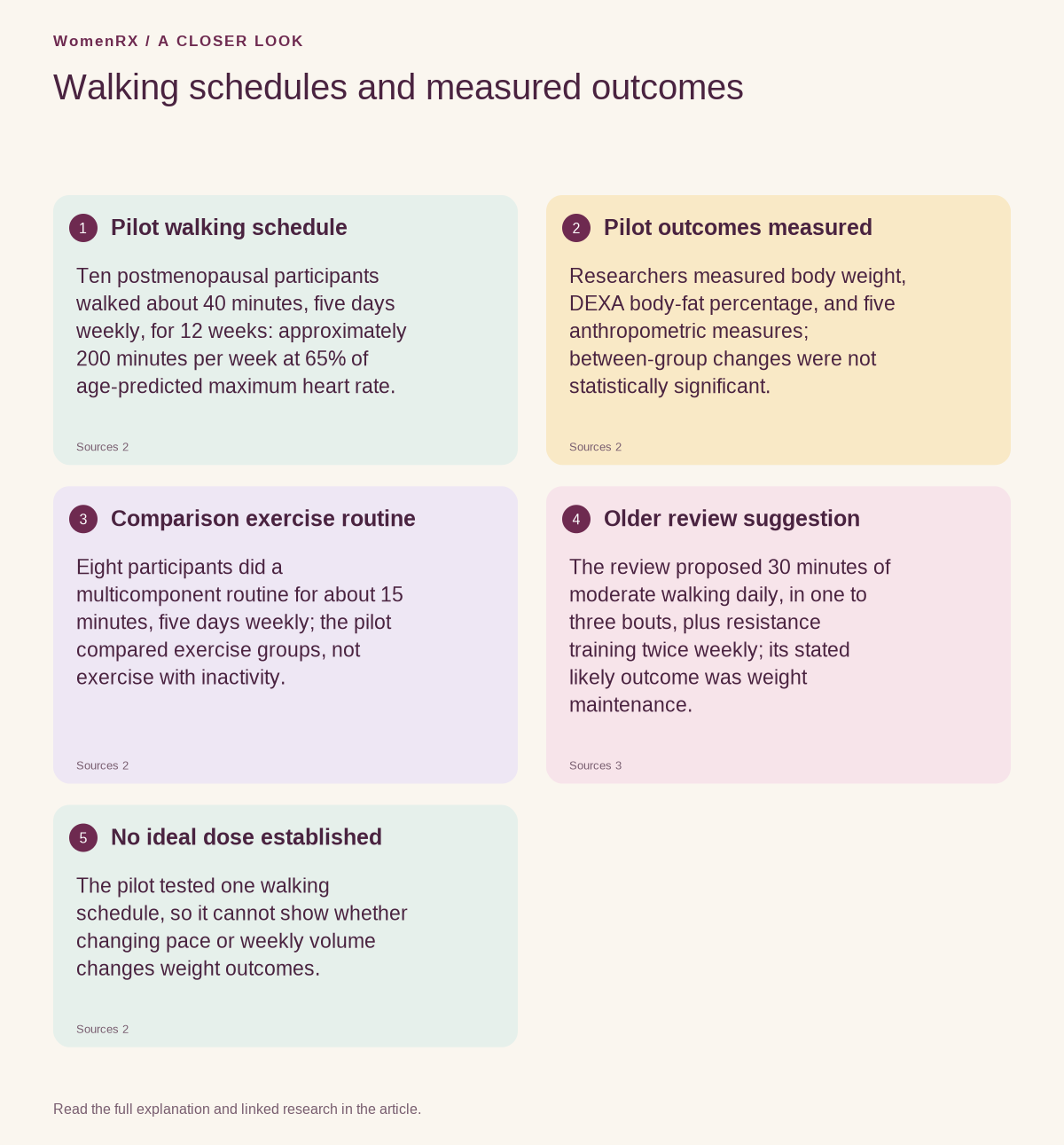
Walking schedules and measured outcomes
Pilot walking schedule: Ten postmenopausal participants walked about 40 minutes, five days weekly, for 12 weeks: approximately 200 minutes per week at 65% of age-predicted maximum heart rate.2
Pilot outcomes measured: Researchers measured body weight, DEXA body-fat percentage, and five anthropometric measures; between-group changes were not statistically significant.2
Comparison exercise routine: Eight participants did a multicomponent routine for about 15 minutes, five days weekly; the pilot compared exercise groups, not exercise with inactivity.2
Older review suggestion: The review proposed 30 minutes of moderate walking daily, in one to three bouts, plus resistance training twice weekly; its stated likely outcome was weight maintenance.3
No ideal dose established: The pilot tested one walking schedule, so it cannot show whether changing pace or weekly volume changes weight outcomes.2
Read the figure as text
The pilot tested one walking schedule, while an older review proposed a broader routine. Their outcomes and conclusions are different, and neither sets a guaranteed weight-loss dose.- Pilot walking schedule: Ten postmenopausal participants walked about 40 minutes, five days weekly, for 12 weeks: approximately 200 minutes per week at 65% of age-predicted maximum heart rate.2
- Pilot outcomes measured: Researchers measured body weight, DEXA body-fat percentage, and five anthropometric measures; between-group changes were not statistically significant.2
- Comparison exercise routine: Eight participants did a multicomponent routine for about 15 minutes, five days weekly; the pilot compared exercise groups, not exercise with inactivity.2
- Older review suggestion: The review proposed 30 minutes of moderate walking daily, in one to three bouts, plus resistance training twice weekly; its stated likely outcome was weight maintenance.3
- No ideal dose established: The pilot tested one walking schedule, so it cannot show whether changing pace or weekly volume changes weight outcomes.2
Sources you can check
- Body Weight: MedlinePlusAccessed 2026-09-25Return to first citation
- A randomized comparison study regarding the impact of short-duration, high-intensity exercise and traditional exercise on anthropometric and body composition measurement changes in post-menopausal women--A pilot study.Grossman JA, Payne EK. · Post reproductive health · 2016Return to first citation
- Exercise for health for early postmenopausal women: a systematic review of randomised controlled trials.Asikainen TM, Kukkonen-Harjula K, Miilunpalo S. · Sports medicine (Auckland, N.Z.) · 2004Return to first citation