Strength Training and Weight Management During Menopause
Lifting can improve strength and sometimes lean mass without moving the scale much, so weight is only one way to judge progress.
Strength training can build strength and may increase lean mass during and after menopause, even when your weight barely changes. 3 5 In one 12-week trial including pre-, peri-, and postmenopausal women, body mass did not change differently in the exercise and control groups. 5 The scale reflects muscle, fat, bone, and water, so it can’t show which component changed. 1 Fat-mass changes may depend on other parts of a weight-management plan, too. 2
What lifting can change, and what it may not
Strength training is useful for weight management, but it shouldn’t be treated as a stand-alone promise of lower scale weight. In one 12-week trial of healthy, moderately active pre-, peri-, and postmenopausal women, body mass did not change differently in the exercise and control groups, even though the exercise group improved some measures of strength and lean mass. 5 A systematic review of 34 studies involving 1,541 postmenopausal women found that strength training generally improved body composition and strength. 2
The scale combines muscle, fat, bone, and water, so it can stay steady even as some of those components change. 1 In a 12-week randomized trial of 55 postmenopausal women, the two groups doing resistance training gained skeletal muscle and improved strength. Fat mass fell significantly in the training-only group, but not in the training-plus-protein group; the study did not find clear added benefits from the protein intervention. These results are encouraging, but they don’t guarantee the same changes for every woman. 3
That distinction matters if you’re lifting consistently and your weight isn’t changing. A steadier scale doesn’t tell you by itself whether strength or lean mass has improved. For example, you might notice that a familiar lift feels easier or that carrying groceries takes less effort. Those are practical signs of progress, not a promise that body fat has changed.
Pair lifting with other parts of weight management
If fat loss is your goal, lifting can be one part of the plan rather than the whole plan. In the postmenopausal-women review, 11 studies examined strength training alongside a calorie deficit, and that combination enhanced fat-mass reduction. 2
Aerobic, or endurance, activity can also fit alongside lifting. Research discussed in a study of postmenopausal women found fat-mass reduction appeared more evident with combined resistance and endurance training. That’s a qualitative finding, not a guarantee of greater weight loss for every woman, and it doesn’t establish a best combination or predict how much the scale will change. 3
The practical tradeoff is that weight loss and muscle-building goals aren’t identical. A calorie deficit may help reduce fat mass, while resistance training targets strength and muscle. A gradual change in body composition may matter to you even if total weight changes little. The reviewed studies don’t establish one best diet or training plan for every woman, so avoid treating a specific research protocol as a personal prescription. 2
Does menopause stage change the response?
The available findings don’t point to one simple rule. In a 20-week study of middle-aged women, 31 completed a 10-week free-weight training phase. Strength improved across the premenopausal and postmenopausal groups, but measured increases in fat-free mass and muscle thickness appeared in the premenopausal group, not the postmenopausal group. The authors suggested that more training volume might be needed for body-composition changes after menopause, but that small study can’t establish a universal threshold. 4
A separate 12-week trial included 70 healthy, moderately active pre-, peri-, and postmenopausal women. The exercise group improved some measures of strength and lean mass, with no detected difference in those responses by menopause stage. Body mass did not change differently between the exercise and control groups. 5
These studies differ in their programs and outcomes. Together, they show why it’s better not to assume either that menopause prevents gains or that everyone will gain muscle in the same way. Strength may improve even when detectable muscle or scale changes are modest. The findings also don’t establish that a particular stage of menopause requires a particular routine. 4 5
Set expectations around more than pounds
For a realistic picture, keep separate track of the outcome you care about: strength, how daily movement feels, body composition, or body weight. The scale can be useful, but it can’t tell whether weight reflects muscle, fat, bone, or water. 1 If your main aim is fat loss, the evidence supports treating strength training as one part of a broader approach, not as a guarantee of weight loss on its own. If your main aim is getting stronger, a stable scale doesn’t cancel out that progress.
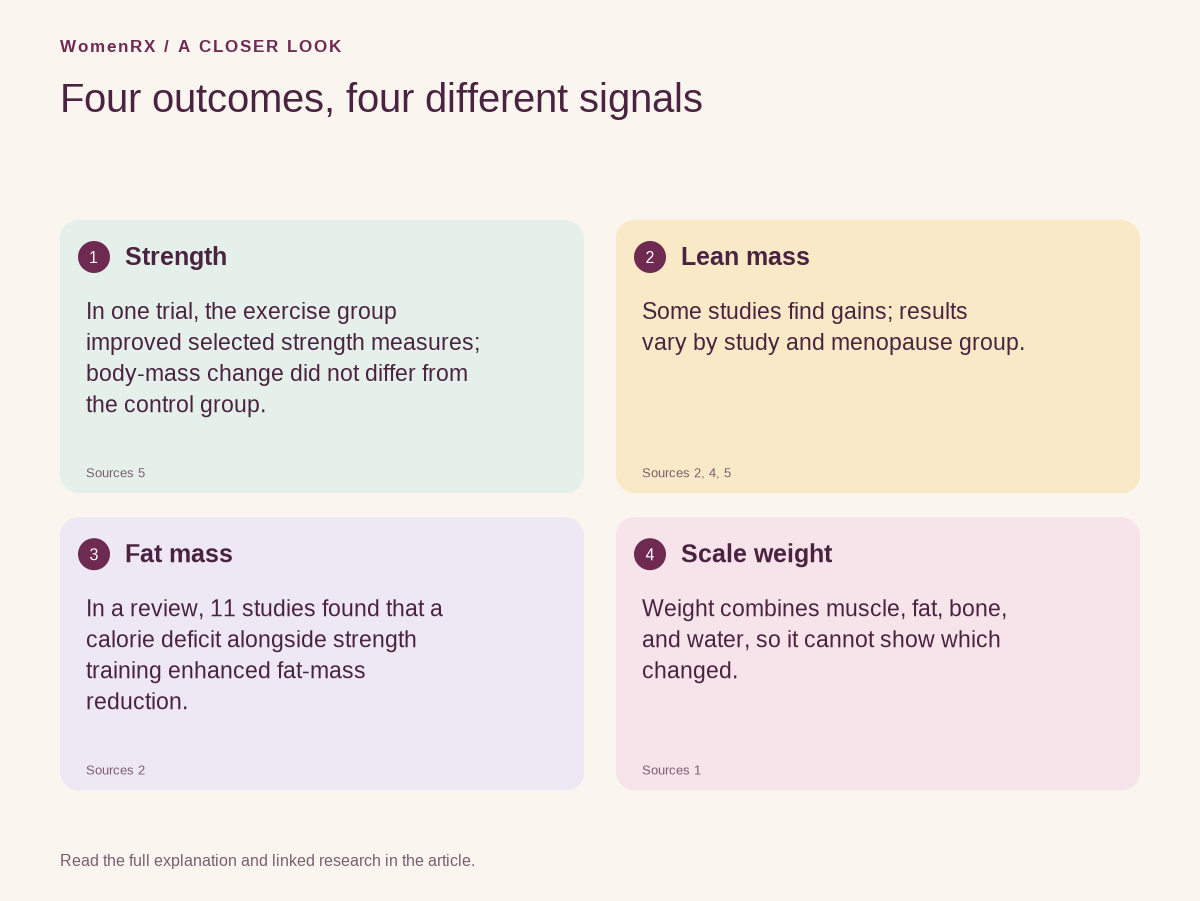
Four outcomes, four different signals
Strength: In one trial, the exercise group improved selected strength measures; body-mass change did not differ from the control group.5
Lean mass: Some studies find gains; results vary by study and menopause group.245
Fat mass: In a review, 11 studies found that a calorie deficit alongside strength training enhanced fat-mass reduction.2
Scale weight: Weight combines muscle, fat, bone, and water, so it cannot show which changed.1
Read the figure as text
These outcomes don't always move together: the scale combines several body components, while studies measure strength, lean mass, and fat mass separately.- Strength: In one trial, the exercise group improved selected strength measures; body-mass change did not differ from the control group.5
- Lean mass: Some studies find gains; results vary by study and menopause group.245
- Fat mass: In a review, 11 studies found that a calorie deficit alongside strength training enhanced fat-mass reduction.2
- Scale weight: Weight combines muscle, fat, bone, and water, so it cannot show which changed.1
Sources you can check
- Body Weight: MedlinePlusAccessed 2026-09-25Return to first citation
- Analysis of the Additive Effects of Nutritional Strategies in Strength Training Interventions on Body Composition, Muscle Strength and Bone Mineral Density in Postmenopausal Women: A Systematic Review.Walter F, Schalla J, Bloch W, Diel P, Geisler S, Isenmann E. · Sports medicine - open · 2026Return to first citation
- Analysis of combinatory effects of free weight resistance training and a high-protein diet on body composition and strength capacity in postmenopausal women - A 12-week randomized controlled trial.Ioannidou P, Dóró Z, Schalla J, Wätjen W, Diel P, Isenmann E. · The journal of nutrition, health & aging · 2024Return to first citation
- Resistance training alters body composition in middle-aged women depending on menopause - A 20-week control trial.Isenmann E, Kaluza D, Havers T, Elbeshausen A, Geisler S, Hofmann K, Flenker U, Diel P, Gavanda S. · BMC women's health · 2023Return to first citation
- A Novel Low-Impact Resistance Exercise Program Increases Strength and Balance in Females Irrespective of Menopause Status.Svensen E, Koscien CP, Alamdari N, Wall BT, Stephens FB. · Medicine and science in sports and exercise · 2025Return to first citation