Strength and Aerobic Exercise Through Menopause
Strength training builds muscle capacity, while aerobic activity supports heart and metabolic health; combining them addresses different needs.
Strength and aerobic exercise support overlapping but distinct parts of health. Strength training helps maintain muscle strength and can improve physical function; aerobic activity gets your heart and lungs working and supports circulation and blood-sugar management. Menopause doesn’t come with a proven, one-size-fits-all exercise prescription, and evidence on preventing bone or muscle loss during the transition is still limited. 1 3 5
Two types of exercise, different jobs
Strength work and aerobic activity aren’t competing choices. They challenge your body in different ways, so a mix can support more than one outcome.
Strength training makes muscles work against resistance. That could mean lifting weights, using resistance bands, or doing body-weight movements. Over time, muscle-strengthening activity can help maintain or increase muscle mass and strength. Those gains matter beyond the gym: strength supports everyday tasks and, as people get older, can help with activities such as standing up from a chair. 1
Aerobic activity keeps larger muscle groups moving and raises your breathing and heart rate. Brisk walking, cycling, and swimming are familiar examples. Regular exercise supports heart and circulation health and can help the body manage blood glucose. These are broad benefits of physical activity, not proof that one particular aerobic routine prevents a specific disease. 1
What a mix may offer
If your routine is mostly walking or another aerobic activity, you may be getting useful cardiovascular and metabolic activity without giving your muscles the same resistance challenge they get from strength work. If you lift weights but rarely do sustained movement, the reverse may be true. Combining the two is a practical way to work on fitness, strength, and function rather than expecting one mode to do everything.
For example, someone might choose brisk walks or cycling on some days and resistance-band or weight exercises on others. That’s an illustration, not a required schedule. The available evidence doesn’t establish a menopause-specific dose or ideal weekly plan.
What the menopause research can, and can’t, say
A review of six trials in women ages 45 to 60 found that the evidence on exercise during perimenopause and early postmenopause was limited and at high risk of bias. In those studies, strength training, endurance training, and tai chi did not improve bone mineral density or lean mass during perimenopause. For early postmenopause, strength training and walking showed benefits on some bone and lean-mass measures, though results varied by exercise type and outcome. The review concluded that it remains unclear which training approach is best for preventing bone and muscle loss through the transition. 3
A small feasibility trial offers a more specific example of potential strength-training effects. In 40 women ages 45 to 60 who were peri- or early postmenopausal, a supervised, progressive strength-and-impact program lasting nine months improved strength measures. Compared with a waitlisted group, the training group also had greater gains in total lean mass, leg power, and lumbar-spine bone density. This is promising, but the small feasibility study doesn’t establish that the same program or results apply to every woman. 5
In another trial, women ages 40 to 60 completed 12 weeks of exercise training with either fortified milk or a placebo after a short period of reduced activity. Muscle and function measures improved during the training phase. Researchers found no added effect from the fortified milk and no evidence that changes differed by menopausal status. Because everyone in this phase trained and received a milk product or placebo, the trial doesn’t isolate the effect of exercise alone. It also doesn’t settle whether exercise effects are identical across menopause stages. 4
Taken together, the evidence supports strength work as a way to build strength and function, while leaving important questions about menopause-stage differences and bone or muscle protection unresolved. The available studies do not establish an ideal menopause-specific dose or exercise plan. 3 4 5
Keep longevity claims in perspective
Regular physical activity is linked with a lower risk of dying early in summaries of long-term health evidence. That doesn’t mean exercise guarantees a longer life, or that a particular combination of strength and aerobic activity has been proven to extend lifespan for an individual woman. The more immediate, tangible reasons to be active include supporting heart health, muscle strength, and the ability to do everyday activities. 1
think of aerobic activity and strength work as complementary tools. Build a routine around the kinds of movement you can sustain, and value the outcomes you can feel and use, such as stamina for a walk or strength for daily tasks.
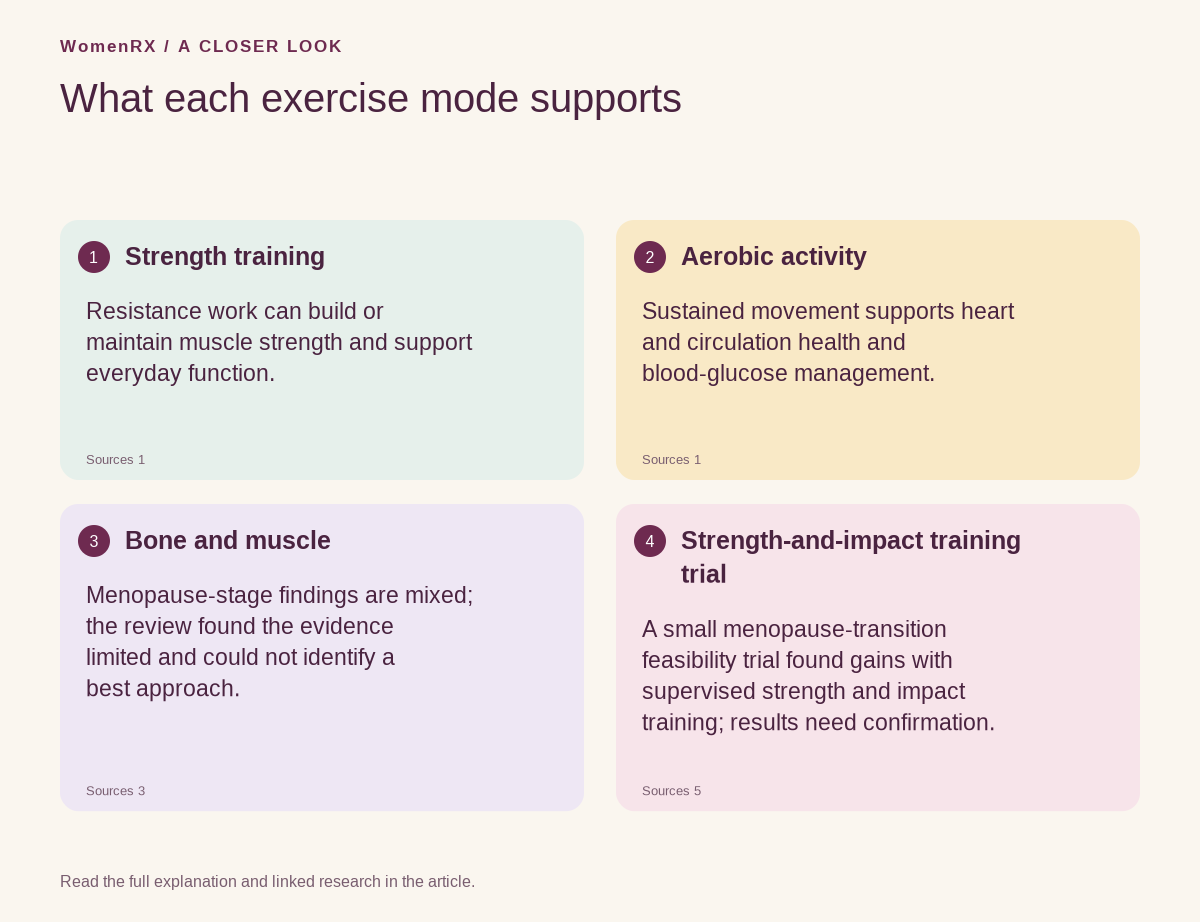
What each exercise mode supports
Strength training: Resistance work can build or maintain muscle strength and support everyday function.1
Aerobic activity: Sustained movement supports heart and circulation health and blood-glucose management.1
Bone and muscle: Menopause-stage findings are mixed; the review found the evidence limited and could not identify a best approach.3
Strength-and-impact training trial: A small menopause-transition feasibility trial found gains with supervised strength and impact training; results need confirmation.5
Read the figure as text
Strength and aerobic activity offer different challenges. This comparison separates broadly supported health roles from the more limited menopause-specific findings.- Strength training: Resistance work can build or maintain muscle strength and support everyday function.1
- Aerobic activity: Sustained movement supports heart and circulation health and blood-glucose management.1
- Bone and muscle: Menopause-stage findings are mixed; the review found the evidence limited and could not identify a best approach.3
- Strength-and-impact training trial: A small menopause-transition feasibility trial found gains with supervised strength and impact training; results need confirmation.5
More questions, answered
Does strength training alone protect bone during menopause?
It may help some bone measures, particularly in early postmenopause, but the menopause-transition evidence is limited and doesn’t establish strength training as a reliable way to prevent bone loss for every woman. The findings vary by menopause stage and outcome. 3 5
Is exercise a proven treatment for hot flashes?
No. The North American Menopause Society’s 2023 evidence review did not recommend exercise as a treatment for vasomotor symptoms such as hot flashes. Exercise can still support other aspects of health. 2
Sources you can check
- Benefits of Exercise: MedlinePlusAccessed 2026-09-25Return to first citation
- The 2023 nonhormone therapy position statement of The North American Menopause Society.Menopause (New York, N.Y.) · 2023Return to first citation
- Does exercising during peri- or early post-menopause prevent bone and muscle loss: A systematic review.Whitman PW, Alexander CJ, Kaluta L, Burt LA, Gabel L. · Bone · 2025Return to first citation
- Postinactivity Exercise Training Improves Sarcopenia Traits in 40-60-Year-Old Women Regardless of Fortified Milk Supplementation.Trezise J, Lima RM, Poppitt SD, Fanning AC, Devine A, Blazevich AJ. · Journal of cachexia, sarcopenia and muscle · 2025Return to first citation
- Preventing muscle and bone loss in peri-menopausal and early post-menopausal females with heavy strength and impact training: Results from the STOP-EM randomised waitlisted controlled feasibility trial.Whitman PW, Alexander CJ, Kaluta L, McDonough MH, Jordan MJ, Billington EO, Burt LA, Gabel L. · Bone reports · 2026Return to first citation