Build a Home Strength Routine That Fits Your Space
A chair, a resistance band, and a little floor space can be enough to start, as long as each exercise feels controlled and can become more challenging over time.
Build a session around a few basic movements: sitting and standing, pushing, pulling, and bending at the hips. Start with one set of each, using a version you can perform with control, and rest as needed between exercises. Pulling needs resistance, such as a band; without one, try a self-resisted row. When a movement feels manageable, keep it, ease it, or add challenge gradually.
Start with movements, not equipment
You don't need a full home gym to practice strength. Start by choosing one exercise for each of these patterns: a squat or sit-to-stand, a push, a pull, and a hip hinge. Together, they give you a simple whole-body framework. These examples are a practical way to organize a session, not a tested program that everyone needs to follow.
Try a sit-to-stand from a sturdy chair for the squat pattern. A wall push-up is one option for pushing. For pulling, sit tall and pull a resistance band held around your feet toward your waist. If you don't have a band, try a self-resisted row: pull one elbow back while your other hand gently pushes against that arm to create resistance. A pull needs some source of resistance, so body weight alone won't reproduce the band row. For a hip hinge, push your hips back while keeping your torso comfortable and controlled; you can keep a hand near a stable counter for support.
A band adds resistance without taking up much room. If you don't have one, begin with body-weight versions for movements that allow it, or use the self-resisted row for pulling. Equipment-free training won't always stay challenging enough: as you get stronger, you may need a harder variation or added resistance.
A simple session you can adjust
As a practical starting example, do one set of each of the four movements: sit-to-stand, wall push-up, a band or self-resisted row, and hip hinge. Choose a number of repetitions you can do while keeping control, and stop if your form starts to slip. Rest between exercises for as long as you need to feel ready to move steadily again. This is an adjustable example, not a tested dose for every person.
For context, a home-based elastic-band training study in adults with type 2 diabetes used two sets of 12 repetitions per exercise; one study in the review increased band tension when participants could complete 12 repetitions with good technique. Those study details offer an example, not a universal starting target or prescription. 4
As a planning example, you might schedule this short session on two days with a day between them, then repeat it. If that doesn't fit, pick a schedule you can maintain and start with fewer sessions. This is a practical way to organize your week, not a frequency proven to be right for every person.
Progress one step at a time
When an exercise feels manageable and your technique stays steady, change one thing: use a stronger band, move from a wall push-up to a lower support, or increase the range of motion if it remains comfortable. You can also slow the movement, especially the lowering part. Change only one feature at a time so you can tell whether the new version suits you.
Use your control as the decision point. If the movement stays steady and feels manageable, keep that version or make it a little harder. If you can't keep control, shorten the movement, choose a more supported version, or reduce the resistance. There's no need to progress just because a certain number of sessions has passed.
Set up for a safer session
Before you begin, clear the floor of cords, rugs that slide, and other trip hazards. Use a chair that won't shift, and keep it against a wall if you need support. Check a resistance band for visible damage before using it, and avoid attaching it to furniture or a door unless the attachment is designed for that purpose. Start with a version of each movement that feels stable, and stop if you can't maintain control.
For adults 60 and older living in the community, a meta-analysis of 21 randomized trials involving 4,053 participants found modest improvements in lower-limb strength, leg power measured by sit-to-stand, and one measure of balance after unsupervised home resistance training. The review reported no major adverse events, but adherence averaged 67%, and it found no benefit for several other measures, including falls. The findings support home training as a useful option for some older adults, not a guarantee of safety or improvement for every person. The studies were not reported as women-only evidence. 3
Adjust for your stage and situation
If you're in the first weeks after giving birth, follow the activity guidance you were given for recovery rather than starting this routine on a preset timeline. MedlinePlus advises following your doctor's instructions about activity during the first few weeks after birth. 1
For menopause, this is a flexible strength routine, not a menopause-specific protocol. If maintaining muscle strength is a priority, include resistance movements you can perform with control, then gradually make them more challenging as they become manageable. Muscle-strengthening activity can help increase or maintain muscle mass and strength, but that general benefit isn't evidence of a menopause-specific effect. Choose movements and resistance based on your current ability and comfort. 2
If you're older or feel unsteady, use a stable support within reach and choose versions that let you practice safely. Strengthening activity can help maintain muscle mass and strength; for older adults, strength also matters for everyday tasks such as getting out of a chair. 2
A home plan is a starting structure, not a fit for every health condition or recovery situation. If a movement feels unsafe or your activity has been limited for a medical reason, get guidance tailored to that situation before progressing.
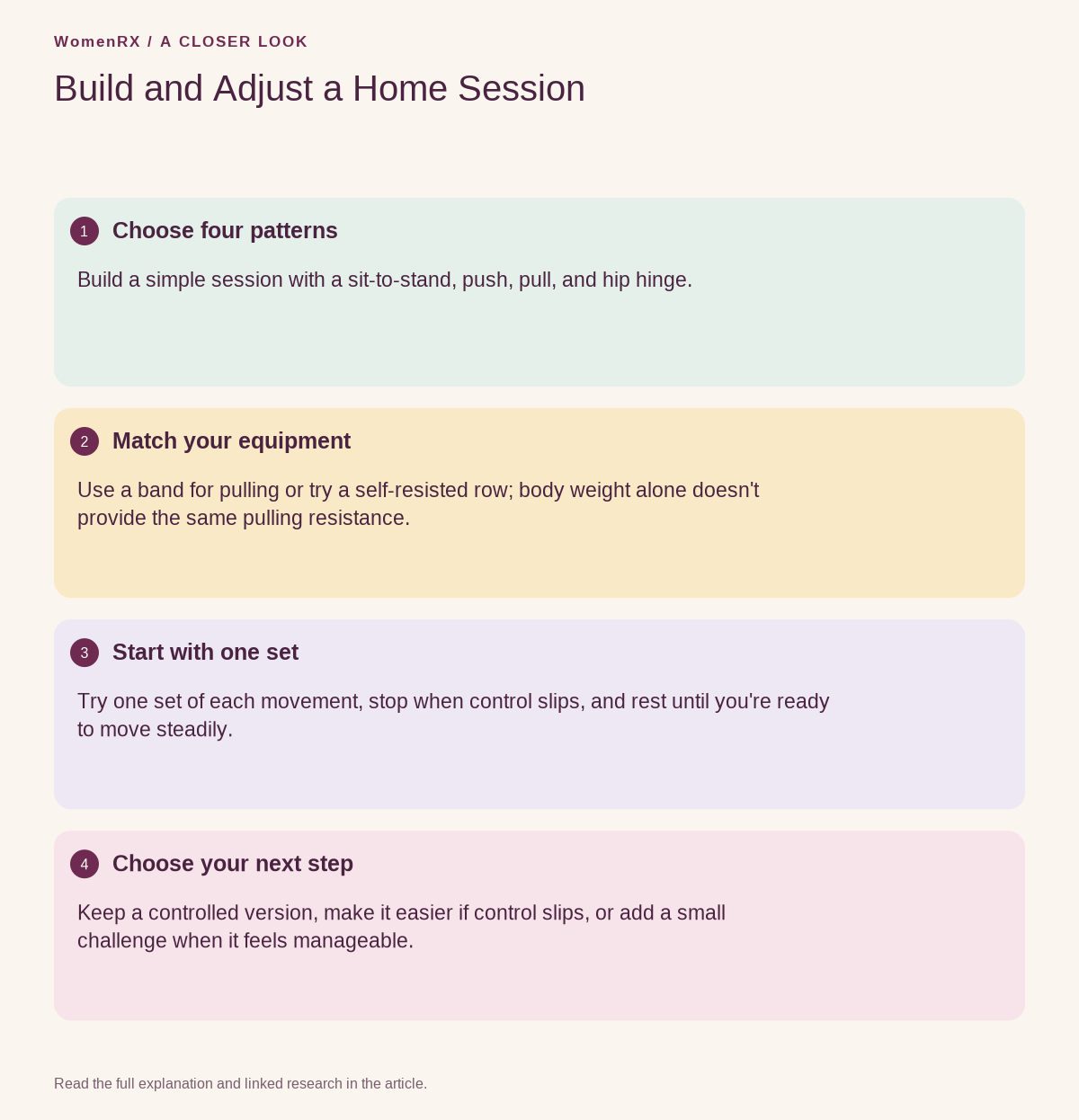
Build and Adjust a Home Session
Choose four patterns: Build a simple session with a sit-to-stand, push, pull, and hip hinge.
Match your equipment: Use a band for pulling or try a self-resisted row; body weight alone doesn't provide the same pulling resistance.
Start with one set: Try one set of each movement, stop when control slips, and rest until you're ready to move steadily.
Choose your next step: Keep a controlled version, make it easier if control slips, or add a small challenge when it feels manageable.
Read the figure as text
Choose movement patterns, match pulling to the resistance you have, start with a manageable amount of work, then use control to decide whether to keep, ease, or progress.- Choose four patterns: Build a simple session with a sit-to-stand, push, pull, and hip hinge.
- Match your equipment: Use a band for pulling or try a self-resisted row; body weight alone doesn't provide the same pulling resistance.
- Start with one set: Try one set of each movement, stop when control slips, and rest until you're ready to move steadily.
- Choose your next step: Keep a controlled version, make it easier if control slips, or add a small challenge when it feels manageable.
More questions, answered
Can I build strength without buying equipment?
Body-weight exercises can be a useful starting point. For pulling, use a self-resisted row or another source of resistance; if body-weight movements stop feeling challenging while you still have good control, try a harder variation or add resistance with a band. Equipment-free exercise won't provide enough challenge indefinitely for everyone.
Does home strength training help prevent falls as I get older?
The evidence is mixed by outcome. A review of home resistance-training trials in community-dwelling older adults found improvements in some measures of leg strength, leg power, and balance, but it did not find a benefit for falls. 3
Sources you can check
- Postpartum Care: MedlinePlusAccessed 2026-09-25Return to first citation
- Benefits of Exercise: MedlinePlusAccessed 2026-09-25Return to first citation
- Unsupervised home-based resistance training for community-dwelling older adults: A systematic review and meta-analysis of randomized controlled trials.Mañas A, Gómez-Redondo P, Valenzuela PL, Morales JS, Lucía A, Ara I. · Ageing research reviews · 2021Return to first citation
- Effects of elastic-band resistance training on glycemic control, muscle strength, and functional outcomes in patients with type 2 diabetes mellitus: a systematic review and meta-analysis of randomized controlled trials.Zhu Y, Zhu Z, Wang H, Cao S, Shan C, Yuan X. · Frontiers in public health · 2026Return to first citation