Strength Training Basics: What to Know Before You Start
Sets, reps, rest, and gradual progression are simple tools for making resistance training easier to understand, not rules you have to master before beginning.
A repetition is one complete movement; a set is a group of repetitions, and rest is the pause between sets. Resistance training makes muscles work against resistance, which can come from weights, bands, machines, or body weight. 2 Start by learning a few movements at an effort you can control. Over time, gradually make the work more demanding rather than trying to exhaust yourself at every session. 2
The basic terms, without the gym jargon
Resistance training is any exercise where your muscles work against resistance. That resistance might be a dumbbell, a machine, a band, or your own body weight. The goal is to challenge the muscles doing the movement, not to use a particular kind of equipment. 2
A rep, short for repetition, is one complete movement. One squat down and back up is one rep. A set is a group of reps performed before you pause. If you do several squats, take a break, then do several more, those are separate sets. Rest is the pause between sets. It gives you a chance to reset and decide whether you can repeat the next set with control. There is no need to turn the pause into another exercise.
A movement pattern is a handy way to group exercises by what your body is doing. For example, a chair squat is a squat pattern, a hip hinge resembles bending to pick something up, and a wall push-up is a push. Pulling a band toward you is a pull. This is an organizing tool, not a required checklist or a special method for women.
Choose an effort you can control
A useful beginner effort cue is whether you can repeat the movement with steady control. The exercise should feel like work, but a rep does not have to be a struggle or a dramatic test of willpower. If your movement changes because you are rushing or losing control, that is a reason to pause or make the exercise easier.
You also do not have to train until you cannot complete another rep. In a large overview of research reviews involving healthy adults, training to momentary muscle fatigue did not consistently improve the outcomes compared with other approaches. The review found that resistance training improved strength and other muscle and physical-function outcomes overall, while several details of how people trained did not reliably change results. 2
That research is not a women-only prescription. The review covered healthy adults, but the reported summary does not give a women-specific subgroup result. Its broad findings can inform general beginner concepts, but they do not establish a separate ideal method for women at different life stages. 2
Progress means a gradual change, not a dramatic leap
Progressive resistance training means increasing the challenge over time. 2 As an illustrative practical option, you could add a few controlled repetitions when an exercise feels manageable. That is one example, not a progression method specifically established by the review. It does not mean making every workout harder than the last one, and it does not require changing several things at once.
For example, you might begin practicing a chair squat with body weight: do five controlled squats (five reps), pause to rest, then do another five (a second set). Once the movement feels controlled and the repetitions feel manageable, you could add a few repetitions or hold a light object. That is an illustration of gradual progression, not a required starting plan. The larger evidence review supports progressive resistance training for healthy adults, but does not make one example the right choice for everyone. 2
Research findings about sets and loads are useful context, not entrance requirements. In the review, strength gains were enhanced in some comparisons by heavier loads, 2-3 sets, and training at least twice weekly. Those are findings across the studies included, not a demand that a beginner test a maximum lift, start with a particular weight, or follow one exact schedule. The review also found that strength benefited from using a complete range of motion, when suitable for the movement. 2
A first session is practice, too
You do not need to memorize a full program before trying resistance training. Learn what counts as a rep and set, pick movements you can perform with control, and notice how challenging the work feels. Rest between sets, then continue only if you can repeat the movement steadily. As you get comfortable, make one gradual adjustment rather than piling on weight, repetitions, and extra sets at once.
Muscle-strengthening activity can help increase or maintain muscle mass and strength, and strength matters in everyday tasks as well as exercise. 1 The point of learning the basics is to make the next step feel clearer, not to chase a promised body shape or prove how much you can lift.
Your strength-training basics
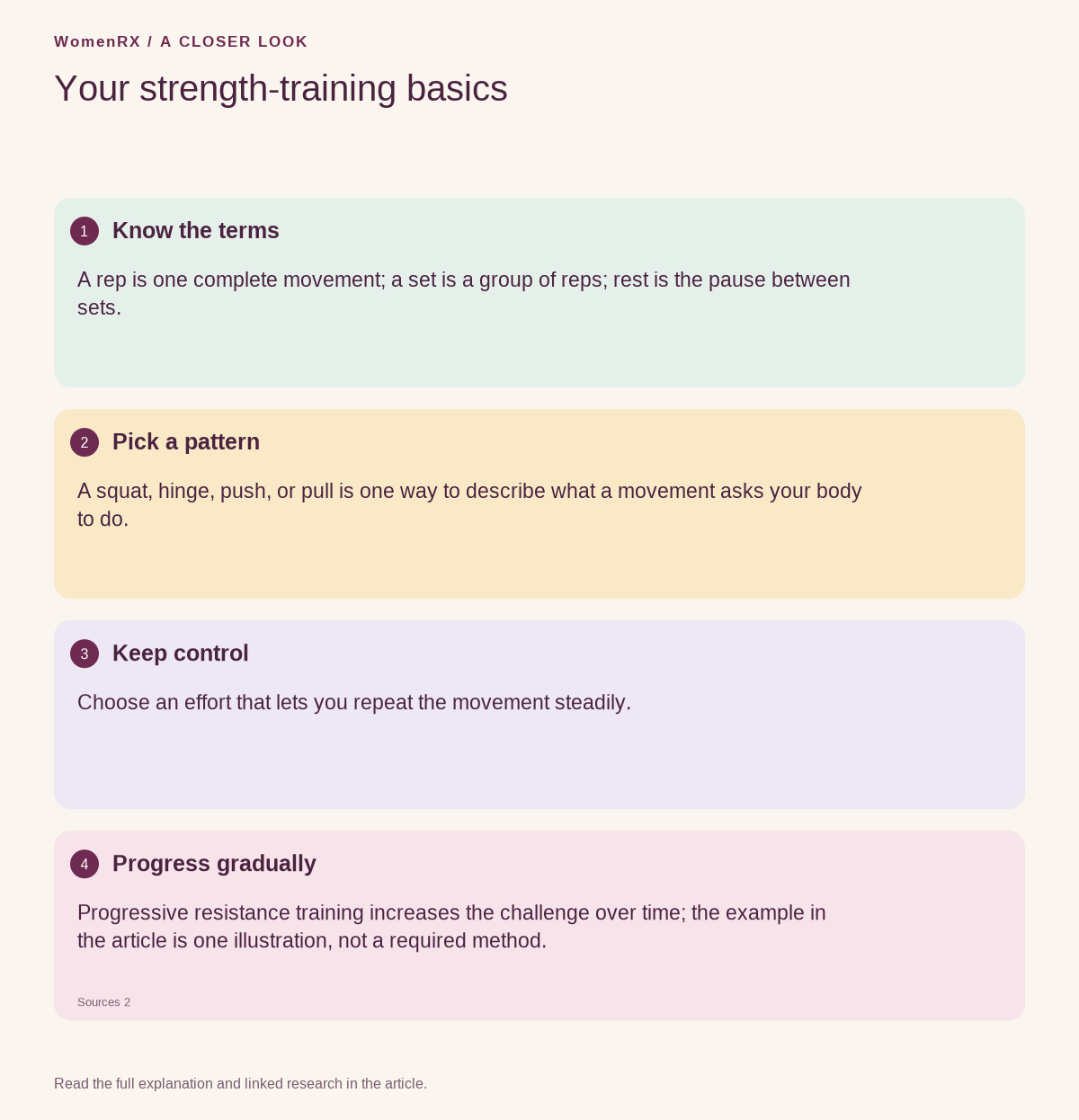
Know the terms: A rep is one complete movement; a set is a group of reps; rest is the pause between sets.
Pick a pattern: A squat, hinge, push, or pull is one way to describe what a movement asks your body to do.
Keep control: Choose an effort that lets you repeat the movement steadily.
Progress gradually: Progressive resistance training increases the challenge over time; the example in the article is one illustration, not a required method.2
Read the figure as text
A quick check of the ideas that make a first resistance-training session easier to understand.- Know the terms: A rep is one complete movement; a set is a group of reps; rest is the pause between sets.
- Pick a pattern: A squat, hinge, push, or pull is one way to describe what a movement asks your body to do.
- Keep control: Choose an effort that lets you repeat the movement steadily.
- Progress gradually: Progressive resistance training increases the challenge over time; the example in the article is one illustration, not a required method.2
More questions, answered
Do I need weights to start strength training?
No. Resistance can come from body weight, bands, machines, or free weights, so equipment is one way to create resistance, not a requirement. 2
Sources you can check
- Benefits of Exercise: MedlinePlusAccessed 2026-09-25Return to first citation
- American College of Sports Medicine Position Stand. Resistance Training Prescription for Muscle Function, Hypertrophy, and Physical Performance in Healthy Adults: An Overview of Reviews.Currier BS, D'Souza AC, Singh MAF, Lowisz CV, Rawson ES, Schoenfeld BJ, Smith-Ryan AE, Steen JP, Thomas GA, Triplett NT, Washington TA, Werner TJ, Phillips SM. · Medicine and science in sports and exercise · 2026Return to first citation