Start Bodyweight Strength Training With a Simple Progression Plan
Begin with controlled versions of a few basic movements, then change the leverage or range when they stop feeling challenging.
You can start with a chair squat, wall push-up, glute bridge and a floor-based core movement, choosing versions you can control comfortably. Make each easier or harder by changing the support, range or leverage. Research reports strength benefits from bodyweight training in older adults overall, while evidence in postmenopausal women covers strength training more broadly, not bodyweight-only routines. 1 3
You don’t need a gym to begin building strength. Start with a handful of movements you can do with control, and adjust the version so the last part feels like work without your form falling apart. The goal isn’t to rush toward the hardest variation. It’s to find a repeatable challenge and make it a little greater as you get stronger.
A simple no-gym starting routine
Choose one movement from each pattern below. For example: sit-to-stand from a chair, wall push-ups, glute bridges and bird dogs. As a practical example, you could begin with one round of 5 to 8 controlled repetitions of each movement, and 4 to 6 bird-dog reaches on each side. Use a version that lets you stay steady, and stop a set when you can no longer keep the movement controlled. This is an illustrative starting template, not a tested or individually prescribed program.
If you want a schedule, two sessions a week is one reasonable example to try. A trial in adults aged 65 and older used bodyweight resistance training twice weekly for 12 weeks, but that doesn’t show that this is the best frequency for every woman or age group. 2
Progress one movement at a time
Use the ladders as options, not a test you have to pass. Start where the movement feels manageable. When you can do it steadily and it no longer feels like much of a challenge, try the next step. You can also make a movement easier by using more support or a smaller range.
- Squat: Sit down and stand up from a higher chair → use a lower seat → squat without sitting → try a split squat with support nearby.
- Push: Wall push-up → push-up against a stable countertop → knee push-up → floor push-up.
- Hips: Glute bridge with both feet down → bridge with a longer pause at the top → single-leg bridge, if you can keep your hips level.
- Core: Bird dog with a small reach → extend one arm and the opposite leg farther → hold the extended position briefly while keeping your trunk steady.
Change just one thing at a time, such as the range, support or leverage. That makes it easier to tell whether a new version suits you. A stable chair or countertop can help with balance and setup; don’t use a surface that shifts.
Where bodyweight has limits
Bodyweight can be a useful starting resistance. If a movement no longer feels challenging, you can try a harder variation or consider another form of resistance. A network meta-analysis of 102 trials in community-dwelling older adults found that bodyweight, bands, free weights and machines all improved strength compared with no intervention. Machine-based training had the largest estimated effect in that analysis, though the authors also emphasized the role of choosing suitable training demands. The findings are from older adults, not a direct comparison in women of all ages. 3
You may notice a limit first with pulling movements. Without something to pull against, it can be difficult to increase resistance for the back in the same straightforward way you can make a push-up harder. If your routine no longer feels challenging, a resistance band or a securely set up row option may expand your choices. Bodyweight is an option, not a requirement or a ceiling you have to accept.
What the evidence says about women
A systematic review of 34 studies involving 1,541 postmenopausal women reported that systematic strength training improved strength, body composition and bone mineral density overall. The review covers strength training broadly; it doesn’t establish that a bodyweight-only routine produces the same results. 1
A separate analysis of resistance-training types involved community-dwelling older adults, with a mean age of 70. It found strength benefits across several training modes, including bodyweight exercise, but did not report a women-specific result. The evidence doesn’t establish an ideal bodyweight routine across adult ages or report results specifically for cycling years or perimenopause. 3
The useful takeaway is simple: begin with movements you can do steadily, adjust the difficulty as your strength changes, and add resistance or equipment if bodyweight stops being enough for your goals.
Choose a version, then adjust
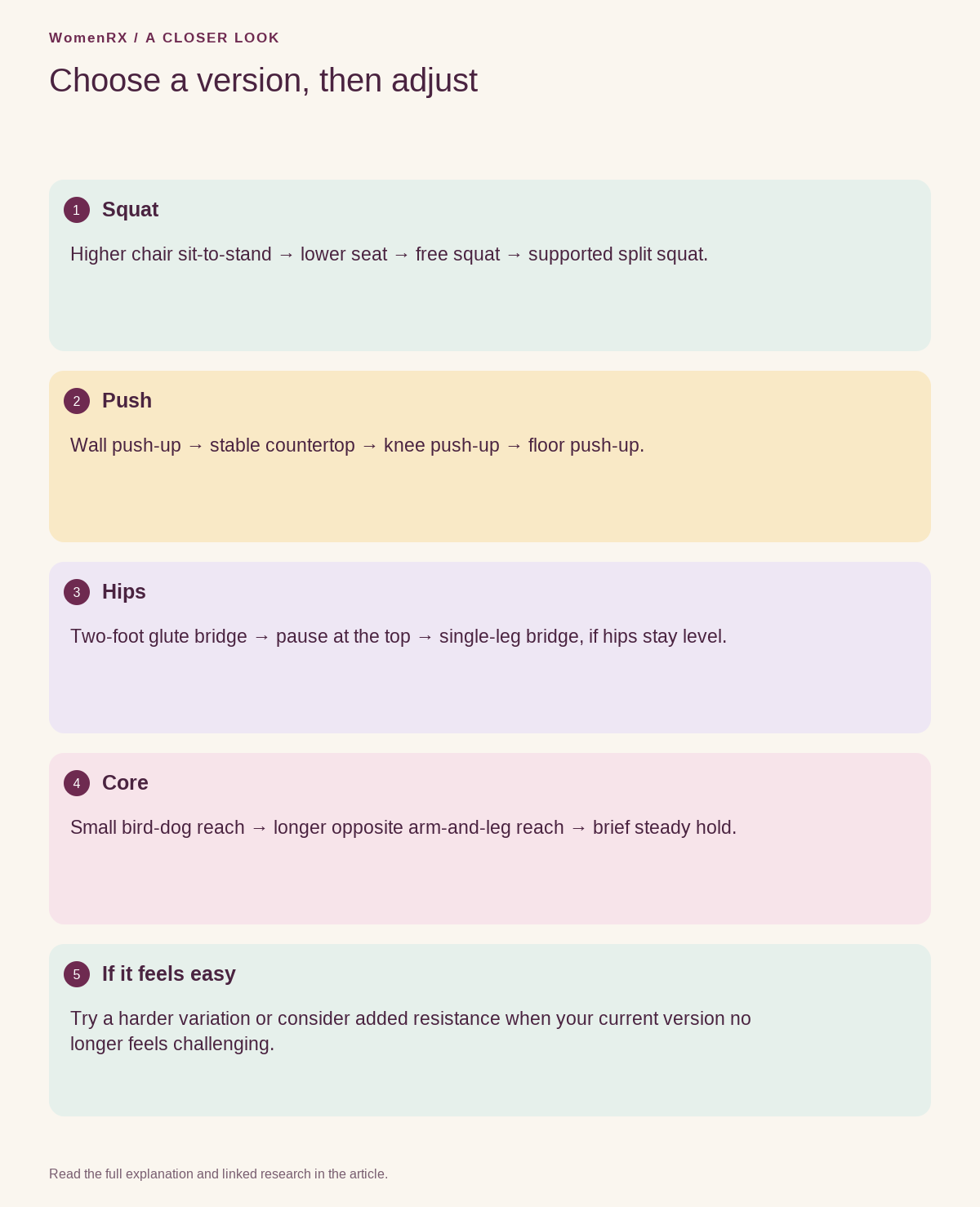
Squat: Higher chair sit-to-stand → lower seat → free squat → supported split squat.
Push: Wall push-up → stable countertop → knee push-up → floor push-up.
Hips: Two-foot glute bridge → pause at the top → single-leg bridge, if hips stay level.
Core: Small bird-dog reach → longer opposite arm-and-leg reach → brief steady hold.
If it feels easy: Try a harder variation or consider added resistance when your current version no longer feels challenging.
Read the figure as text
These example ladders show how support, range and leverage can change the challenge of familiar bodyweight movements. Start with a version you can control.- Squat: Higher chair sit-to-stand → lower seat → free squat → supported split squat.
- Push: Wall push-up → stable countertop → knee push-up → floor push-up.
- Hips: Two-foot glute bridge → pause at the top → single-leg bridge, if hips stay level.
- Core: Small bird-dog reach → longer opposite arm-and-leg reach → brief steady hold.
- If it feels easy: Try a harder variation or consider added resistance when your current version no longer feels challenging.
More questions, answered
Do I need to replace an exercise as soon as it feels easy?
Not necessarily. First try a little more range, less support or a more demanding position. If the movement still doesn’t provide a meaningful challenge, consider a different variation or added resistance. The point is to match the challenge to your current ability, not to keep advancing for its own sake.
Does evidence in postmenopausal women specifically prove bodyweight training works?
No. A review found benefits from systematic strength training in postmenopausal women, but it did not establish those benefits for bodyweight-only programs. A separate review found bodyweight training improved strength in older adults overall, without reporting a women-only result. 1 3
Sources you can check
- Analysis of the Additive Effects of Nutritional Strategies in Strength Training Interventions on Body Composition, Muscle Strength and Bone Mineral Density in Postmenopausal Women: A Systematic Review.Walter F, Schalla J, Bloch W, Diel P, Geisler S, Isenmann E. · Sports medicine - open · 2026Return to first citation
- Lemon myrtle extract enhances muscle hypertrophy induced by low-load bodyweight resistance training in older adults: Findings from two independent randomized controlled trials.Sawada S, Nishino A, Honda S, Tominaga Y, Makio S, Ozaki H, Machida S. · The journal of nutrition, health & aging · 2025Return to first citation
- The Effects of Different Resistance Training Modalities on Muscle Strength in Community-Dwelling Older Adults: A Network Meta-Analysis.Wiedenmann T, Held S, Morat T, Rappelt L, Isenmann E, Berndsen E, Hopp NH, Donath L. · Gerontology · 2025Return to first citation