Can Bodyweight Training Support Strength During Menopause?
Bodyweight exercises can count as resistance training, but getting stronger depends on keeping the work challenging over time.
Yes. Bodyweight movements can provide resistance, and resistance training has improved strength in older adults, though those findings don’t establish a menopause-specific effect or isolate bodyweight workouts. To judge whether a movement still serves your strength goal, notice whether the working muscles are challenged while you can control the movement. Exercise can also support weight management alongside eating habits, but it doesn’t guarantee weight loss. 1 3
What bodyweight training can do
Squats, wall push-ups, step-ups and similar movements use your body as resistance. Resistance training is defined broadly enough to include body-weight exercises, but that doesn’t mean every bodyweight workout provides the same challenge. The movement, how you perform it and how hard it feels all matter. 3
A systematic review of resistance training in older adults with sarcopenia, a condition involving low muscle mass and strength, included 25 randomized trials involving 1,302 participants. Resistance training improved muscle strength and several other outcomes. These findings don’t show that bodyweight-only workouts produced those gains or establish a menopause-specific effect. 3
So the fair takeaway is encouraging but measured: bodyweight training can be a way to do resistance exercise, while the strength findings come from broader resistance-training research.
The practical test is progression
A workout can feel strenuous at first and become easier as you adapt. As a practical check, pay attention to the muscles doing the work: do they have to work noticeably harder as you repeat the movement, while you can still perform it with control? If you could keep going in the same way with little muscular effort, that version may no longer offer much challenge for your strength goal. If controlling the movement becomes difficult, a less demanding version may be a better choice. This is a way to judge training demand, not a validated menopause-specific test. Progressive resistance training changes the challenge as your capacity changes. 3
For example, if a standard squat becomes comfortable, you might try a version that asks for more control or strength, such as sitting down to a chair more slowly, or you could add resistance. If a wall push-up feels easy, you might use a lower, sturdier surface for your hands. These are examples of ways to adjust the challenge, not a tested menopause-specific program.
You don’t have to abandon bodyweight training to progress. But if changing the movement no longer makes it challenging, equipment such as resistance bands or weights can offer another way to increase resistance. The useful question is not whether a workout is labeled “bodyweight” or “strength training,” but whether it gives your muscles a meaningful challenge that can be progressed.
Strength work addresses the goal of challenging your muscles. It needn’t be your entire activity routine: other movement, such as walking, can contribute to broader physical activity and weight-management goals. Feeling out of breath during a circuit also doesn’t, by itself, tell you whether each movement is demanding enough for your muscles. 1 3
Strength and weight management are related, not identical
Exercise can support weight management, but it isn’t a guarantee of weight loss by itself. MedlinePlus describes exercise as one part of managing weight alongside diet; weight loss requires using more calories than you take in. 1
Also, the scale doesn’t tell the whole story. Body weight includes muscle, fat, bone and water, so a number alone can’t show whether your strength is improving or what has changed in your body composition. 2 A more useful expectation is that strength training can help you work toward strength goals while physical activity plays a role in broader weight management. Don’t expect a bodyweight workout to selectively reduce fat from one area or to produce a specific change on the scale.
If your main goal is weight management, bodyweight strength work can be one part of your activity routine. It doesn’t replace the other parts of weight management, and the studies summarized above don’t quantify weight change from a menopause-specific bodyweight program.
Choosing whether to add resistance
Stay with bodyweight movements if they’re still challenging your muscles and you can adjust them as you get stronger. Consider adding resistance when you can perform your current variations with little muscular effort and changes to the movement don’t restore the challenge you want. That’s a practical application of progressive training, not a menopause-specific threshold established by trials. 3
The evidence supports resistance training generally in older adults with sarcopenia, and bodyweight exercise falls within the broad definition of resistance training. It doesn’t settle whether bodyweight-only training is as effective as equipment-based training for women in perimenopause or postmenopause. Either way, the point is to choose a form of resistance you can keep making appropriately challenging.
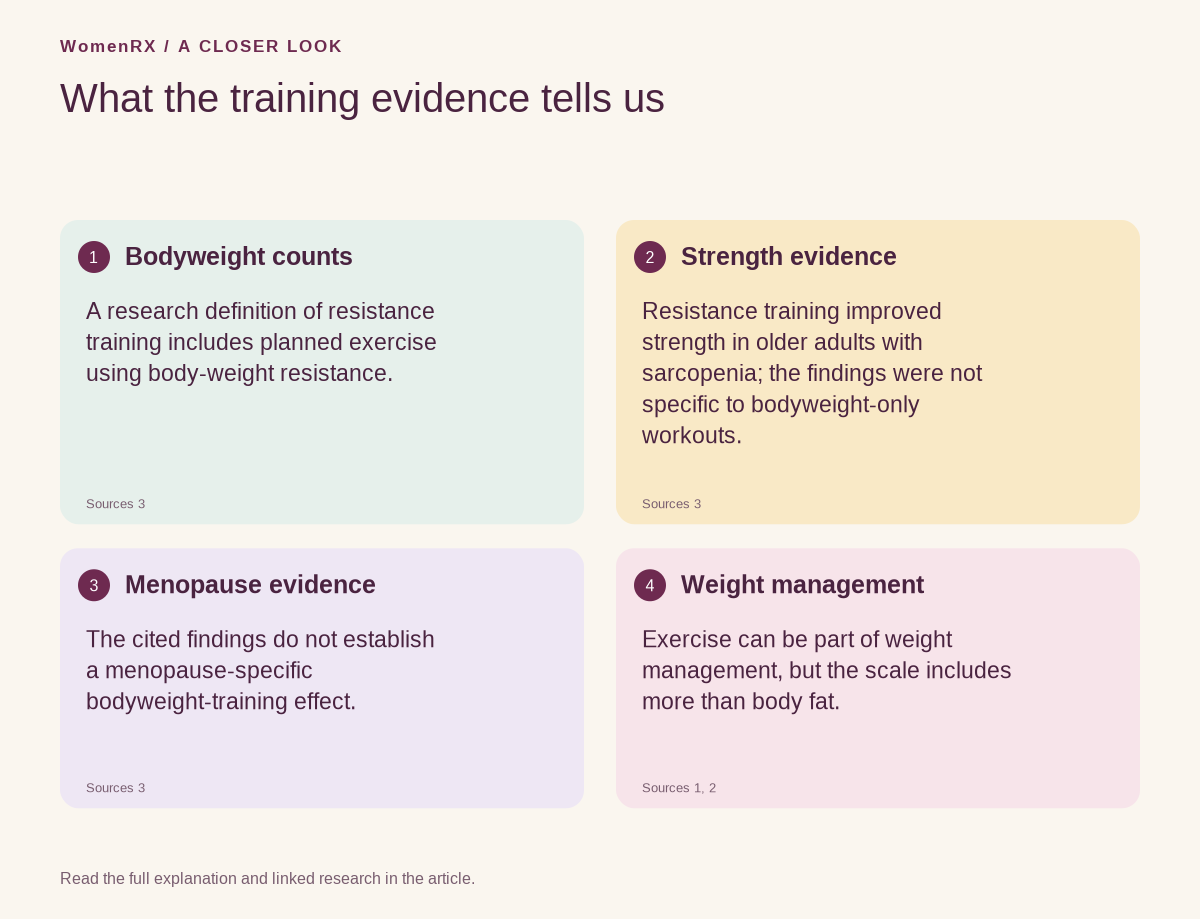
What the training evidence tells us
Bodyweight counts: A research definition of resistance training includes planned exercise using body-weight resistance.3
Strength evidence: Resistance training improved strength in older adults with sarcopenia; the findings were not specific to bodyweight-only workouts.3
Menopause evidence: The cited findings do not establish a menopause-specific bodyweight-training effect.3
Weight management: Exercise can be part of weight management, but the scale includes more than body fat.12
Read the figure as text
Separate what research supports about resistance training generally from what it does not establish about bodyweight workouts during menopause.- Bodyweight counts: A research definition of resistance training includes planned exercise using body-weight resistance.3
- Strength evidence: Resistance training improved strength in older adults with sarcopenia; the findings were not specific to bodyweight-only workouts.3
- Menopause evidence: The cited findings do not establish a menopause-specific bodyweight-training effect.3
- Weight management: Exercise can be part of weight management, but the scale includes more than body fat.12
More questions, answered
Can the scale tell whether strength training is working?
Not by itself. Body weight includes muscle, fat, bone and water, so a scale reading can’t show the whole picture of changes in strength or body composition. 2
Sources you can check
- Benefits of Exercise: MedlinePlusAccessed 2026-09-25Return to first citation
- Body Weight: MedlinePlusAccessed 2026-09-25Return to first citation
- Optimizing prescription of resistance training for body composition, muscle strength, and physical performance in older adults with sarcopenia: a systematic review and meta-analysis.Tan Z, Jiang Y, Candow DG, Castagna C, Wang X, Zheng H. · European review of aging and physical activity : official journal of the European Group for Research into Elderly and Physical Activity · 2026Return to first citation