Strength Training, Calcium, and Bone Health After Menopause
Strength training and calcium support bone health in different ways, and neither replaces an assessment of your fracture risk.
After menopause, lower estrogen increases bone remodeling and bone loss. Resistance training makes muscles work against a load and puts stress on bones; weight-bearing activity, such as brisk walking or stair climbing, also makes bones work. Calcium supports bone maintenance, with food and supplements both counting toward intake. The right activity and any need for a supplement depend on your diet and bone health. 162
Why the two approaches aren’t interchangeable
After menopause, decreased estrogen increases bone remodeling, and women begin to lose calcium from bone. Getting enough calcium helps support bone maintenance, while physical activity gives bones work to respond to and helps maintain muscle. Both matter, but neither on its own tells you whether you have osteoporosis or how likely you are to fracture a bone. 1634
A useful way to review what you’re already doing is to separate movement that loads bone, calcium you get across the day, and your individual fracture risk. That keeps a calcium tablet from standing in for exercise, or a walking routine from standing in for a look at your diet.
What counts as bone-supporting activity?
Weight-bearing activity puts force on bones as you move. Brisk walking, climbing stairs, dancing, and racket sports are examples. Resistance training makes muscles work against resistance, using equipment such as weights or bands, or your own body weight. It stresses bones too. These categories can overlap, but they’re not identical: a walk and a set of band exercises challenge your body in different ways. 6
Strength work has another practical role. Muscle-strengthening activity can help maintain muscle mass and strength, while balance and strengthening activities can help older adults reduce their risk of falling. That matters alongside bone density: preventing a fall and supporting bone are different parts of reducing the chance of a fracture. 3
To take stock, look for variety rather than one perfect exercise. For example, a routine of walks might already include weight-bearing movement but little resistance work. A routine built around weights might benefit from walking and balance activity as well. General adult guidance includes strengthening activities on two or more days a week; older-adult guidance calls for a mix of aerobic, strengthening, and balance activity. Those are broad activity goals, not a promise that a particular routine will restore bone density after menopause. 76
If you’ve been inactive, build up gradually. If you have low bone density, osteoporosis, or physical limitations, get help choosing activities that are safe for you before starting a new program. That’s especially useful before assuming that a higher-impact option, such as running, is the best next step simply because it’s weight-bearing. 76
Count calcium from food before adding a pill
The US recommended dietary allowance for calcium is 1,200 mg a day for women older than 50, compared with 1,000 mg for younger adult women. That’s a target for total intake, not an instruction to take that amount as a supplement. It was set with bone maintenance in mind. 1
Milk, yogurt, and cheese are common calcium sources in the US. If you eat little or no dairy, don’t assume a supplement is automatically necessary or unnecessary: first look at the calcium in the foods you regularly eat. Food labels list calcium, so they can help you compare products and estimate what contributes to your daily total. Adults with lactose intolerance who avoid dairy tend to have lower calcium intakes, although research has not consistently linked lactose intolerance itself with worse bone outcomes. 215
Supplements can help fill a gap when food isn’t providing enough, but the amount depends on what you already eat. Common forms include calcium carbonate and calcium citrate. Calcium carbonate is absorbed best with food, and supplements can cause gas, bloating, or constipation for some people. If you already take a multivitamin, antacid, or calcium supplement, include its calcium when reviewing your total rather than counting food alone. 2
Calcium matters, but more is not automatically better for bones. Research in adults over 50 has found increases in bone mineral density with higher calcium intake from food or supplements; whether those increases were clinically significant is unclear. Bone density is also not the whole picture of fracture risk. 14
Know when the decision needs more than a routine review
If you have osteoporosis or low bone density, the immediate activity question is which movements are appropriate for you, not whether you should give up movement. If you’ve had a fracture after a minor fall, ask whether your bone health and fracture risk need assessment before you change your exercise plan. A bone-density scan can help predict fracture risk, but clinical factors matter too; the scan alone does not capture every aspect of bone strength. 614
For calcium, the useful question is narrower: How much am I getting from food and products I already take, and is there a gap to fill? For activity, it’s: Do I have both weight-bearing movement and resistance work, and do my bone health or physical limitations change what’s safe? Those answers make any change more purposeful than adding the hardest workout or a supplement by default. 126
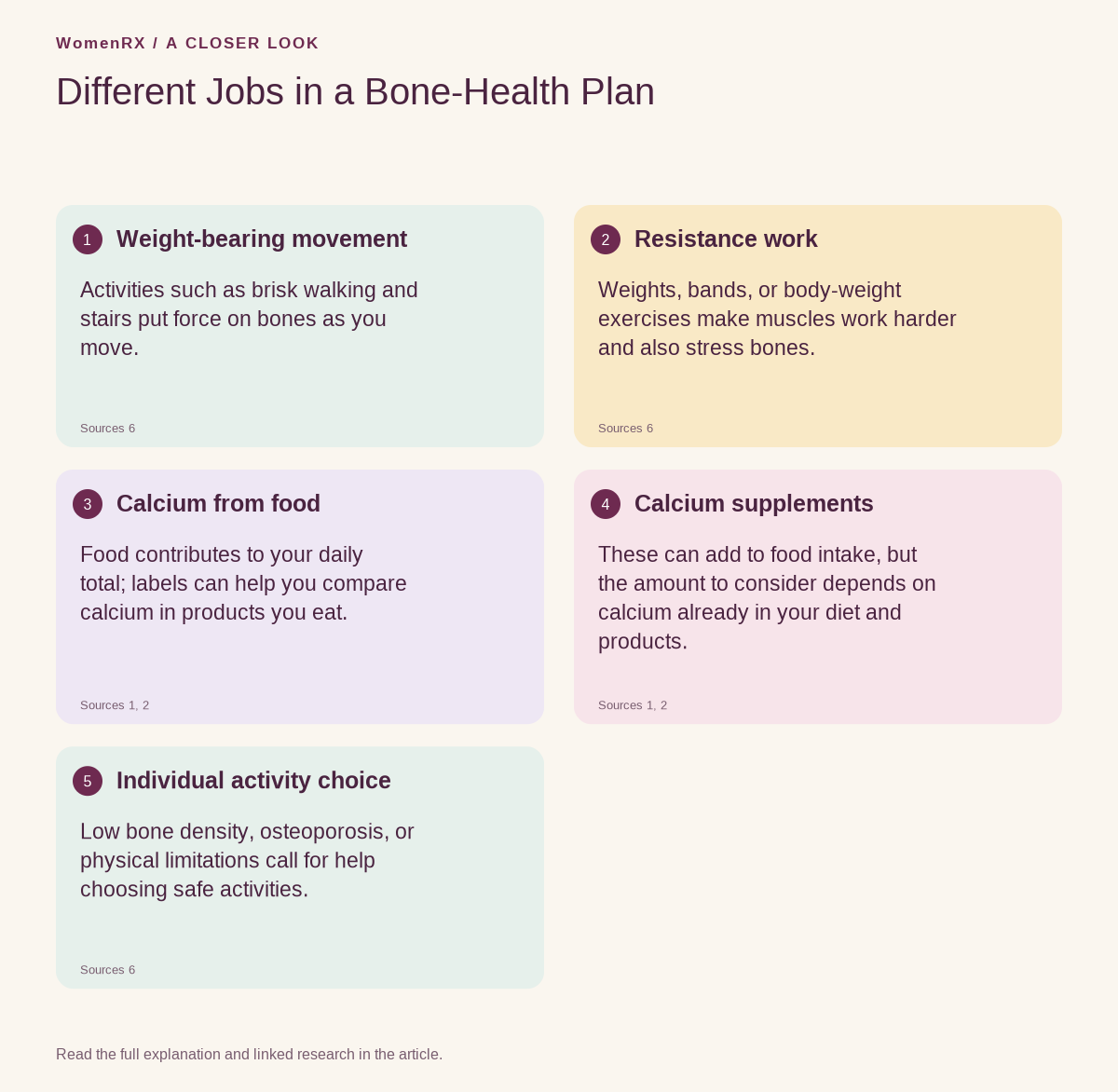
Different Jobs in a Bone-Health Plan
Weight-bearing movement: Activities such as brisk walking and stairs put force on bones as you move.6
Resistance work: Weights, bands, or body-weight exercises make muscles work harder and also stress bones.6
Calcium from food: Food contributes to your daily total; labels can help you compare calcium in products you eat.12
Calcium supplements: These can add to food intake, but the amount to consider depends on calcium already in your diet and products.12
Individual activity choice: Low bone density, osteoporosis, or physical limitations call for help choosing safe activities.6
Read the figure as text
Compare the role of each activity or calcium source, then see which choice depends on your own bone health.- Weight-bearing movement: Activities such as brisk walking and stairs put force on bones as you move.6
- Resistance work: Weights, bands, or body-weight exercises make muscles work harder and also stress bones.6
- Calcium from food: Food contributes to your daily total; labels can help you compare calcium in products you eat.12
- Calcium supplements: These can add to food intake, but the amount to consider depends on calcium already in your diet and products.12
- Individual activity choice: Low bone density, osteoporosis, or physical limitations call for help choosing safe activities.6
More questions, answered
Why does a food label use a different calcium number than the recommendation for women over 50?
US food labels use a calcium Daily Value of 1,300 mg to help people compare products. The recommended dietary allowance for women older than 50 is 1,200 mg a day. Use the label to estimate how a food contributes to your intake, rather than treating its Daily Value as a separate supplement target. 1
Sources you can check
- Calcium - Health Professional Fact SheetAccessed 2026-09-25Return to first citation
- Calcium | MedlinePlusAccessed 2026-09-25Return to first citation
- Benefits of Exercise: MedlinePlusAccessed 2026-09-25Return to first citation
- Bone mineral density assessment by DXA in disease-associated osteoporosis: the limitations.Asadipooya K, Greene LW. · Frontiers in endocrinology · 2026Return to first citation
- Calcium, Vitamin D, and Phosphorus Levels and Bone Health in Adults with Lactose Intolerance: A Systematic Review.Almalki AH, Apekey T, Ranawana V. · Nutrition reviews · 2026Return to first citation
- Exercise for Your Bone Health | NIAMSAccessed 2026-09-25Return to first citation
- How Much Exercise Do I Need?: MedlinePlusAccessed 2026-09-25Return to first citation