Calcium Supplements and Bone Health: When They Help
A supplement may help close a calcium gap, but reaching for one automatically after menopause isn’t the same as preventing a fracture.
Calcium supplements are most relevant when your usual food intake falls short of your age-based daily target. For women, that target is 1,000 mg a day through age 50 and 1,200 mg from age 51 onward, counting food, fortified drinks, supplements, and calcium-containing antacids. Supplements can improve some bone-density measures, but evidence that they prevent fractures is mixed, so higher intake isn’t a guarantee of protection. 1
Start with your total intake, not a supplement bottle
Calcium is part of bone, and bone is continually remodeled. Around menopause, lower estrogen speeds bone breakdown, which is one reason bone loss becomes a greater concern. But that change doesn’t mean every woman needs a calcium pill: the useful first question is how much calcium you already get from food and drinks. 1
The recommended daily intake is 1,000 mg for women ages 19-50 and 1,200 mg for women ages 51 and older. These are totals from all sources, not supplement doses. Milk, yogurt, fortified soy beverages, calcium-set tofu, and canned fish with edible bones can all contribute. Calcium is also found in some antacids, so include those if you use them. 1
For a quick estimate, check serving sizes and calcium amounts on food labels. As examples, an 8-ounce serving of plain yogurt has about 415 mg, and a cup of calcium-fortified soy milk has about 299 mg. Those numbers vary by product, and other foods add to the daily total. A supplement is potentially useful when your usual pattern leaves a consistent shortfall, not simply because you’re in menopause. 1
Bone density and fractures aren’t the same result
Some research finds that calcium, often taken with vitamin D, can increase bone mineral density at certain sites in older adults. Bone density is a useful measure, but a change in that measure does not automatically mean fewer fractures. In studies of older adults, findings on fracture prevention have not been consistent: some reviews reported fewer fractures with calcium plus vitamin D, while others found no reduction. 1
For postmenopausal women, the U.S. Preventive Services Task Force found that daily combinations below 1,000 mg of calcium and 400 IU of vitamin D did not prevent fractures. It judged the evidence for larger amounts insufficient to determine whether they help. That does not show that correcting a low dietary intake has no value; it does mean a supplement shouldn’t be presented as proven fracture protection for every woman. 1
There’s a separate question for women already being treated for osteoporosis. A systematic review of trials in postmenopausal women receiving antiresorptive medicines found no statistically significant association between calcium supplementation and the outcomes it assessed. This evidence applies to women on osteoporosis treatment, not to every woman considering a supplement, and it doesn’t make calcium a replacement for prescribed bone treatment. 3
A practical way to decide whether a supplement adds value
- Estimate a typical day. Add up calcium from foods, fortified drinks, supplements, and calcium-containing antacids. Look at more than one ordinary day if your meals vary.
- Compare it with your age-based target. A gap between your usual intake and the target is a reason to consider how to fill it, not a reason to assume that more is better.
- Consider food options you’ll actually use. Fortified products, dairy foods, tofu made with calcium sulfate, and canned salmon or sardines with bones are examples. Labels matter because calcium content varies.
- If food doesn’t cover the gap, review a supplement choice with your medication list in view. Supplement amounts vary, and calcium carbonate and calcium citrate differ in how they’re absorbed. Calcium carbonate can interfere with levothyroxine absorption; calcium can also affect dolutegravir and quinolone antibiotic absorption. Ask a pharmacist about the specific product and medicines you take. 12
This is a way to identify whether a supplement may fill an intake gap. It doesn’t estimate your personal fracture risk. If you’ve had a fragility fracture, have known osteoporosis, or have been advised to receive treatment, you could ask how calcium intake fits alongside the rest of your care. 13
Keep the tradeoffs in view
Calcium supplements can cause gas, bloating, or constipation. Calcium carbonate appears more likely than calcium citrate to cause these symptoms in some people. Kidney-stone findings are less clear: one large study linked supplemental calcium with more stones, while later evidence reviews did not find the same association. That uncertainty is a reason to avoid adding calcium without checking what you already get, especially if you’ve had kidney stones. 1
The adult upper limit for total calcium intake is 2,500 mg per day through age 50 and 2,000 mg per day from age 51 onward. These are safety ceilings, not goals. Staying below a ceiling doesn’t prove a supplement will prevent fractures, and reaching the daily target doesn’t replace care for osteoporosis. 1
If you’re weighing a supplement, bring a rough food-and-drink estimate and your medication list to a pharmacist or clinician. The useful question is specific: “Given my usual intake and bone-health situation, would a supplement fill a meaningful gap?”
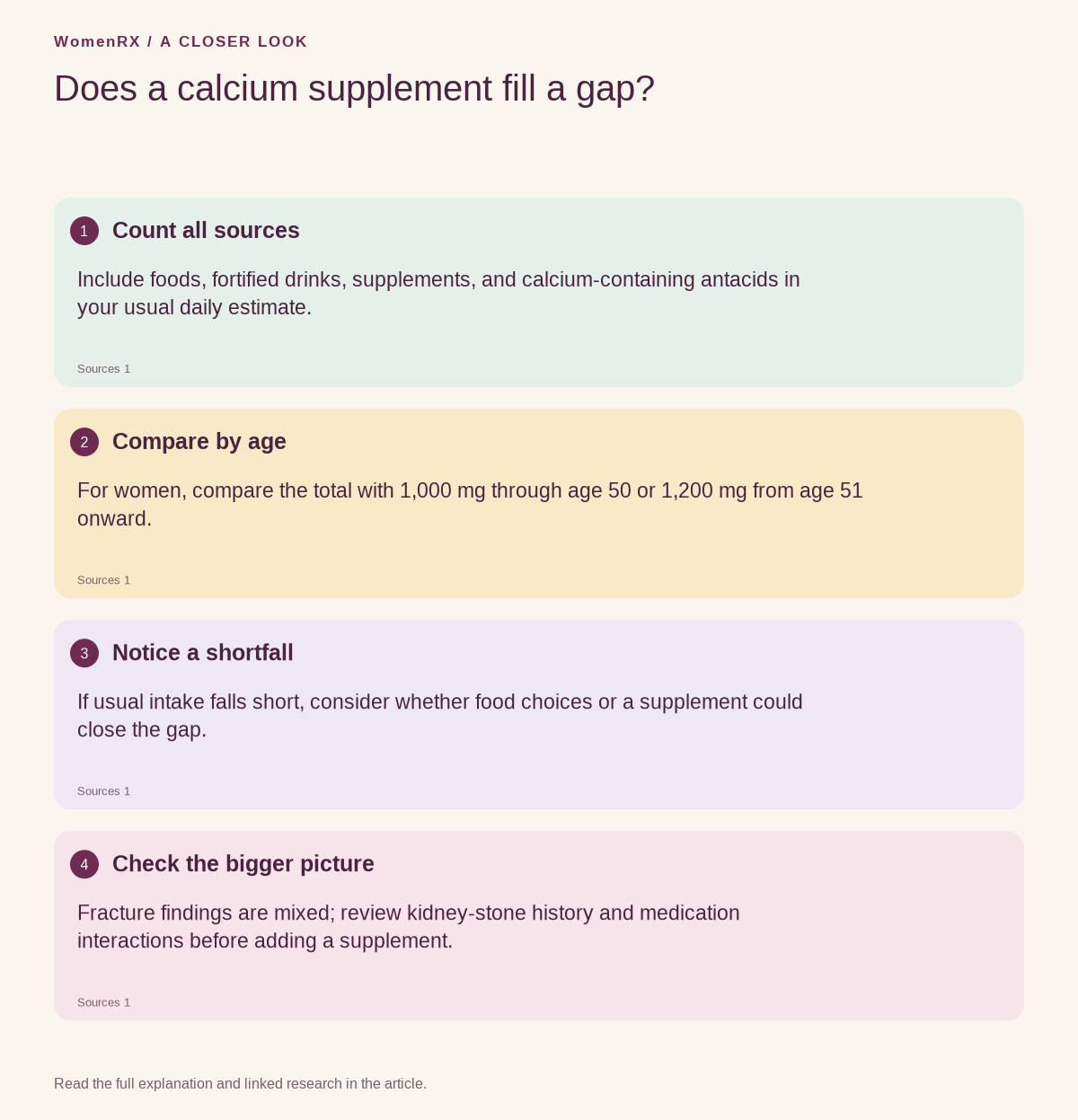
Does a calcium supplement fill a gap?
Count all sources: Include foods, fortified drinks, supplements, and calcium-containing antacids in your usual daily estimate.1
Compare by age: For women, compare the total with 1,000 mg through age 50 or 1,200 mg from age 51 onward.1
Notice a shortfall: If usual intake falls short, consider whether food choices or a supplement could close the gap.1
Check the bigger picture: Fracture findings are mixed; review kidney-stone history and medication interactions before adding a supplement.1
Read the figure as text
A simple route from daily intake to a more informed supplement question.- Count all sources: Include foods, fortified drinks, supplements, and calcium-containing antacids in your usual daily estimate.1
- Compare by age: For women, compare the total with 1,000 mg through age 50 or 1,200 mg from age 51 onward.1
- Notice a shortfall: If usual intake falls short, consider whether food choices or a supplement could close the gap.1
- Check the bigger picture: Fracture findings are mixed; review kidney-stone history and medication interactions before adding a supplement.1
More questions, answered
Can a blood calcium test tell me whether I eat enough calcium?
Not reliably. Blood calcium is tightly regulated and generally doesn’t reflect how much calcium you get from food. A bone-density scan measures bone mineral density, which provides different information and may be relevant to assessing bone health. 1
Does calcium citrate work better than calcium carbonate?
Neither is universally better. Calcium citrate is less dependent on stomach acid for absorption; carbonate may be less suitable for some people with low stomach acid and can cause more gastrointestinal symptoms. Check the product’s calcium amount and consider your medicines and tolerance when comparing forms. 12
Sources you can check
- Calcium - Health Professional Fact SheetAccessed 2026-09-25Return to first citation
- Calcium | MedlinePlusAccessed 2026-09-25Return to first citation
- Vitamin D and calcium supplementation in women undergoing pharmacological management for postmenopausal osteoporosis: a level I of evidence systematic review.Migliorini F, Maffulli N, Colarossi G, Filippelli A, Memminger M, Conti V. · European journal of medical research · 2025Return to first citation