Calcium After Menopause: Count Food Before Supplements
For most women age 51 and older, the daily calcium target is 1,200 mg from food and supplements combined, so a few label checks can show whether you have a gap.
If you’re 51 or older, aim for 1,200 mg of calcium a day from food and supplements combined; women ages 19 to 50 need 1,000 mg. Add up calcium in the foods and drinks you usually have, then consider a supplement only for the shortfall. If you do use one, check the elemental calcium amount on its label. 1
Start with your age-based target
The recommended daily amount is 1,200 mg for women ages 51 and older, including women over 70. For women ages 19 to 50, it’s 1,000 mg. These amounts are totals from food, drinks, and supplements, not supplement targets. Menopause can speed bone loss as estrogen levels fall, but that doesn’t mean every postmenopausal woman needs a calcium pill. 1
Think of the target as a way to check your usual intake, not a score for your bones. Meeting it doesn’t tell you your bone density or whether you have osteoporosis. Calcium is one part of bone health, so keep your intake in the context of any bone-health concerns or care plan you already have. 1
Add up what you actually eat
Look at a typical day rather than one unusually calcium-rich meal. Check food and drink labels, and note the serving sizes you really use. Calcium-fortified soy beverages, juices, cereals, and some tofu can contribute; amounts vary by product, so use the label rather than assuming all brands are alike. Dairy foods, canned fish with edible bones, and some vegetables are other options. 1
For a rough example, 8 ounces of plain low-fat yogurt provides about 415 mg, a cup of calcium-fortified soy milk about 299 mg, and a half-cup of tofu made with calcium sulfate about 253 mg. Together, that’s about 967 mg. For a woman 51 or older, that example day would be roughly 233 mg below the 1,200 mg target. These are example values, not guarantees for every product or serving. 1
When you add foods, don’t assume every plant source provides calcium equally well. The body absorbs less calcium from some foods, including spinach, because of compounds that bind calcium. The NIH reference notes that calcium absorption from spinach is lower than from milk, while absorption from kale and broccoli is more similar to milk. That doesn’t mean you need to avoid spinach; it’s a reason not to count it as equivalent to every other calcium-rich choice. 1
If there’s a gap, read the supplement label
If your usual food intake falls short, a supplement may help fill the difference. Check the Supplement Facts panel for calcium, which lists elemental calcium. You don’t need to work out how much calcium is in the compound: calcium carbonate and calcium citrate have different calcium percentages by weight, but the label gives the amount that counts toward your daily total. 1
For example, if your food estimate is about 967 mg and your target is 1,200 mg, the gap is about 233 mg. That calculation can help you look for an amount that fits the gap rather than automatically choosing a larger serving. It’s an estimate based on your usual intake, and a supplement is not necessary just because you’re postmenopausal.
The amount taken at one time matters for absorption. Calcium from supplements is absorbed best in amounts of 500 mg or less at a time. If a plan you’ve discussed involves more than that from supplements in a day, dividing it into smaller amounts may be worth discussing rather than taking it all at once. 12
Calcium carbonate is absorbed best with food and may be less well absorbed when stomach acid is low. Calcium citrate is less dependent on stomach acid and can be taken without food. Supplements can cause gas, bloating, or constipation for some people; the form, amount, and whether it’s taken with food may affect tolerability. 12
Keep the calculation in perspective
A calcium estimate answers a specific question: are you getting roughly the recommended amount? It doesn’t measure bone density or decide whether you need osteoporosis treatment. If you’ve had a low-trauma fracture, have a diagnosis of osteoporosis, or aren’t sure how your calcium intake fits into your bone-health plan, bring the food-and-label estimate to a care professional who can consider it alongside your overall situation. The useful next step may be changing a food choice, discussing a small supplement amount, or reviewing bone health more broadly, not simply adding more calcium. 1
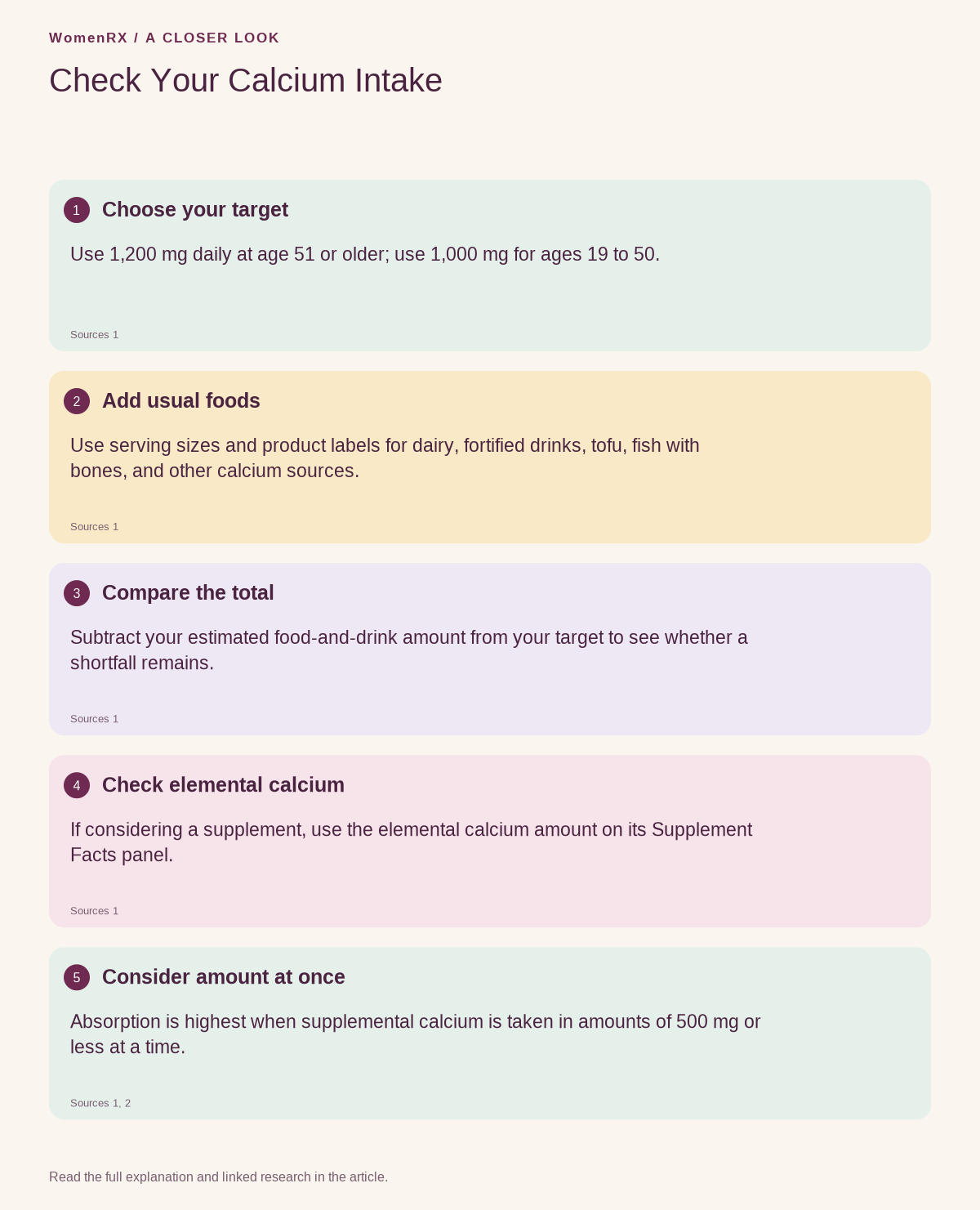
Check Your Calcium Intake
Choose your target: Use 1,200 mg daily at age 51 or older; use 1,000 mg for ages 19 to 50.1
Add usual foods: Use serving sizes and product labels for dairy, fortified drinks, tofu, fish with bones, and other calcium sources.1
Compare the total: Subtract your estimated food-and-drink amount from your target to see whether a shortfall remains.1
Check elemental calcium: If considering a supplement, use the elemental calcium amount on its Supplement Facts panel.1
Consider amount at once: Absorption is highest when supplemental calcium is taken in amounts of 500 mg or less at a time.12
Read the figure as text
Use this food-first sequence to estimate whether your usual intake is near your age-based target and whether a supplement gap remains.- Choose your target: Use 1,200 mg daily at age 51 or older; use 1,000 mg for ages 19 to 50.1
- Add usual foods: Use serving sizes and product labels for dairy, fortified drinks, tofu, fish with bones, and other calcium sources.1
- Compare the total: Subtract your estimated food-and-drink amount from your target to see whether a shortfall remains.1
- Check elemental calcium: If considering a supplement, use the elemental calcium amount on its Supplement Facts panel.1
- Consider amount at once: Absorption is highest when supplemental calcium is taken in amounts of 500 mg or less at a time.12
More questions, answered
Do calcium-containing antacids count toward my daily total?
Yes. Some antacids contain calcium carbonate, so include them when estimating your total. The calcium amount can vary by product and strength; check the label rather than assuming each tablet contains the same amount. 1
Should I take calcium even if my food estimate meets the target?
Not automatically. The recommended amount is a total from food and supplements combined. If your usual intake meets your age-based target, adding a supplement could increase your total without filling a gap. 1
Sources you can check
- Calcium - Health Professional Fact SheetAccessed 2026-09-25Return to first citation
- Calcium | MedlinePlusAccessed 2026-09-25Return to first citation