Calcium-Rich Foods: Build a Practical Daily Intake
Compare calcium in everyday servings, then choose a mix that fits your age and eating style.
Most women ages 19-50 need 1,000 mg of calcium a day; women 51 and older need 1,200 mg. Dairy, calcium-set tofu, canned fish with bones, some greens, and fortified foods can all contribute. Use serving sizes and product labels to estimate your intake, while remembering that the amount listed isn’t always the amount your body absorbs. 12

Start with the amount for your age
For healthy girls ages 9-18, the recommended daily amount is 1,300 mg. For women ages 19-50, it’s 1,000 mg; for women 51 and older, it’s 1,200 mg. Pregnancy and lactation don’t change the listed amount for ages 14-18 or 19-50. The reference table doesn’t list pregnancy or lactation values for ages 9-13, so don’t assume those entries apply to that age group. 1
These recommendations are daily totals from food and drinks, not a target that one meal needs to meet. They’re general guidance for healthy people; a bone-health condition may call for an individualized plan.
Compare ordinary servings
Dairy offers several substantial servings: 8 ounces of plain low-fat yogurt provides 415 mg of calcium, 1 cup of nonfat milk provides 299 mg, and 1.5 ounces of part-skim mozzarella provides 333 mg. Milk’s calcium content varies a little with fat content. 1
Nondairy foods can add meaningful amounts, too. A half-cup of firm tofu made with calcium sulfate provides 253 mg; a half-cup of soft tofu made with that calcium salt provides 138 mg. Three ounces of canned sardines with bones provides 325 mg, and 3 ounces of canned salmon with bones provides 181 mg. One cup of cooked kale provides 94 mg. 1
Fortified products vary, so check the label for the serving you actually use. In the reference food table, 1 cup of calcium-fortified soy milk provides 299 mg, 1 cup of calcium-fortified orange juice provides 349 mg, and a serving of cereal fortified with 10% of the Daily Value provides 130 mg. The Daily Value helps compare labels; it isn’t the same as your age-specific recommendation. 1
For example, 1 cup of fortified soy milk, a half-cup of firm calcium-set tofu, and 1 cup of cooked kale add up to 646 mg using those table values. That’s a useful contribution, not a full day’s total. Actual products may differ, and other foods and drinks count too. 1
Calcium on the label is not the whole story
A food’s listed calcium is the amount in the serving, not a direct measure of how much your body absorbs. Absorption varies by food. The NIH reference estimates that about 30% of calcium from dairy and fortified foods is absorbed on average. It gives spinach as an example of a high-oxalate plant: estimated absorption is 5%, compared with 27% from milk. By contrast, calcium absorption from lower-oxalate greens such as kale, broccoli, and cabbage is described as similar to milk, even though these vegetables generally provide less calcium per serving. 1
That doesn’t mean you need to avoid spinach or calculate absorbed calcium at every meal. It does help explain why two foods with similar listed amounts may not contribute identically. Eating a range of foods is likely to make these plant-compound effects of little or no nutritional consequence. 1
Fortification details can matter as well. A laboratory digestion study of 25 plant-based products found wide variation in calcium bioaccessibility, including low values for some tested fortified beverages. The researchers linked some of that variation to the calcium compound used. This was an in-vitro study, not a measurement of absorption in people, and its results don’t describe every fortified drink on the market. Treat the product’s label as a starting point, not a guarantee that all sources behave alike. 2
Tofu is another example where the details matter: the calcium values above apply to tofu made with calcium sulfate. Tofu made with other salts may provide little calcium, so check the product’s nutrition information rather than assuming all tofu has the same amount. 1
Make a mix that suits your routine
If you eat dairy, yogurt, milk, and cheese are straightforward options. If you avoid it, you can combine choices from different categories, such as a fortified beverage, calcium-set tofu, kale or bok choy, and fortified cereal. Canned fish with bones is another option if you eat fish. No single food has to supply the whole day.
If lactose is the issue, lactose-free or reduced-lactose dairy products contain the same amounts of calcium as regular dairy products. If you avoid dairy because of an allergy or preference, fortified foods and nondairy sources can help you build your intake across the day. 1
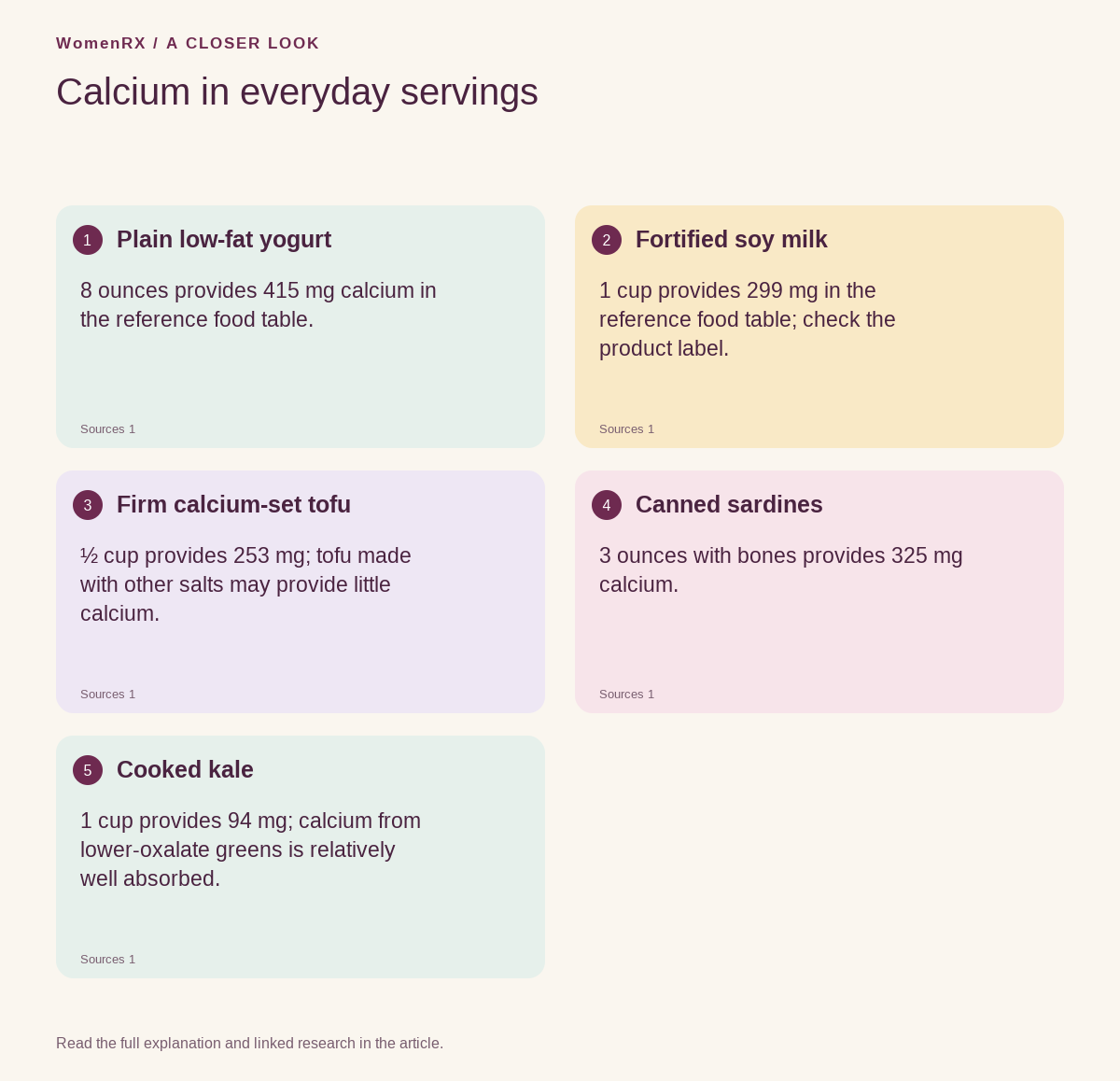
Calcium in everyday servings
Plain low-fat yogurt: 8 ounces provides 415 mg calcium in the reference food table.1
Fortified soy milk: 1 cup provides 299 mg in the reference food table; check the product label.1
Firm calcium-set tofu: ½ cup provides 253 mg; tofu made with other salts may provide little calcium.1
Canned sardines: 3 ounces with bones provides 325 mg calcium.1
Cooked kale: 1 cup provides 94 mg; calcium from lower-oxalate greens is relatively well absorbed.1
Read the figure as text
Compare listed calcium amounts across familiar food choices. These are serving values, not estimates of how much an individual absorbs.- Plain low-fat yogurt: 8 ounces provides 415 mg calcium in the reference food table.1
- Fortified soy milk: 1 cup provides 299 mg in the reference food table; check the product label.1
- Firm calcium-set tofu: ½ cup provides 253 mg; tofu made with other salts may provide little calcium.1
- Canned sardines: 3 ounces with bones provides 325 mg calcium.1
- Cooked kale: 1 cup provides 94 mg; calcium from lower-oxalate greens is relatively well absorbed.1
Sources you can check
- Calcium - Health Professional Fact SheetAccessed 2026-09-25Return to first citation
- A comparison of the bioaccessible calcium supplies of various plant-based products relative to bovine milk.Muleya M, F Bailey E, H Bailey E. · Food research international (Ottawa, Ont.) · 2024Return to first citation