Vitamin D for Women: Daily Intake, Testing, and When to Supplement
For most adults, the daily target is 600 IU through age 70 and 800 IU after 70, but a test result or risk factor doesn’t automatically tell you what supplement dose to take.
In the U.S., the recommended daily intake is 600 IU for women ages 19 to 70, including during pregnancy and breastfeeding, and 800 IU after age 70. Those amounts include food and supplements and assume little sun exposure. A test result is a separate question: levels below 12 ng/mL raise concern for deficiency, but results and risk factors need context rather than an automatic dose. 12
Start with the daily target, not a supplement bottle
For most women ages 19 to 70, the recommended dietary allowance (RDA) for vitamin D is 600 IU (15 mcg) a day. After age 70, it’s 800 IU (20 mcg) a day. The same 600 IU RDA applies during pregnancy and breastfeeding. These amounts refer to total daily intake from food and supplements, not a dose everyone needs to take as a pill. The recommendations were set assuming minimal sun exposure. 1
Vitamin D helps your body absorb calcium, which supports bone mineralization. In the U.S., fortified foods such as milk and some plant milks or cereals contribute vitamin D; fatty fish is another source. Check labels because fortification varies. Sunlight can also contribute, but the amount your skin makes depends on factors such as season, skin pigmentation, and time outdoors. There isn’t a reliable one-size-fits-all sun-exposure target, and UV exposure carries skin-cancer risk. 12
A practical first step is to look at the vitamin D in the foods and supplements you already use. For example, if you take a multivitamin and eat fortified foods, add those sources together before deciding whether you need another supplement. The goal is to meet the recommended intake, not to push your total higher without a reason.
When your situation may call for an assessment
Some circumstances make low vitamin D more likely: very limited sun exposure, older age, darker skin, obesity, gastric bypass, or a condition that affects fat absorption, such as celiac or Crohn’s disease. Liver or kidney disease and some medicines can also affect vitamin D absorption, processing, or levels. These factors are reasons to consider your individual situation, not proof that you are deficient or that you need a particular dose. 12
If one applies to you, ask whether testing would change what you do next. The usual blood test measures 25-hydroxyvitamin D, also called 25(OH)D. Routine testing isn’t recommended for every healthy person without a specific reason; the U.S. Preventive Services Task Force has found insufficient evidence to assess the benefits and harms of screening asymptomatic adults. 1
Testing may be more useful when a medical condition, procedure, or treatment could affect vitamin D status or when a result would guide a care plan. If you have a known risk factor, the useful question is not simply “Should I get tested?” but “Would the result change whether or how I supplement?” 12
Read a result as a clue, not a dose
The NIH Office of Dietary Supplements summarizes National Academies thresholds this way: a 25(OH)D level below 12 ng/mL is associated with deficiency risk; 12 to below 20 ng/mL may be inadequate for some people; and 20 ng/mL or higher is sufficient for most people. These are population reference points, not a universal treatment plan or a guarantee of health for an individual. The amount considered optimal for every person has not been established, and lab tests can vary. 1
That’s why a low result shouldn’t be translated into the same supplement dose for everyone. A clinician may consider the level, why it was checked, your health conditions, and what you already take. If deficiency is diagnosed, treatment amounts and duration are different from routine intake guidance and should be directed for your situation. 12
Pregnancy, breastfeeding, and after menopause
Pregnancy and breastfeeding: The RDA for the mother is 600 IU daily, the same as for other adults through age 70. That recommendation doesn’t mean every pregnant or breastfeeding woman needs an additional 600-IU pill on top of food, prenatal vitamins, and other supplements. Check the total in your current products rather than doubling up. Separately, breastfed infants generally need their own vitamin D supplement; the infant recommendation is not a higher maternal dose. 12
Postmenopause: Menopause does not, by itself, change the RDA. Age does: it rises to 800 IU after 70. Vitamin D supports calcium absorption, but that doesn’t mean a supplement alone prevents fractures for every postmenopausal woman. Studies of vitamin D and calcium supplements show small increases in bone mineral density in some groups, while fracture findings for people living in the community are inconsistent. If you have osteoporosis or a history of fracture, vitamin D is one part of a broader bone-health discussion, not a substitute for an individualized plan. 1
Keep safety in the picture
For adults, the tolerable upper intake level is 4,000 IU (100 mcg) a day from all sources. That’s a limit, not a target, and taking more is not a shortcut to better bone health. Excessive supplement intake can raise blood calcium and, in severe cases, harm the kidneys. If you take high-dose vitamin D, use several products containing it, or have a condition affecting absorption or kidney function, get advice on your total intake rather than adding another product on your own. 12
The short decision path: Meet the age-based daily intake through food and supplements combined; consider your risk factors; ask about a test only when the result could guide care; and treat a low result as a reason for an individualized plan, not a universal dose.
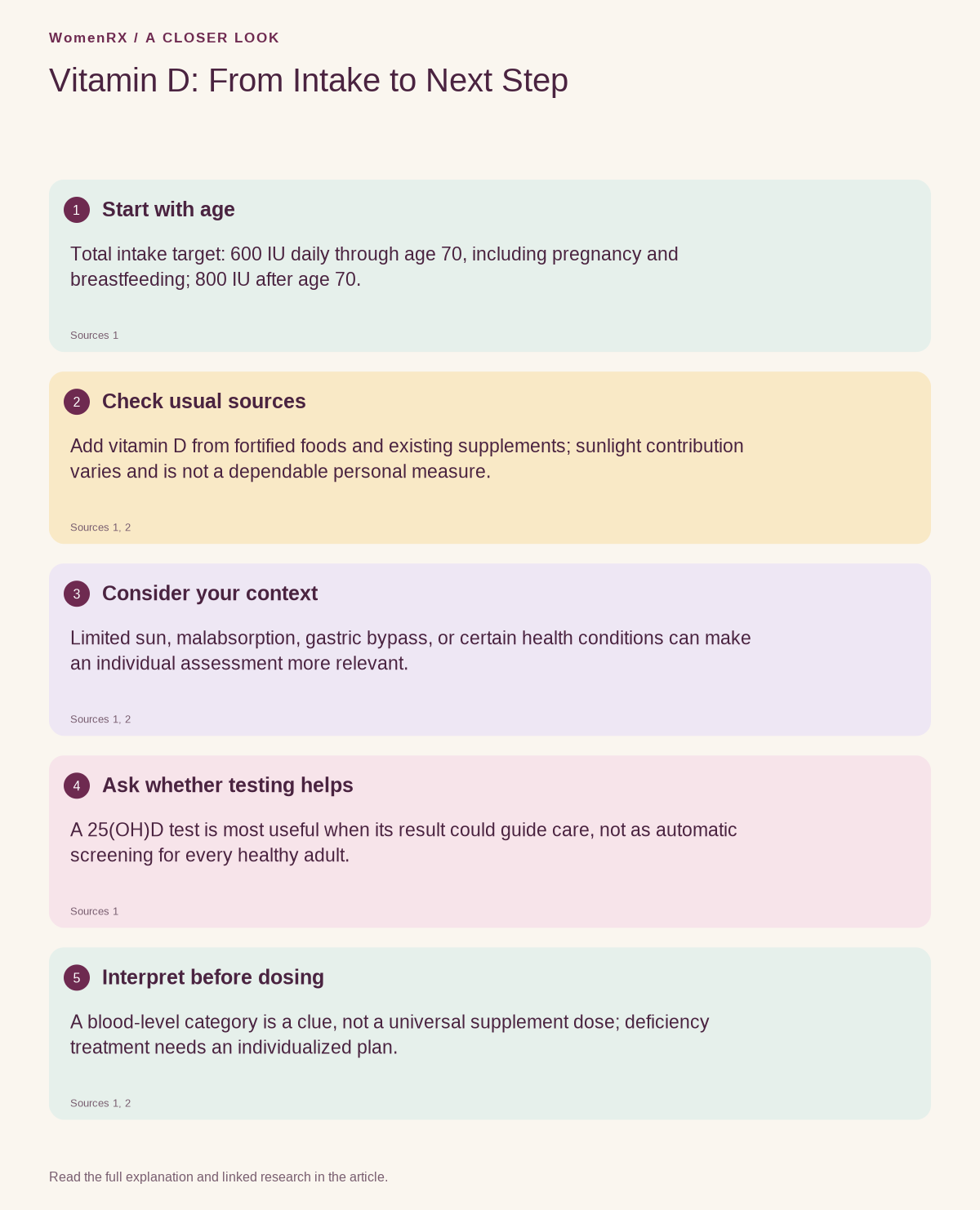
Vitamin D: From Intake to Next Step
Start with age: Total intake target: 600 IU daily through age 70, including pregnancy and breastfeeding; 800 IU after age 70.1
Check usual sources: Add vitamin D from fortified foods and existing supplements; sunlight contribution varies and is not a dependable personal measure.12
Consider your context: Limited sun, malabsorption, gastric bypass, or certain health conditions can make an individual assessment more relevant.12
Ask whether testing helps: A 25(OH)D test is most useful when its result could guide care, not as automatic screening for every healthy adult.1
Interpret before dosing: A blood-level category is a clue, not a universal supplement dose; deficiency treatment needs an individualized plan.12
Read the figure as text
Follow the distinction between an age-based intake target, a reason to consider testing, and a result that may need an individualized plan.- Start with age: Total intake target: 600 IU daily through age 70, including pregnancy and breastfeeding; 800 IU after age 70.1
- Check usual sources: Add vitamin D from fortified foods and existing supplements; sunlight contribution varies and is not a dependable personal measure.12
- Consider your context: Limited sun, malabsorption, gastric bypass, or certain health conditions can make an individual assessment more relevant.12
- Ask whether testing helps: A 25(OH)D test is most useful when its result could guide care, not as automatic screening for every healthy adult.1
- Interpret before dosing: A blood-level category is a clue, not a universal supplement dose; deficiency treatment needs an individualized plan.12
More questions, answered
Does limited sun exposure mean I automatically need a supplement?
Not automatically. The U.S. RDA is based on minimal sun exposure, and it describes total intake from food and supplements. Review your usual food and supplement sources, then consider whether personal risk factors or a medical condition make an assessment useful. 12
Is 20 ng/mL the right vitamin D level for every woman?
No single blood level is established as optimal for everyone. The National Academies consider 20 ng/mL or higher sufficient for most people, but age, health context, and variability between lab assays affect how a result should be interpreted. 1
Sources you can check
- Vitamin D - Health Professional Fact SheetAccessed 2026-09-25Return to first citation
- Vitamin D Deficiency: MedlinePlusAccessed 2026-09-25Return to first citation