When Vitamin D Supplements May Be Useful
Vitamin D supports bone health, but a supplement makes the most sense when it addresses a real intake gap or a specific risk, not an unspecified wellness goal.
Vitamin D helps your body absorb calcium and maintain healthy bones. A supplement may be useful when your food intake is low or you have factors that raise the chance of deficiency, such as limited sun exposure, a condition affecting absorption, or gastric bypass. During pregnancy, the Endocrine Society recommends routine supplementation, while the 600 IU daily recommendation is a total-intake target, not a treatment dose. 1
Start with the reason you’re considering it
Vitamin D has a clear job: it helps your body absorb calcium, which supports bone mineralization. Too little can cause rickets in children and osteomalacia, a softening of the bones, in adults. That makes preventing or treating deficiency different from taking vitamin D in hopes of improving mood or preventing cancer. Clinical trials have not shown that supplements prevent or treat depressive symptoms, and generally have not shown that they prevent cancer. 1
For healthy adults, the recommended daily amount is 600 IU from all sources through age 70, and 800 IU after age 70. The recommendation is 600 IU during pregnancy and lactation, too. It’s a target for total intake, not a treatment dose for a low blood level. 1
Who may have a more specific reason to consider it?
It’s worth looking at your usual intake and personal risk if you rarely eat vitamin-D-fortified foods, have limited sun exposure, or are older. Vitamin D deficiency is also more likely with conditions that interfere with absorbing fat, such as celiac disease or Crohn’s disease, and after gastric bypass. Obesity is associated with lower blood levels as well. People with darker skin may make less vitamin D from sunlight, although the health effects of lower blood levels in this group aren’t fully clear. 1
Many US diets get vitamin D from fortified foods such as milk and some plant-based beverages, cereals, and other products. Check the Nutrition Facts label rather than assuming a food is fortified. Fatty fish also provides vitamin D. Sunlight contributes, but the amount your skin makes varies with factors such as season, time of day, skin pigmentation, and cloud cover. Because UV exposure raises skin-cancer risk, it isn’t a dependable reason to skip sun protection. 12
If you’re pregnant, the Endocrine Society recommends routine vitamin D supplementation. That recommendation is distinct from the 600 IU daily target for total intake from food and supplements, and it doesn’t specify a separate supplement dose. A low test result or a risk factor may call for an individualized plan to address deficiency. If you’re breastfeeding, the adult recommended intake is still 600 IU daily from all sources. Breast milk alone doesn’t ordinarily provide enough vitamin D for an infant: the American Academy of Pediatrics recommends 400 IU daily for exclusively and partially breastfed infants, starting shortly after birth. Your intake and the baby’s supplementation are separate questions. 1
After menopause, bone loss becomes a more pressing concern, but vitamin D is only one part of bone health. It supports calcium absorption, and inadequate vitamin D can contribute to bone problems. Trials of vitamin D with calcium have found small increases in bone mineral density in some older adults, but whether supplements prevent fractures for people living in the community remains uncertain. In a large trial of generally healthy older adults, vitamin D alone did not reduce fractures over a median follow-up of 5.3 years; most participants had sufficient levels at the start. 1
What a blood test can tell you
When a test is warranted, the main test is serum 25-hydroxyvitamin D, written as 25(OH)D. It reflects vitamin D from food, supplements, and the body’s own production. The active hormone test, 1,25-dihydroxyvitamin D, usually isn’t the right way to check vitamin D stores. 1
There isn’t one universally settled blood-level cutoff that answers every question about bone or overall health. The National Academies consider 20 ng/mL or more sufficient for most people and identify levels below 12 ng/mL as a risk for deficiency; results between those levels may indicate inadequacy. These are population-level reference points, not a complete diagnosis. Lab methods can vary, and a result needs to be considered alongside your health, risk factors, and reason for testing. 1
Routine testing isn’t recommended for every healthy person without symptoms or an identified risk. For asymptomatic adults, evidence is insufficient to determine whether screening improves health outcomes, and the Endocrine Society does not recommend routine testing in healthy individuals. Testing is more useful when the result could help guide care, such as when a condition or procedure raises your risk of deficiency. 1
A practical conversation about supplements
If you’re considering a supplement, bring the reason you’re considering it, your usual sources of vitamin D, and any test results to the conversation. Ask whether your risk factors justify testing, whether a result changes the plan, and how much vitamin D you already get from foods and other supplements. If you have a low result or a condition that affects absorption, ask what dose and follow-up make sense for you. The right plan depends on the reason for supplementation; there isn’t one treatment dose for everyone.
More isn’t automatically better. The adult upper intake level is 4,000 IU a day from all sources, including during pregnancy and lactation. That’s an upper limit for usual intake, not a recommended target. Excessive supplement intake can cause high calcium levels and, in severe cases, kidney and heart problems. 1
If you take orlistat, corticosteroids such as prednisone, or a thiazide diuretic, mention it when discussing vitamin D. Orlistat can reduce absorption; corticosteroids can affect vitamin D metabolism and calcium absorption; and thiazides combined with vitamin D may raise the risk of high calcium, particularly in some older adults or people with kidney problems. 1
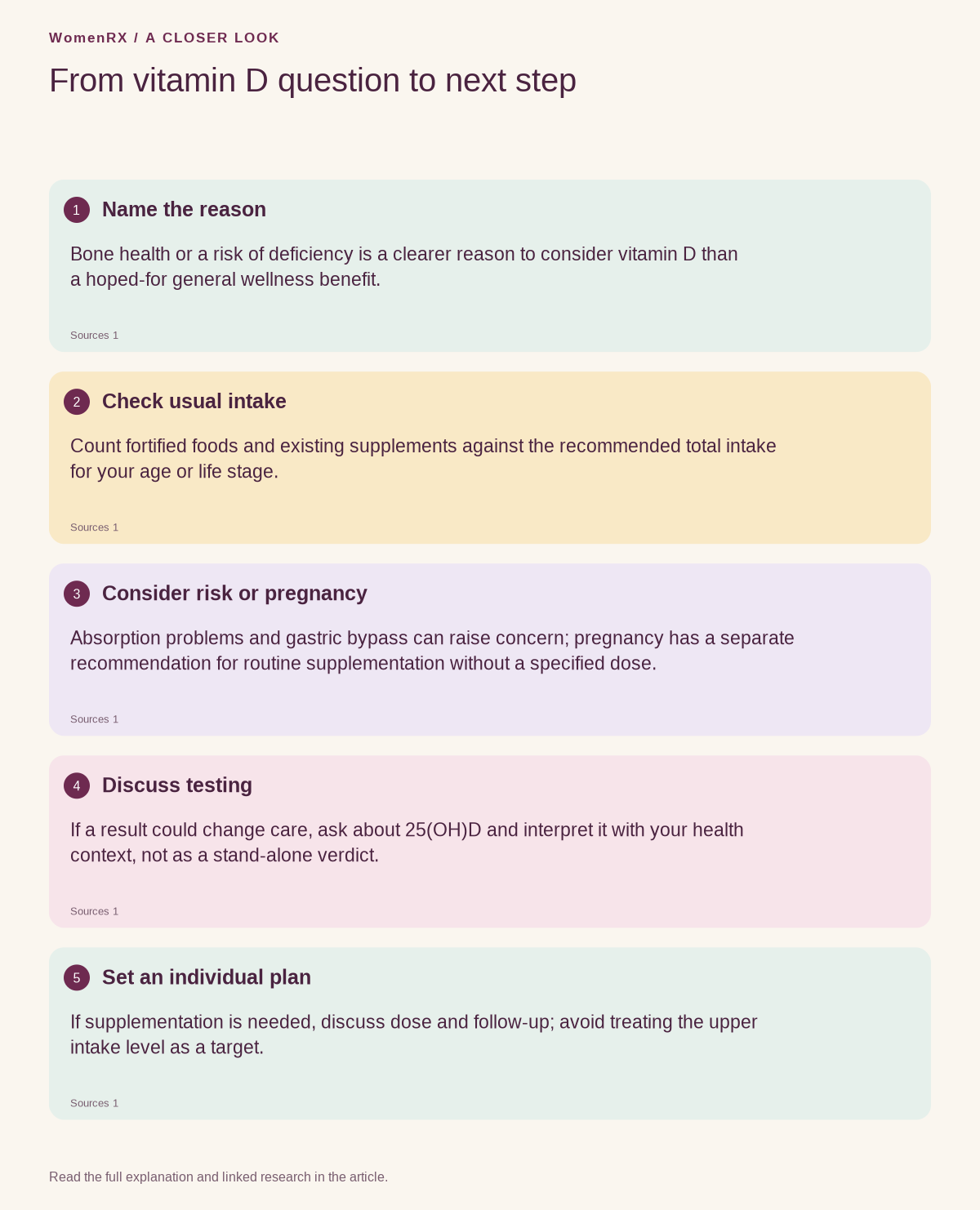
From vitamin D question to next step
Name the reason: Bone health or a risk of deficiency is a clearer reason to consider vitamin D than a hoped-for general wellness benefit.1
Check usual intake: Count fortified foods and existing supplements against the recommended total intake for your age or life stage.1
Consider risk or pregnancy: Absorption problems and gastric bypass can raise concern; pregnancy has a separate recommendation for routine supplementation without a specified dose.1
Discuss testing: If a result could change care, ask about 25(OH)D and interpret it with your health context, not as a stand-alone verdict.1
Set an individual plan: If supplementation is needed, discuss dose and follow-up; avoid treating the upper intake level as a target.1
Read the figure as text
A simple route from the reason you’re considering vitamin D to an intake check, possible testing, and an individualized plan, with a distinct path for pregnancy.- Name the reason: Bone health or a risk of deficiency is a clearer reason to consider vitamin D than a hoped-for general wellness benefit.1
- Check usual intake: Count fortified foods and existing supplements against the recommended total intake for your age or life stage.1
- Consider risk or pregnancy: Absorption problems and gastric bypass can raise concern; pregnancy has a separate recommendation for routine supplementation without a specified dose.1
- Discuss testing: If a result could change care, ask about 25(OH)D and interpret it with your health context, not as a stand-alone verdict.1
- Set an individual plan: If supplementation is needed, discuss dose and follow-up; avoid treating the upper intake level as a target.1
More questions, answered
Which vitamin D blood test should I ask about?
The usual test for vitamin D status is serum 25-hydroxyvitamin D, or 25(OH)D. The active-form test, 1,25-dihydroxyvitamin D, generally isn’t a good measure of vitamin D stores. 1
Does vitamin D3 work better than D2?
Both forms can raise blood levels. Evidence summarized by NIH indicates that D3 tends to raise those levels more and maintain them longer than D2. That difference doesn’t make a particular form or dose right for everyone. 12
Sources you can check
- Vitamin D - Health Professional Fact SheetAccessed 2026-09-25Return to first citation
- Vitamin D: MedlinePlusAccessed 2026-09-25Return to first citation