Vitamin D and Fatigue: When It May Matter
Vitamin D may be relevant when you have a deficiency, but feeling tired doesn’t tell you whether your level is low.
Vitamin D is most relevant to fatigue when a deficiency is identified, but fatigue alone can’t diagnose one. A trial in perimenopausal women with vitamin D deficiency reported improved fatigue after supplementation, though it doesn’t show that vitamin D helps everyone who feels tired. If fatigue lasts for weeks, consider a broader assessment of possible causes, including sleep problems, pregnancy, anemia, and mood. 2 5
Fatigue doesn’t point to one vitamin
Vitamin D helps your body absorb calcium and also has roles in muscle, nerve, and immune function. But tiredness isn’t a specific sign of low vitamin D. Fatigue can follow poor sleep or stress, and it can also occur with pregnancy, anemia, thyroid disease, depression, sleep disorders, and other conditions. 1 2
That distinction matters: correcting a confirmed deficiency is different from taking vitamin D as a general energy supplement. A tired feeling by itself can’t tell you which situation you’re in.
What the research can, and can’t, say
One randomized, double-blind, placebo-controlled trial studied 100 perimenopausal women with vitamin D deficiency. The researchers reported improvements in fatigue and mood in the vitamin D group compared with placebo after six months. The abstract doesn’t report how large the fatigue improvement was. And a finding in women with deficiency at this life stage doesn’t establish that supplementation will help women with normal vitamin D levels, or people whose fatigue has another cause. 5
A separate year-long trial offers a different kind of comparison. It included 75 African American adults with type 2 diabetes and vitamin D levels below 25 ng/mL. Participants received one of two vitamin D supplement amounts; the higher-amount group did not have significantly different mental or functional health scores from the lower-amount group. Because both groups received vitamin D, this trial doesn’t tell us whether supplementation works better than no supplementation for fatigue. 4
Together, these studies offer a reason to take deficiency seriously, not a basis for treating vitamin D as a reliable energy boost for anyone who feels tired.
When testing may be worth discussing
A blood test measuring 25-hydroxyvitamin D is the main indicator of vitamin D status. Experts don’t use a single settled threshold for every purpose, and optimal levels for general health haven’t been established. The NIH Office of Dietary Supplements summarizes the Endocrine Society’s position that healthy people don’t need routine testing. That doesn’t mean testing is never useful; whether it fits depends on your health and risk factors. 3
Limited sun exposure, difficulty absorbing nutrients, and some medicines can raise the chance of deficiency. These factors can make vitamin D worth discussing, but they don’t prove it’s the reason you’re tired. 1 3
If a deficiency is found, treatment may involve supplements. The amount and duration depend on individual circumstances, so avoid taking extra vitamin D simply in hopes of gaining energy. Very high levels can raise calcium in the blood and damage the kidneys. 1
Keep the wider picture in view
If fatigue has lasted for weeks or is getting in the way of your usual activities, arrange an evaluation rather than assuming vitamin D is the answer. A clinician can ask about sleep, daily activities, appetite, and exercise, and decide whether an exam or lab tests could help identify the cause. 2
Pregnancy is one possible context for fatigue, and anemia is another. If you’re pregnant, recently gave birth, or notice that fatigue coincides with a change in menstrual bleeding, include that context when describing what’s going on. Those details can help frame a broader assessment; they don’t establish vitamin D deficiency. 2
The useful question isn’t just “Should I take vitamin D?” It’s “Is deficiency plausible in my situation, and what else could explain this fatigue?”
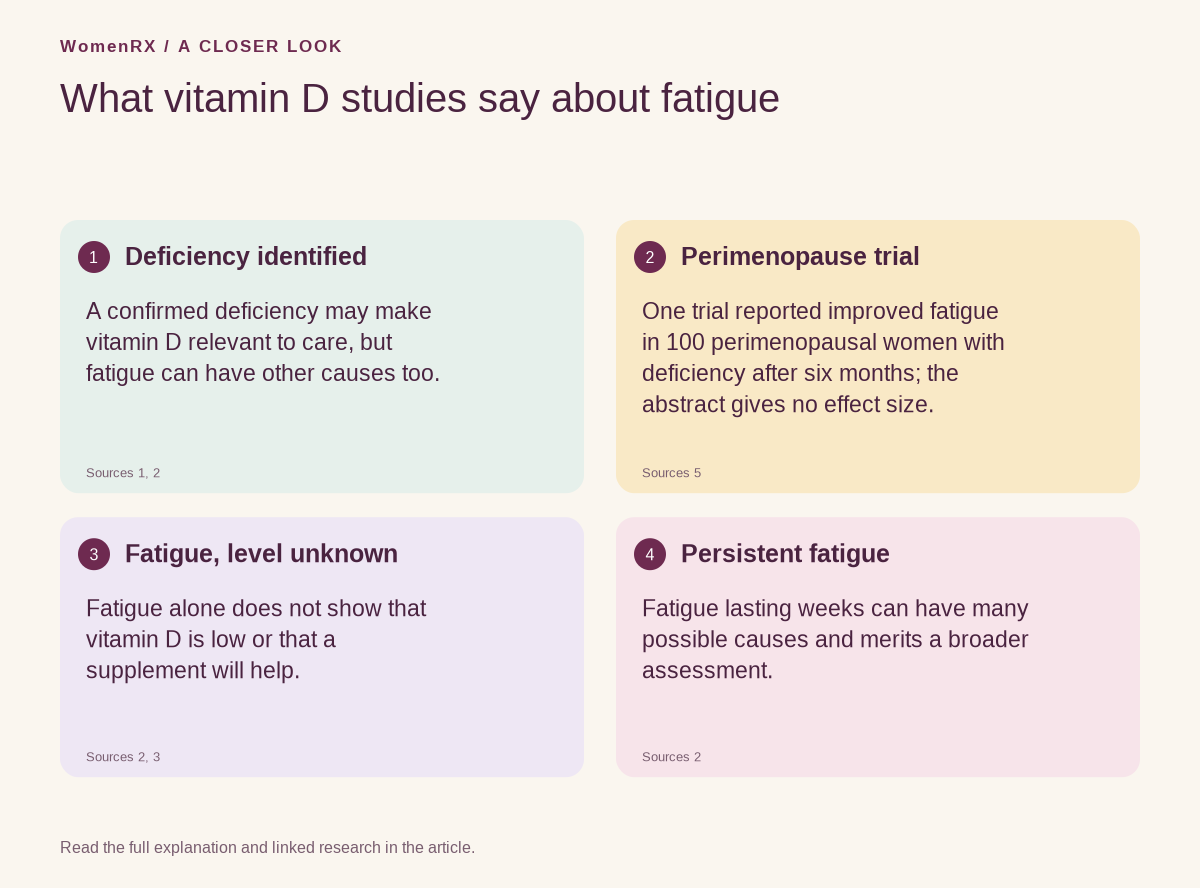
What vitamin D studies say about fatigue
Deficiency identified: A confirmed deficiency may make vitamin D relevant to care, but fatigue can have other causes too.12
Perimenopause trial: One trial reported improved fatigue in 100 perimenopausal women with deficiency after six months; the abstract gives no effect size.5
Fatigue, level unknown: Fatigue alone does not show that vitamin D is low or that a supplement will help.23
Persistent fatigue: Fatigue lasting weeks can have many possible causes and merits a broader assessment.2
Read the figure as text
The key distinction is between a reported result in people with deficiency and what can be concluded about fatigue more broadly.- Deficiency identified: A confirmed deficiency may make vitamin D relevant to care, but fatigue can have other causes too.12
- Perimenopause trial: One trial reported improved fatigue in 100 perimenopausal women with deficiency after six months; the abstract gives no effect size.5
- Fatigue, level unknown: Fatigue alone does not show that vitamin D is low or that a supplement will help.23
- Persistent fatigue: Fatigue lasting weeks can have many possible causes and merits a broader assessment.2
More questions, answered
Does feeling tired mean my vitamin D is low?
No. Fatigue has many possible causes, including sleep problems, pregnancy, anemia, thyroid disease, and depression. A tired feeling alone can’t establish vitamin D deficiency. 2
Can I take extra vitamin D to see if my energy improves?
Taking extra isn’t a dependable way to find out whether vitamin D is behind your fatigue. Very high vitamin D levels can raise blood calcium and harm the kidneys; if deficiency is a concern, discuss whether testing or treatment makes sense for you. 1 3
Sources you can check
- Vitamin D Deficiency: MedlinePlusAccessed 2026-09-25Return to first citation
- Fatigue: MedlinePlusAccessed 2026-09-25Return to first citation
- Vitamin D - Health Professional Fact SheetAccessed 2026-09-25Return to first citation
- The effect of vitamin D supplementation on mental and functional health outcomes in African Americans with type 2 diabetes.Jones KE, Riek AE, Castelblanco E, Oh J, Porta D, Villatoro C, Carney RM, Dusso AS, Bernal-Mizrachi C. · The Journal of steroid biochemistry and molecular biology · 2025Return to first citation
- Effect of vitamin D supplementation on fatigue and mood among perimenopausal women.Ray P, Srivastava A, Jani P. · Bioinformation · 2026Return to first citation