Can Vitamin D Supplements Improve Mood?
Correcting a vitamin D deficiency matters for your health, but it isn’t a proven stand-alone treatment for depression.
Vitamin D supplementation may ease depressive symptoms for some people, but trial results vary, and they don’t show that supplements can replace depression care. Correcting a confirmed deficiency is worthwhile for health, yet it’s a different goal from treating depression. If low mood or loss of interest lasts at least two weeks or makes daily life harder, seek a separate assessment rather than waiting to see whether a supplement helps. 3 5
Vitamin D is often discussed as a possible mood booster because low blood levels have been associated with depression. But an association can’t show whether low vitamin D contributes to low mood, results from it, or reflects other factors. Supplement trials offer a better test of cause and effect, and their findings are mixed. 4 5
The practical takeaway: treat a confirmed deficiency for its health implications, but don’t count on vitamin D alone to resolve persistent depression. Mood symptoms deserve attention in their own right.
What the supplement trials actually show
A 2024 review pooled 31 randomized trials with 24,189 adults, including people with and without depression. It found a small average reduction in depressive symptoms associated with supplementation, with a larger effect in the 15 trials involving people who already had depressive symptoms. The results describe changes in symptom scores across studies, not proof that vitamin D prevents or treats depression for every person. 5
A separate 2026 review focused on people diagnosed with depression. Across 15 studies and 962 participants, it found a larger average improvement compared with placebo, but results varied considerably from trial to trial. That variation matters: participants, baseline vitamin D levels, and supplement regimens differed, so the pooled result doesn’t tell you what will happen for an individual woman or establish a standard treatment. 4
These reviews aren’t necessarily contradictory. One included a broad mix of adults, while the other focused on people with a depression diagnosis. They also included different sets of trials and populations. Taken together, they suggest a possible benefit in some circumstances, not a reliable substitute for established depression care.
What we know about women and life stages
A 2026 review of four randomized trials in adult women included 18,628 participants, but the studies did not represent one uniform group. Three enrolled women with type 2 diabetes or prediabetes and vitamin D deficiency; the fourth was a large prevention trial in adults aged 50 and older without depression at the start. Some trials found symptom improvement in women with deficiency and metabolic conditions, while another found no overall difference between groups. The prevention trial found no reduction in depression incidence with supplementation. 6
That evidence doesn’t establish that vitamin D has the same mood effect during pregnancy, postpartum, perimenopause, or after menopause. Those stages can bring distinct physical and hormonal changes, and women are more likely than men to experience depression, but that doesn’t mean vitamin D is the answer to mood symptoms at any particular stage. 3 6
If your mood reliably shifts before your period, that’s a separate pattern from ongoing depression. A review of five trials found possible improvement in premenstrual symptoms, including depressive symptoms, but rated the evidence very uncertain and reported substantial variation across studies. 7
Deficiency and depression are different questions
A blood test measuring 25-hydroxyvitamin D is the main way to assess vitamin D status. If a test confirms deficiency, supplementation is used to correct it; the appropriate plan depends on your situation. Vitamin D supports calcium absorption and bone health, among other functions. Treating a deficiency is worthwhile for those reasons, even though it doesn’t guarantee a change in mood. 1 2
The distinction is simple: “Do I have a deficiency that needs correcting?” and “What is causing my low mood, and what care could help?” are related but separate questions. A supplement may be part of the first answer without being enough for the second.
When mood symptoms need their own care
Depression is more than a few difficult or irritable days. A depressed mood or loss of interest that affects daily life and lasts at least two weeks is a reason to seek an assessment. Depression can also affect sleep, eating, work, and basic routines. Getting help early can make symptoms easier to manage. 3
That assessment can consider depression itself as well as other possible contributors. Some medical conditions, including thyroid disorders, and some medicines can cause symptoms that resemble depression. If you’re already taking vitamin D, mention it, but don’t let a supplement trial postpone care for symptoms that are persisting or interfering with your life. 3
Vitamin D can also be harmful in very high amounts: excess can raise blood calcium and damage the kidneys. Don’t assume that taking more will improve mood more; research results don’t establish a personal dose or a safe treatment plan for depression. 1 4 5
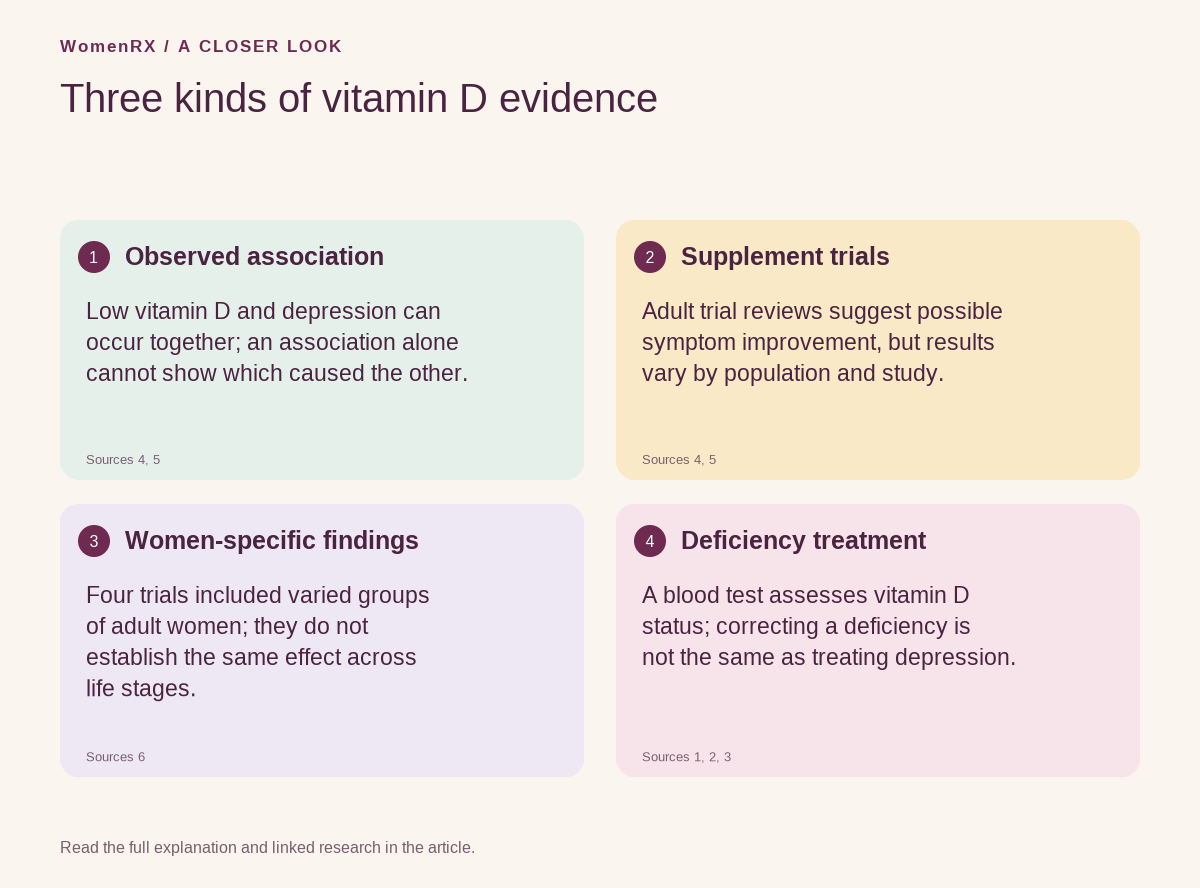
Three kinds of vitamin D evidence
Observed association: Low vitamin D and depression can occur together; an association alone cannot show which caused the other.45
Supplement trials: Adult trial reviews suggest possible symptom improvement, but results vary by population and study.45
Women-specific findings: Four trials included varied groups of adult women; they do not establish the same effect across life stages.6
Deficiency treatment: A blood test assesses vitamin D status; correcting a deficiency is not the same as treating depression.123
Read the figure as text
These findings answer different questions: whether low vitamin D is associated with mood, whether supplementation changes symptoms in trials, and what deficiency treatment is for.- Observed association: Low vitamin D and depression can occur together; an association alone cannot show which caused the other.45
- Supplement trials: Adult trial reviews suggest possible symptom improvement, but results vary by population and study.45
- Women-specific findings: Four trials included varied groups of adult women; they do not establish the same effect across life stages.6
- Deficiency treatment: A blood test assesses vitamin D status; correcting a deficiency is not the same as treating depression.123
More questions, answered
Should I get my vitamin D level checked because I feel low?
A vitamin D blood test can assess your vitamin D status, but it doesn’t diagnose depression or explain every cause of low mood. Whether testing makes sense depends on your health and risk factors; mood symptoms that persist or disrupt daily life still deserve separate attention. 1 2 3
Sources you can check
- Vitamin D Deficiency: MedlinePlusAccessed 2026-09-25Return to first citation
- Vitamin D - Health Professional Fact SheetAccessed 2026-09-25Return to first citation
- Depression: MedlinePlusAccessed 2026-09-25Return to first citation
- Efficacy of vitamin D supplementation in patients diagnosed with depression: a dose-response meta-analysis of randomized controlled trials.Liu HH, Liu TH, Liu CY, Wu JY, Lin CH, Lai CC. · Frontiers in nutrition · 2026Return to first citation
- The effect of vitamin D supplementation on depression: a systematic review and dose-response meta-analysis of randomized controlled trials.Ghaemi S, Zeraattalab-Motlagh S, Jayedi A, Shab-Bidar S. · Psychological medicine · 2024Return to first citation
- Effects of vitamin D supplementation on depression in adult women: a systematic review of randomized controlled trials.Park BJ, Kim SD. · Journal of Korean biological nursing science · 2026Return to first citation
- Efficacy of Vitamin D Supplementation to Alleviate Premenstrual Syndrome Symptoms: A Systematic Review and Meta-Analysis of Randomized Controlled Trials.Zainab A, Tageldin RS, Patel R, Hassan MA, Aburas LA, Alkahily M, Shamsan L, Al-Olaimat SS, Sayeed A, Abu-Zaid A. · Journal of clinical medicine · 2026Return to first citation