Calcium Around Menopause: Food, Supplements, and Bone Health
Start by estimating what you get from food and checking your bone-health context; a calcium supplement isn’t automatically needed.
Calcium supports bone, but menopause-related bone loss doesn’t mean every woman needs a supplement. Compare your usual food intake with the age-based daily target, then count calcium in any multivitamin or other supplement. Your bone-health risks and, when appropriate, a bone-density scan can add context; a blood calcium result alone doesn’t show whether your diet provides enough. 1 2 3
Start with what you eat
Calcium is part of the mineral structure of bone, and the body stores nearly all its calcium there. As estrogen levels fall around menopause, bone remodeling changes and bone mass can decline. That makes calcium worth considering, but it doesn’t show that a supplement is the right answer for every woman. 1 2
For women over 50, the recommended daily intake is 1,200 mg; for younger adult women, it’s 1,000 mg. Think of that as a daily intake target, not a supplement dose. First look at a usual day of eating and add calcium from foods and drinks whose labels list it. Dairy foods are common sources, as are some leafy greens, canned fish with edible bones, and calcium-fortified drinks, tofu, cereals, or juice. 2 3
A practical starting point is to write down what you typically eat and drink over a few ordinary days, including brands and serving sizes for fortified products. Labels can help you estimate the contribution of each item. Check your multivitamin and any other supplements too, so you don’t overlook calcium you already take. This estimate won’t diagnose a deficiency, but it can show whether your diet appears to leave a gap worth discussing.
Put the estimate in bone-health context
A food estimate is only one part of the picture. Age, family history, and some medical conditions can affect bone density. A bone-density scan measures bone mineral density and can show low bone density or osteoporosis; it offers information about bone health that a food tally cannot. 1
A blood calcium result answers a different question. Calcium levels in blood are not a good reflection of an individual’s calcium status, so a normal result doesn’t establish that your diet is meeting your needs. 2
If you’re in perimenopause, postmenopause, or have had a bone-density scan, use that context when deciding whether a supplement question needs individual assessment. A clinician can consider your diet alongside your medical history and bone-health findings. This matters especially if you have a condition that may affect bone density, or a family history of low bone mass or osteoporosis. 1
If you’re considering a supplement
Look at the calcium amount on the label and consider it alongside your food intake and other supplements. Products vary, and multivitamins may contain calcium too. The aim is to address a likely gap, not to add a supplement simply because menopause is approaching. 2 4
The form may affect how a supplement fits your routine. Calcium carbonate is absorbed best with food. Calcium citrate can be taken with or without food and is absorbed more easily than carbonate by people with low stomach acid. Calcium supplements can cause gas, bloating, or constipation for some people. 3
Before adding one, bring your intake estimate, supplement labels, and any bone-density results into the conversation. Ask whether your usual diet appears to meet your age-based target, whether your bone-health history changes the plan, and whether a supplement would fill a specific gap. Those questions help make the decision about your needs, rather than a blanket menopause rule.
Calcium is one part of the plan
Adequate calcium is part of a bone-supportive diet, but it isn’t a stand-alone guarantee against bone loss or fracture. MedlinePlus also identifies vitamin D, regular physical activity, limiting alcohol, and not smoking as part of supporting bone health. 1
Research connecting calcium intake to bone density in older adults is mixed: one analysis found an association between higher dietary intake and greater lumbar-spine density in women, while a study of older Australian women found no association between calcium-intake groups and bone density. These findings don’t establish that taking a supplement prevents fractures. 2
The useful next move is to estimate your intake, check what’s already in your supplements, and weigh that against your individual bone-health context. If the estimate suggests a shortfall, or your history or scan raises concern, a personalized assessment can help determine what makes sense.
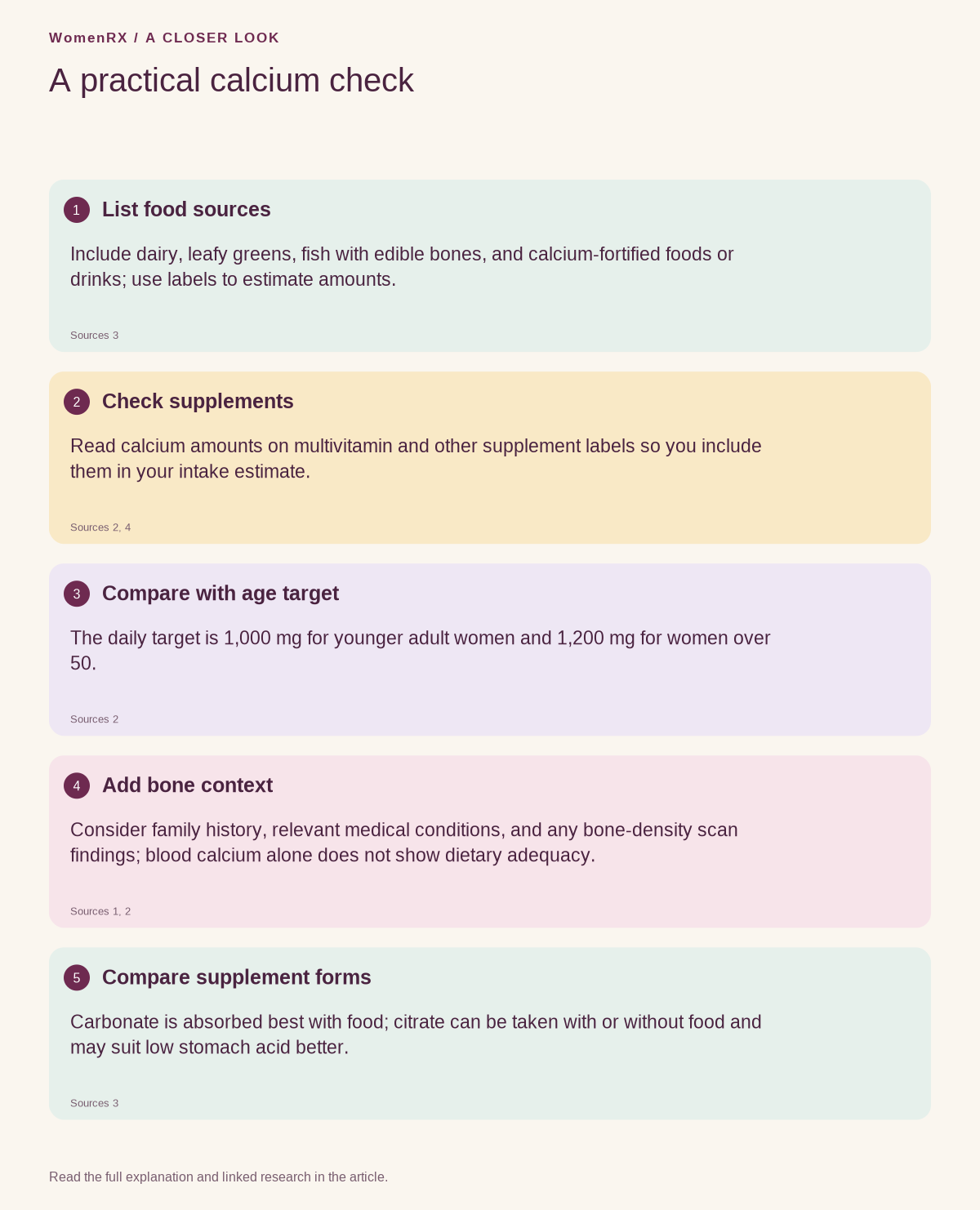
A practical calcium check
List food sources: Include dairy, leafy greens, fish with edible bones, and calcium-fortified foods or drinks; use labels to estimate amounts.3
Check supplements: Read calcium amounts on multivitamin and other supplement labels so you include them in your intake estimate.24
Compare with age target: The daily target is 1,000 mg for younger adult women and 1,200 mg for women over 50.2
Add bone context: Consider family history, relevant medical conditions, and any bone-density scan findings; blood calcium alone does not show dietary adequacy.12
Compare supplement forms: Carbonate is absorbed best with food; citrate can be taken with or without food and may suit low stomach acid better.3
Read the figure as text
Use these steps to separate your calcium intake estimate from your bone-health context and supplement choice.- List food sources: Include dairy, leafy greens, fish with edible bones, and calcium-fortified foods or drinks; use labels to estimate amounts.3
- Check supplements: Read calcium amounts on multivitamin and other supplement labels so you include them in your intake estimate.24
- Compare with age target: The daily target is 1,000 mg for younger adult women and 1,200 mg for women over 50.2
- Add bone context: Consider family history, relevant medical conditions, and any bone-density scan findings; blood calcium alone does not show dietary adequacy.12
- Compare supplement forms: Carbonate is absorbed best with food; citrate can be taken with or without food and may suit low stomach acid better.3
More questions, answered
Can a blood test tell me if I’m getting enough calcium?
Not reliably. Blood calcium levels aren’t a good reflection of an individual’s calcium status. A bone-density scan measures bone mineral density, while a food and supplement estimate helps you assess calcium intake. 1 2
Are calcium carbonate and calcium citrate interchangeable?
They’re different forms with different practical considerations. Carbonate is absorbed best with food; citrate can be taken with or without food and may be absorbed more easily when stomach acid is low. 3
Sources you can check
- Bone Density | Bone Mineral Density | BMD | MedlinePlusAccessed 2026-09-25Return to first citation
- Calcium - Health Professional Fact SheetAccessed 2026-09-25Return to first citation
- Calcium | MedlinePlusAccessed 2026-09-25Return to first citation
- Multivitamin/mineral Supplements - Health Professional Fact SheetAccessed 2026-09-25Return to first citation