Calcium Supplements: What Changes, and When?
You can check whether calcium is filling an intake gap before a bone-density scan can show whether bone has changed.
Calcium supplements don’t have a reliable “you’ll feel it” signal. First, compare the calcium you get from food and supplements with the amount recommended for your age; bone density is assessed with a bone-density scan, not by how you feel. There isn’t one proven date when a supplement should change a scan, and evidence in postmenopausal women shows results vary by bone site and outcome. 1 2 4
Three different questions, three different answers
When you start calcium, it’s easy to look for a quick sign that it’s working. But calcium is a building material for bone, not a treatment whose bone benefits can be judged by an immediate sensation. Your bones continually break down and replace tissue; bone density reflects the minerals in bone, and a bone-density scan is the way to measure it. 1 2
So separate three questions: Are you getting enough calcium? Is bone density changing? And do you feel different? The first can be reviewed by adding up dietary and supplemental calcium. A scan can measure bone density. Feeling no different doesn’t answer either question, and feeling better or worse doesn’t show whether bone density has changed.
Start with the amount you get, not the bottle
The recommended total daily intake depends on age and life stage. For example, the recommended amount is 1,300 mg for ages 9-18, 1,000 mg for adults ages 19-50, and 1,200 mg for women over 50. During pregnancy, the recommendation is 1,000 mg for ages 19-50 and 1,300 mg for ages 14-18. These are totals from food and supplements together, not automatic supplement doses. 2
For a useful review, estimate your usual intake from foods and drinks, then check the calcium amount on the supplement’s “Supplement Facts” label. Dairy foods, some fortified drinks and tofu, and fish with edible bones can contribute calcium. As an example, someone who regularly drinks fortified soy milk and eats yogurt may already get a meaningful amount before counting a supplement. 2
If you use a supplement, check how much calcium it provides, rather than assuming the tablet’s total weight is the amount of calcium. Calcium carbonate and calcium citrate are common forms. Carbonate is absorbed best with food; citrate is less dependent on stomach acid. The form and amount you can tolerate matter, too: calcium supplements can cause gas, bloating, or constipation, and carbonate may cause these effects more often than citrate. 2 3
The percentage absorbed tends to fall as the amount of elemental calcium taken at one time rises; absorption is highest for amounts of 500 mg or less at a time. That’s a reason to review the amount in each serving and your total intake, rather than assuming that more is better. 2
Bone changes need a measurement, not a feeling
A bone-density scan can show whether bone density is low and help assess fracture risk. It won’t tell you whether a particular supplement is the reason for a change, and one scan can’t turn into a dependable “working” sensation. Ask whether a scan is appropriate for your situation and, if you already have one, what the result means for your overall bone-health plan. 1
There isn’t a single scan deadline that applies to everyone. In a review of 11 randomized trials involving 43,869 postmenopausal women with osteoporosis, combined calcium and vitamin D modestly improved bone density at the pelvis, but not significantly at the lumbar spine, femoral neck, or total hip. The review found no significant reduction in overall fracture risk. These results concern combined supplements in women with osteoporosis, not calcium alone or every woman taking a supplement. 4
That difference matters: bone-density findings depend on the site measured, and a change in a scan isn’t the same outcome as preventing fractures. The scan schedule and what counts as a meaningful change should be interpreted in light of your starting result and risk, rather than using a fixed number of weeks as a pass-or-fail test. 1 4
Your age changes the question
During adolescence, calcium recommendations are higher because these years are a period of bone accumulation. The recommended intake for ages 9-18 is 1,300 mg a day, from all sources. The practical question is whether food and any supplement together meet that target, not whether a supplement creates a sensation. 2
During pregnancy, the recommended intake depends on age: 1,000 mg a day for ages 19-50 and 1,300 mg for ages 14-18. Those recommendations don’t mean every pregnant person needs a calcium supplement. Research on supplementation in pregnancy has examined maternal and birth outcomes as well as maternal bone density after birth; it doesn’t establish one universal bone-density timeline for individual readers. 2 5
After menopause, women’s bone loss is influenced by lower estrogen, which affects calcium absorption and the movement of calcium into and out of bone. The recommended intake rises to 1,200 mg daily for women over 50. That target supports adequate intake, but it isn’t a promise that supplements alone will reverse bone loss or prevent fractures. 2 4
Questions that make a review more useful
Bring the question back to your actual intake and bone-health picture:
- How much calcium do I usually get from food and drinks, and how much would a supplement add?
- Is the amount on this label the calcium itself, and what form is it?
- Given my age, pregnancy status, or bone-density result, is my total intake appropriate?
- If a bone-density scan is relevant for me, when should it be repeated and what change would matter?
The most useful sign that your plan is on track isn’t a new sensation. It’s a clear reason for the amount you’re taking, a total intake that fits your life stage, and a measurement plan when your risk makes one appropriate.
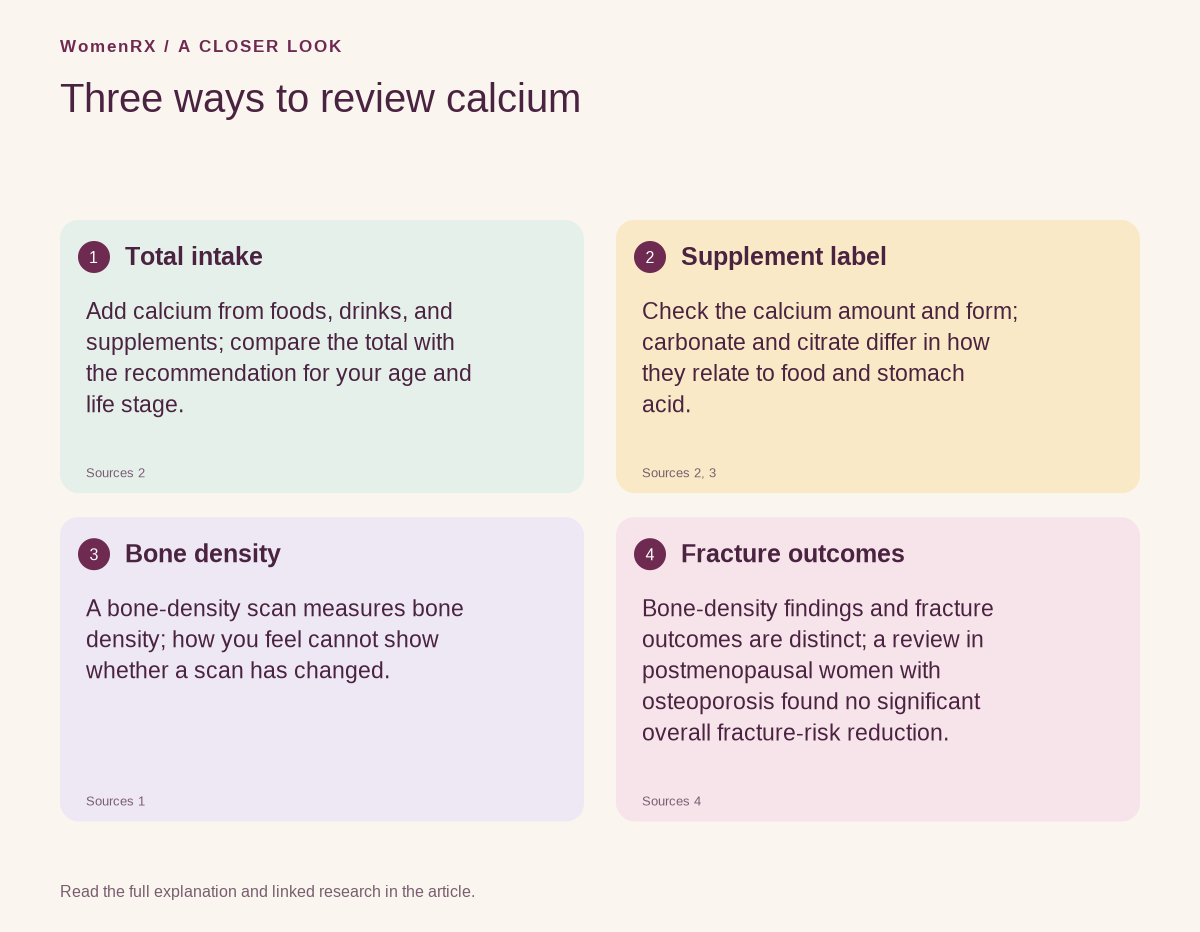
Three ways to review calcium
Total intake: Add calcium from foods, drinks, and supplements; compare the total with the recommendation for your age and life stage.2
Supplement label: Check the calcium amount and form; carbonate and citrate differ in how they relate to food and stomach acid.23
Bone density: A bone-density scan measures bone density; how you feel cannot show whether a scan has changed.1
Fracture outcomes: Bone-density findings and fracture outcomes are distinct; a review in postmenopausal women with osteoporosis found no significant overall fracture-risk reduction.4
Read the figure as text
These are separate checks, not stages on a guaranteed supplement timeline.- Total intake: Add calcium from foods, drinks, and supplements; compare the total with the recommendation for your age and life stage.2
- Supplement label: Check the calcium amount and form; carbonate and citrate differ in how they relate to food and stomach acid.23
- Bone density: A bone-density scan measures bone density; how you feel cannot show whether a scan has changed.1
- Fracture outcomes: Bone-density findings and fracture outcomes are distinct; a review in postmenopausal women with osteoporosis found no significant overall fracture-risk reduction.4
More questions, answered
Can I tell from a blood calcium test whether my bones are getting enough calcium?
A bone-density scan measures bone density. A blood calcium result and a bone-density scan are different kinds of information, so don’t use a blood test as a substitute for a scan when the question is bone density. 1 2
Does taking calcium mean I can expect fewer fractures?
Not necessarily. In a review of trials among postmenopausal women with osteoporosis, combined calcium and vitamin D did not significantly reduce overall fracture risk. That finding doesn’t establish the effect of calcium alone or apply to every person or circumstance. 4
Sources you can check
- Bone Density | Bone Mineral Density | BMD | MedlinePlusAccessed 2026-09-25Return to first citation
- Calcium - Health Professional Fact SheetAccessed 2026-09-25Return to first citation
- Calcium | MedlinePlusAccessed 2026-09-25Return to first citation
- The effects of combined calcium and vitamin D supplementation on bone mineral density and fracture risk in postmenopausal women with osteoporosis: a systematic review and meta-analysis of randomized controlled trials.Cong B, Zhang H. · BMC musculoskeletal disorders · 2025Return to first citation
- Calcium Supplementation in Pregnancy: A Systematic Review of Clinical Studies.Gerede A, Papasozomenou P, Stavros S, Potiris A, Domali E, Nikolettos N, Eleftheriades M, Zafrakas M. · Medicina (Kaunas, Lithuania) · 2025Return to first citation