Magnesium and Bone Health: What Supplements Can Do
Magnesium is part of healthy bone, but taking a supplement hasn’t been shown to prevent fractures or treat osteoporosis.
Magnesium helps build and maintain bone, and some studies link higher magnesium intake with higher bone mineral density. But that link doesn’t prove supplements prevent bone loss or fractures. A small, short study in postmenopausal women measured a change in bone-turnover markers, not fractures. If bone loss is a concern, a bone-density scan and an overall care plan matter more than assuming magnesium is the answer. 21
The key difference: intake, density, and fractures
Magnesium contributes to bone structure and affects processes involved in bone formation. Studies have also found associations between magnesium intake and bone mineral density (BMD). But an association between nutrient intake and a bone-density measure doesn’t show that taking a magnesium supplement will prevent a fracture. BMD is one measure of bone health; a bone-density scan can also help assess osteoporosis and fracture risk. 12
That distinction matters after menopause, when bone loss may be a concern. A small study in 20 postmenopausal women with osteoporosis found that magnesium citrate for 30 days changed a bone-turnover marker compared with placebo. That marker suggested less bone breakdown, but the study was short and did not establish that supplements improved BMD or prevented fractures. NIH’s Office of Dietary Supplements says more research is needed to determine whether magnesium supplements can help prevent or manage osteoporosis. 2
What the evidence says about fracture risk
A population-based study of 13,259 US adults found that, among people aged 60 and older, higher magnesium-deficiency scores were associated with lower BMD at some hip sites, higher odds of osteoporosis, and higher estimated fracture risk. The study found no association with a history of hip fracture, and it found no sex-specific difference in the outcomes. Because it was observational, it can show a relationship, not that magnesium supplements would change someone’s risk. 4
Researchers have also reported lower magnesium levels in some women with osteoporosis. That finding doesn’t establish whether low magnesium contributed to bone loss or resulted from other factors. Magnesium status can be difficult to assess: a blood magnesium test is commonly used, but it doesn’t accurately reflect total body magnesium. 2
So, magnesium is relevant to bone biology, but the evidence doesn’t support treating a supplement as osteoporosis prevention or fracture protection. It also doesn’t show that everyone with low bone density needs a magnesium supplement.
How to put magnesium in a bone-health plan
A bone-density scan is a more direct way to measure bone density and can help show whether you have low bone density or osteoporosis and what your fracture risk may be. If you’re worried about bone loss, ask about whether a scan is appropriate and how its results fit with your overall risk. 1
Magnesium shouldn’t displace the better-established pieces of bone care: getting enough calcium and vitamin D, regular physical activity such as weight-bearing exercise, and treatment for low bone density or osteoporosis when needed. These steps are identified as ways to help lower fracture risk; magnesium supplements are not presented as a substitute for them. 3
If you’re considering a supplement because of a suspected deficiency, keep that separate from the question of whether it treats osteoporosis. Low intake and certain health conditions or medications can contribute to deficiency, but symptoms alone don’t establish the cause. A clinician can consider your situation and whether testing is useful. 2
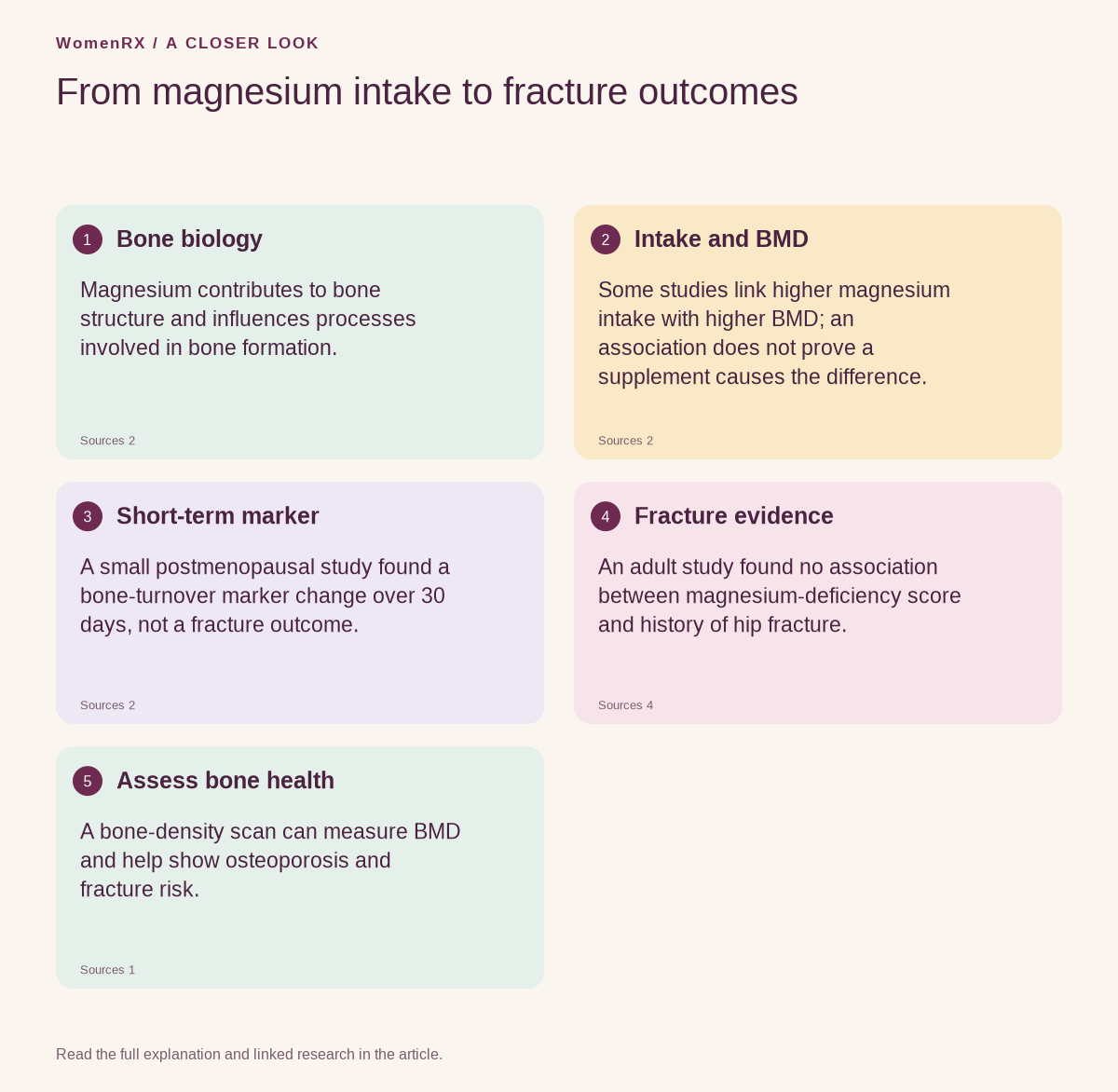
From magnesium intake to fracture outcomes
Bone biology: Magnesium contributes to bone structure and influences processes involved in bone formation.2
Intake and BMD: Some studies link higher magnesium intake with higher BMD; an association does not prove a supplement causes the difference.2
Short-term marker: A small postmenopausal study found a bone-turnover marker change over 30 days, not a fracture outcome.2
Fracture evidence: An adult study found no association between magnesium-deficiency score and history of hip fracture.4
Assess bone health: A bone-density scan can measure BMD and help show osteoporosis and fracture risk.1
Read the figure as text
These are related steps in bone health, but evidence for one step does not automatically prove an effect on the next.- Bone biology: Magnesium contributes to bone structure and influences processes involved in bone formation.2
- Intake and BMD: Some studies link higher magnesium intake with higher BMD; an association does not prove a supplement causes the difference.2
- Short-term marker: A small postmenopausal study found a bone-turnover marker change over 30 days, not a fracture outcome.2
- Fracture evidence: An adult study found no association between magnesium-deficiency score and history of hip fracture.4
- Assess bone health: A bone-density scan can measure BMD and help show osteoporosis and fracture risk.1
More questions, answered
Does a higher bone-density reading mean fewer fractures?
Bone density is one measure of bone health, and denser bones tend to be stronger and less likely to fracture. But a finding about BMD alone is not the same as evidence that a supplement prevents fractures. 12
Should magnesium replace calcium or vitamin D for bone health?
No. Calcium and vitamin D, regular physical activity, and treatment for low bone density when needed are identified as fracture-risk reduction steps. Magnesium supplementation has not been established as a replacement for those measures. 23
Sources you can check
- Bone Density | Bone Mineral Density | BMD | MedlinePlusAccessed 2026-09-25Return to first citation
- Magnesium - Health Professional Fact SheetAccessed 2026-09-25Return to first citation
- Fracture | MedlinePlusAccessed 2026-09-25Return to first citation
- Association between magnesium deficiency scores and hip bone health in adults: a population-based study.Li S, Chang W, Wu G, Wang K, Sun X, Sun H, Zhou J. · Magnesium research · 2025Return to first citation