Collagen Supplements for Bone Health: What Has Been Tested?
Human studies have measured bone density and bone-turnover markers, but some of the most relevant findings in postmenopausal women come from collagen combined with calcium and vitamin D.
Yes. Human studies have measured bone mineral density (BMD) and bone-turnover markers after collagen supplementation. Reviews report some favorable results, including in postmenopausal women, but findings vary. Several relevant studies tested collagen alongside calcium and vitamin D, while one short trial involved resistance-trained men. These results are not proof that collagen prevents fractures or works the same way for every woman. 3 4 2
Bone density and bone-turnover markers answer different questions
BMD is a measure of the minerals in bone. A bone density scan can show whether density is low and help assess fracture risk. Bone-turnover markers are different: they reflect processes involved in bone formation or breakdown. A change in a marker is not the same as a change in BMD, and neither result by itself shows that a supplement prevents fractures. 1 4
That distinction matters when reading collagen research. A study that reports a marker change has measured a signal related to bone metabolism. A study that reports BMD has measured density at a particular site, such as the spine or femoral neck. Those are relevant outcomes, but they are not interchangeable.
What the human collagen studies report
A scoping review identified 15 human studies of oral collagen with bone-related outcomes, including BMD and bone-turnover markers. It found favorable results in some studies, including studies involving postmenopausal women, but also neutral findings. The review described substantial variation in study design, participants, and supplementation protocols. 3
A separate meta-analysis reported increases in spine and femoral-neck BMD, along with improvements in some bone-turnover markers. However, BMD results varied considerably across the studies (I² = 80.1%). The review included trials of collagen peptides taken alone and trials combining them with calcium and vitamin D, so its overall findings don't establish that collagen alone explains every reported benefit. 4
What the postmenopausal findings can tell you
The collagen meta-analysis described four larger trials involving postmenopausal or middle-aged women with low bone density. These lasted six or 12 months and tested collagen-containing supplements alongside calcium and vitamin D. The review reported better BMD results for the collagen-containing combinations than for calcium and vitamin D alone. 4
That comparison is useful: it asks whether the collagen-containing formulation added something beyond calcium and vitamin D in those trials. But it doesn't answer whether collagen on its own improves BMD. Nor does it establish that the findings apply to women with normal bone density, women who are premenopausal, or women taking a different collagen product. The review's reported BMD and marker findings also don't demonstrate fewer fractures. 3 4
There is also a small, different kind of study worth keeping in perspective. An eight-week randomized trial enrolled 40 resistance-trained men who followed supervised strength training; one group received collagen alone. The study reported a lumbar-spine BMD increase in that group, but the participants were men undertaking a specific training program, not postmenopausal women. It cannot answer whether collagen improves bone outcomes for women in everyday settings. 2
A practical way to read the results
When a study or product claim says collagen supports “bone health,” look for the actual outcome: BMD at a named site, a turnover marker, or fractures. Then check who was studied and whether collagen was tested alone or as part of a combination. For a woman considering collagen specifically for bone density, the postmenopausal combination findings are relevant but don't settle the question of collagen alone.
If your concern is your own bone density, a supplement study is not a substitute for measuring it. MedlinePlus identifies a bone density scan as the best way to measure bone health; it can show low density and help assess fracture risk. 1
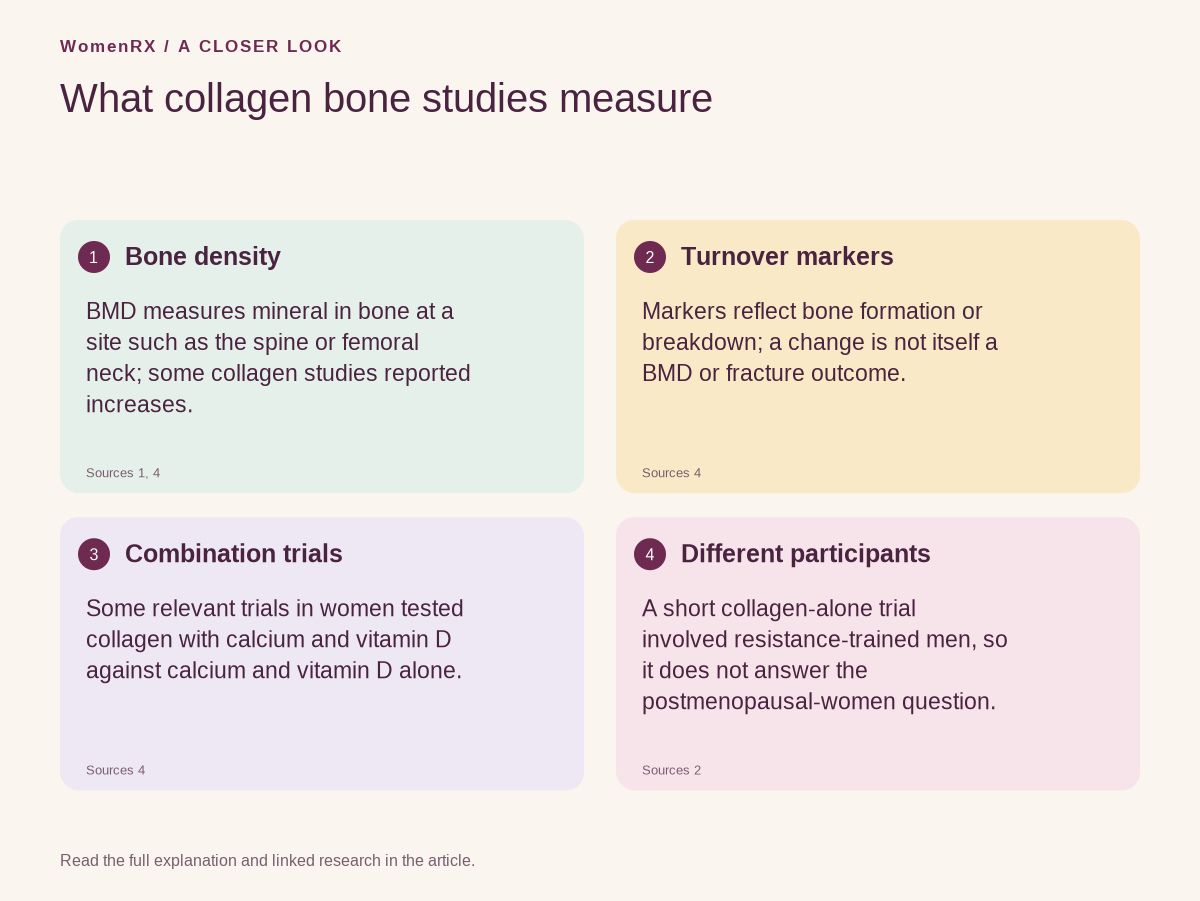
What collagen bone studies measure
Bone density: BMD measures mineral in bone at a site such as the spine or femoral neck; some collagen studies reported increases.14
Turnover markers: Markers reflect bone formation or breakdown; a change is not itself a BMD or fracture outcome.4
Combination trials: Some relevant trials in women tested collagen with calcium and vitamin D against calcium and vitamin D alone.4
Different participants: A short collagen-alone trial involved resistance-trained men, so it does not answer the postmenopausal-women question.2
Read the figure as text
Separate the measured outcome from the study population and supplement combination to see what a result can reasonably tell you.- Bone density: BMD measures mineral in bone at a site such as the spine or femoral neck; some collagen studies reported increases.14
- Turnover markers: Markers reflect bone formation or breakdown; a change is not itself a BMD or fracture outcome.4
- Combination trials: Some relevant trials in women tested collagen with calcium and vitamin D against calcium and vitamin D alone.4
- Different participants: A short collagen-alone trial involved resistance-trained men, so it does not answer the postmenopausal-women question.2
Sources you can check
- Bone Density | Bone Mineral Density | BMD | MedlinePlusAccessed 2026-09-25Return to first citation
- The combined effects of whey protein and collagen supplementation on bone mineral density and muscle mass in resistance-trained men: a randomized controlled trial.Seyhan S, Jourkesh M, Salatin A, Acar G, Bilici MF, Girginer FG, Bilici OF, Soylu C. · BMC sports science, medicine & rehabilitation · 2026Return to first citation
- The Role of Collagen Supplementation in Bone Metabolism and Structure: A Scoping Review.Kuhlman NM, Jagim AR, Blesso C, Jones MT, Chun O, Puglisi M, Fields JB. · Clinical journal of sport medicine : official journal of the Canadian Academy of Sport Medicine · 2026Return to first citation
- Efficacy of collagen peptide supplementation on bone and muscle health: a meta-analysis.Sun C, Yang A, Teng F, Xia Y. · Frontiers in nutrition · 2025Return to first citation