Collagen After 40: What’s Been Tested?
Trials in midlife and menopausal women offer some evidence for skin changes, but skin results can’t answer bone or joint questions.
Collagen isn’t something you need simply because you’re over 40. Trials in midlife and menopausal women have reported improvements in some skin measures over 12 weeks to six months, though the results depend on the product and comparison used. A menopausal-women trial found no significant change in measured bone-turnover markers, and these trials don’t answer whether collagen relieves joint symptoms. 2 3
Match the claim to your concern
“Collagen after 40” sounds like one question, but skin appearance, bone health, and joint symptoms are different outcomes. A supplement that changes a skin measurement hasn’t necessarily changed bone strength or how your knees feel on the stairs. The useful way to judge a collagen claim is to check who took it, what else was in the product, and what the researchers actually measured.
Skin: the clearest midlife findings
In a randomized trial, 119 healthy, sedentary women ages 35-55 were assigned to a nonsupplemented control group or one of two amounts of a specific bioactive collagen peptide. After 12 weeks, both supplement groups had improved skin hydration and elasticity; the higher-amount group also had fewer and shorter facial wrinkles. That’s relevant if your concern is skin in midlife. Because the comparison group received no supplement rather than a placebo, though, the trial doesn’t answer the same question a blinded placebo-controlled trial would. Nor does it show that every collagen powder has the same effect. 3
A separate six-month randomized trial enrolled menopausal women. It compared placebo, fish-derived collagen peptides, calcium plus vitamin D, and all three together. The researchers reported improved elasticity from baseline in the collagen-only group and improved hydration and elasticity from baseline in the combined group. A change from a group’s own starting measurement isn’t, by itself, proof that the group did better than placebo. 2
Other skin findings need a careful label, too. A study of Chinese women ages 32-54 reported improvements after a formula containing collagen peptides, ergothioneine, and sodium hyaluronate. It can’t tell you what collagen alone contributed. A placebo-controlled trial in 70 healthy adults reported improvements in several skin measures after eight weeks of a particular collagen peptide product, but the reported findings don’t separate results for women over 40. 1 4
Taken together, these are reasons to consider a possible short-term skin benefit from particular products, not a reason to expect collagen to reverse aging or work uniformly after a birthday or menopause.
Bone: a different outcome needs different proof
Bone health is an especially meaningful question after menopause, but skin elasticity isn’t a stand-in for bone density. A review found associations between some skin and bone measurements in women studied for postmenopausal osteoporosis. Those correlations don’t show that taking collagen improves either measurement. 5
The six-month menopausal-women supplement trial measured bone-turnover markers, including P1NP, bone-specific alkaline phosphatase, and osteocalcin. It reported no significant changes in those markers across its groups. Its reported findings therefore don’t establish that collagen improves bone density or prevents fractures. They also don’t turn the trial’s skin findings into a bone benefit. 2
You may see promising explanations about collagen and estrogen-related bone loss. One experiment found bone effects in mice whose ovaries had been removed, alongside cell experiments. That’s a research lead, not a demonstrated benefit for postmenopausal women taking a supplement. 6
Joints: don’t borrow an answer from skin research
If you’re considering collagen because of joint pain or stiffness, the skin trials and the menopausal-women trial above don’t report whether participants’ joints felt or functioned better. That doesn’t prove collagen cannot help joints; it means these results cannot settle your joint question. 1 2 3 4
The same boundary applies to broader claims about staying strong after 40. These trials don’t compare collagen with a general dietary-protein approach or resistance exercise. If a product is advertised as a replacement for either, its skin measurements don’t support that leap. 1 2 3 4
For a skin goal, the most relevant question is whether the claim comes from a trial of that product, in a population like yours, against a meaningful comparison. For a bone or joint goal, ask for a study that measures that outcome in people, rather than one that measures wrinkles or proposes a biological mechanism.
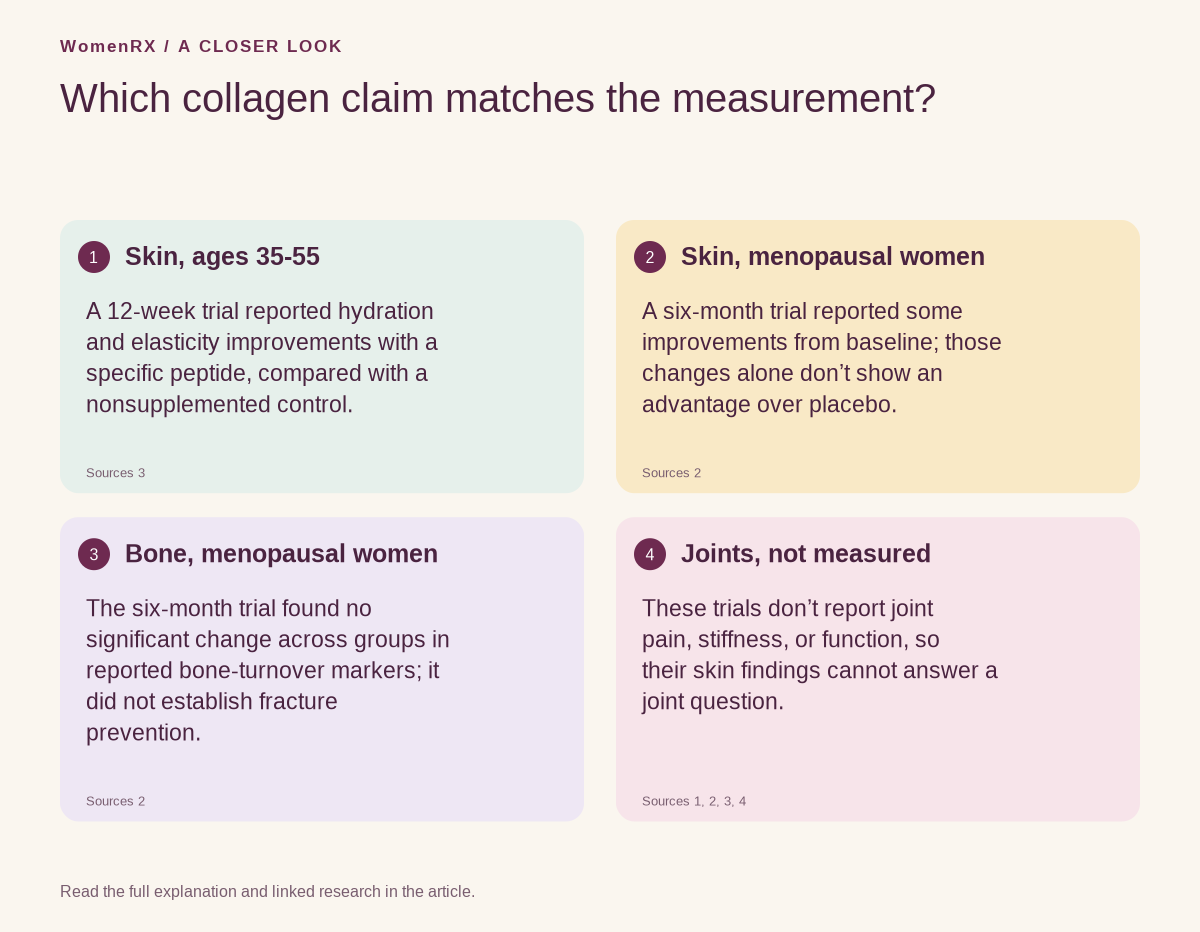
Which collagen claim matches the measurement?
Skin, ages 35-55: A 12-week trial reported hydration and elasticity improvements with a specific peptide, compared with a nonsupplemented control.3
Skin, menopausal women: A six-month trial reported some improvements from baseline; those changes alone don’t show an advantage over placebo.2
Bone, menopausal women: The six-month trial found no significant change across groups in reported bone-turnover markers; it did not establish fracture prevention.2
Joints, not measured: These trials don’t report joint pain, stiffness, or function, so their skin findings cannot answer a joint question.1234
Read the figure as text
The same supplement category has been studied in different populations for different outcomes.- Skin, ages 35-55: A 12-week trial reported hydration and elasticity improvements with a specific peptide, compared with a nonsupplemented control.3
- Skin, menopausal women: A six-month trial reported some improvements from baseline; those changes alone don’t show an advantage over placebo.2
- Bone, menopausal women: The six-month trial found no significant change across groups in reported bone-turnover markers; it did not establish fracture prevention.2
- Joints, not measured: These trials don’t report joint pain, stiffness, or function, so their skin findings cannot answer a joint question.1234
Sources you can check
- Ergothioneine, collagen peptides, and sodium hyaluronate ameliorate facial skin aging via modulating oxidative stress, inflammation, and extracellular matrix homeostasis.Zhou Z, Zhao L, Chen L, Zhao X, Li X, Luo X, Zhang B, Miao J, Liu F. · Frontiers in nutrition · 2026Return to first citation
- Calcium and Vitamin D Supplementation with and Without Collagen on Bone Density and Skin Elasticity in Menopausal Women-A Randomized Controlled Study.Duangjai A, Srivilai J, Nangola S, Amornlerdpison D. · Clinics and practice · 2025Return to first citation
- Immune-Modulatory Effects of Bioactive Collagen Peptides Improve Skin Health in Middle-Aged Women.Paula-Vieira RHR, Dias SR, Silva-Reis A, Moura-Maia MS, Ramos-Gomes NV, Jesus-Silva K, Oliveira-Leal YR, Castro-Pimentel LT, Carvalho WSF, Melo F, Martins JLR, Bachi ALL, Vieira RP... · Dermatology and therapy · 2026Return to first citation
- Skin Anti-Aging and Moisturizing Effects of Low-Molecular-Weight Collagen Peptide Supplementation in Healthy Adults: A Randomized, Double-Blind, Placebo-Controlled Clinical Trial.Lee E, Ahn DK, Kim JH, Lee S, Kim HJ, Lee HK, Shin JH. · Journal of microbiology and biotechnology · 2025Return to first citation
- Correlation between skin and bone parameters in women with postmenopausal osteoporosis: A systematic review.Aurégan JC, Bosser C, Bensidhoum M, Bégué T, Hoc T. · EFORT open reviews · 2018Return to first citation
- Dietary Collagen Hydrolysates Retard Estrogen Deficiency-Induced Bone Loss through Blocking Osteoclastic Activation and Enhancing Osteoblastic Matrix Mineralization.Kim SI, Park SH, Na W, Shin YC, Oh MS, Sim YE, Zheng Y, Kim AH, Kang IJ, Kang YH. · Biomedicines · 2022Return to first citation