Collagen Supplements: What Daily Amounts Have Been Studied?
Skin trials have tested several collagen amounts, but their results apply to specific products and outcomes, not to a universal daily requirement.
For skin, clinical trials have tested collagen products ranging from 1 to 5 grams daily, with the cited regimens lasting 12 weeks. But dose alone doesn’t tell you whether a product matches the research: collagen formulation, added ingredients, and measured outcome differ. One 12-week trial compared 1- and 5-gram doses and reported changes in skin hydration, but its reported results don’t establish which dose produced them. 1
There isn’t one research-established daily amount
Collagen studies test a particular product at a particular amount for a particular goal. They don’t establish a daily requirement or show that every collagen powder will produce the same result. If you’re comparing a label with a study, match the form, amount of collagen itself, length of use, and outcome measured, not just the number of grams.
The clearest comparisons in the skin trials are between products tested at 1, 2.5, and 5 grams daily. Those amounts are study regimens, not a recommendation that every woman should take collagen or that a higher amount works better.
What skin studies tested
A 12-week trial in 99 healthy Japanese women aged 35 to 50 compared collagen peptides at 1 gram daily, 5 grams daily, and placebo. The study reported increased skin water content and decreased transepidermal water loss with collagen peptide intake, but its reported results don’t establish which dose produced those changes. Skin elasticity and thickness did not change. That difference matters if your goal is firmer-looking skin: the reported hydration result wasn’t also a demonstrated result for elasticity. 1
Another trial tested 5 grams daily for 84 days in 85 women aged 43 to 65. Participants also used the same face cream, so the findings describe supplementation alongside that skincare routine, not collagen in isolation from all other care. The study reported improved dermis density and skin moisture compared with placebo. 3
A separate 12-week trial in 72 women aged 35 or older tested a drink containing 2.5 grams of collagen peptides plus acerola, vitamin C, zinc, biotin, and vitamin E. Skin hydration, elasticity, roughness, and density improved compared with placebo. Because it was a multi-ingredient product, the result can’t tell you how much of the effect came from collagen alone. 4
A 12-week trial in 77 healthy women tested 5 grams daily of a specific bioactive peptide product and reported changes in hydration, transepidermal water loss (TEWL), and dermal measures. That is evidence about that product and regimen, not proof that all 5-gram collagen supplements perform alike. 2
How to compare a product with a study
- Check what the grams refer to. A product’s serving weight may include other ingredients. For example, one trial’s 2.5-gram figure referred to collagen peptides in a drink that also contained vitamins and other ingredients. 4
- Match the collagen form where possible. Trials tested different peptide products, including a specific bioactive formulation. A result for one formulation doesn’t establish the same effect for another. 1 2
- Match the goal. Hydration, elasticity, wrinkles, and dermal density are separate outcomes. In a trial comparing 1- and 5-gram doses, the study described changes in hydration but no change in elasticity or thickness; its reported results don’t establish which dose produced the hydration changes. 1
- Look at the study duration. The cited supplementation regimens lasted 12 weeks. In the trial comparing 1- and 5-gram doses, researchers also measured outcomes at weeks 4 and 8 during that 12-week regimen. Those measurement points weren’t shorter supplementation regimens. 1 2 4
What this means for joints or other goals
These skin studies don’t establish an amount for joint symptoms or another non-skin goal. A label that says “collagen peptides” isn’t enough to transfer a skin-trial amount to a different outcome. For a joint-focused product, look for research that tests that product type and amount on joint outcomes, rather than assuming a dose studied for skin applies.
The women-only skin trials include adult participants in some age ranges, including ages 35 to 50 and 43 to 65. Those participant descriptions don’t tell you whether the results differ during pregnancy, postpartum, perimenopause, or postmenopause, or establish an appropriate amount for any of those life stages. 1 3
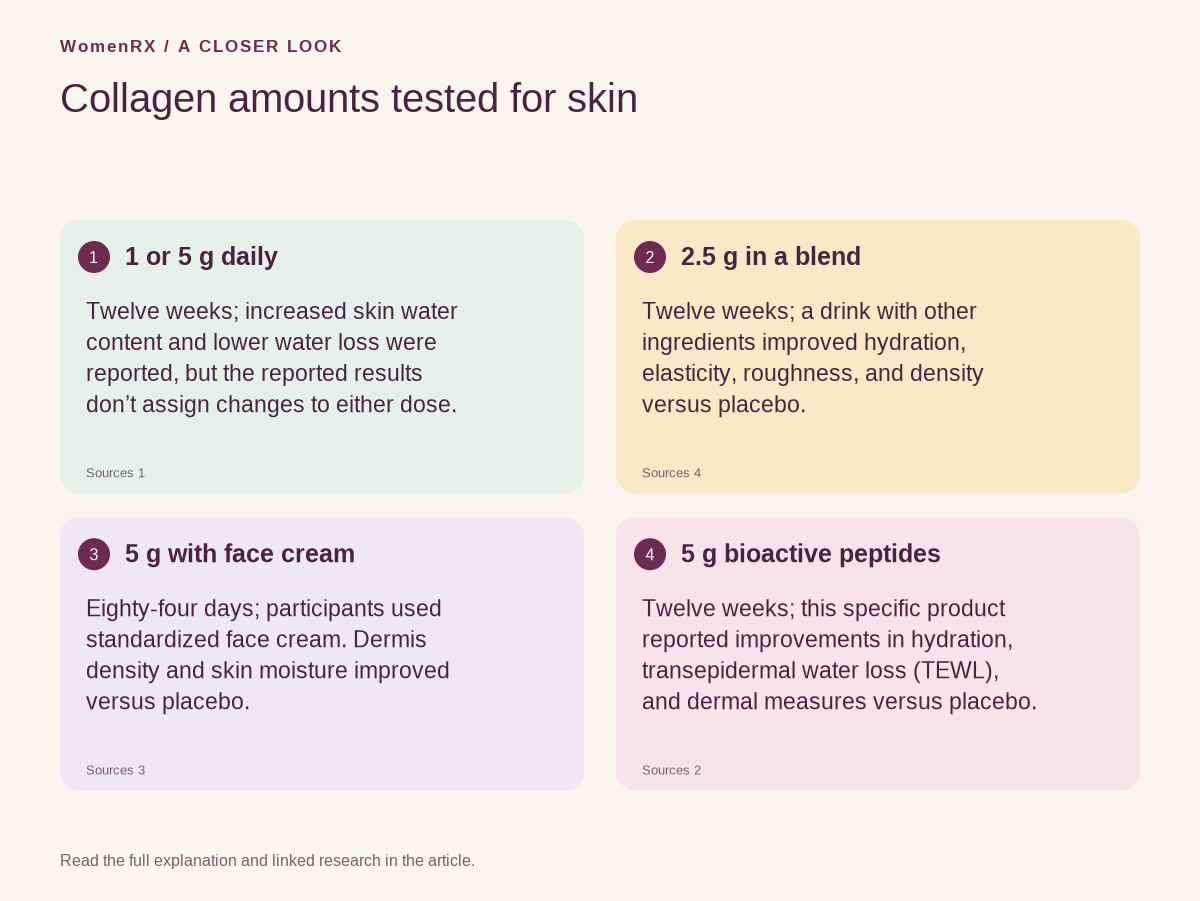
Collagen amounts tested for skin
1 or 5 g daily: Twelve weeks; increased skin water content and lower water loss were reported, but the reported results don’t assign changes to either dose.1
2.5 g in a blend: Twelve weeks; a drink with other ingredients improved hydration, elasticity, roughness, and density versus placebo.4
5 g with face cream: Eighty-four days; participants used standardized face cream. Dermis density and skin moisture improved versus placebo.3
5 g bioactive peptides: Twelve weeks; this specific product reported improvements in hydration, transepidermal water loss (TEWL), and dermal measures versus placebo.2
Read the figure as text
Compare the amount of collagen peptides, product formulation, study duration, and skin outcomes reported.- 1 or 5 g daily: Twelve weeks; increased skin water content and lower water loss were reported, but the reported results don’t assign changes to either dose.1
- 2.5 g in a blend: Twelve weeks; a drink with other ingredients improved hydration, elasticity, roughness, and density versus placebo.4
- 5 g with face cream: Eighty-four days; participants used standardized face cream. Dermis density and skin moisture improved versus placebo.3
- 5 g bioactive peptides: Twelve weeks; this specific product reported improvements in hydration, transepidermal water loss (TEWL), and dermal measures versus placebo.2
Sources you can check
- Oral Supplementation of Collagen Peptides Improves Skin Hydration by Increasing the Natural Moisturizing Factor Content in the Stratum Corneum: A Randomized, Double-Blind, Placebo-Controlled Clinical Trial.Miyanaga M, Uchiyama T, Motoyama A, Ochiai N, Ueda O, Ogo M. · Skin pharmacology and physiology · 2021Return to first citation
- The Sustained Effects of Bioactive Collagen Peptides on Skin Health: A Randomized, Double-Blind, Placebo-Controlled Clinical Study.Wang Y, Zhu W, Luo W, Ma Y, Zhou Y. · Journal of cosmetic dermatology · 2025Return to first citation
- Influence of collagen peptide supplementation on visible signs of skin and nail health and -aging in an East Asian population: A double blind, randomized, placebo-controlled trial.Vleminckx S, Virgilio N, Asserin J, Prawitt J, Silva CIF. · Journal of cosmetic dermatology · 2024Return to first citation
- A Collagen Supplement Improves Skin Hydration, Elasticity, Roughness, and Density: Results of a Randomized, Placebo-Controlled, Blind Study.Bolke L, Schlippe G, Gerß J, Voss W. · Nutrients · 2019Return to first citation