Collagen for Gut Health: What Has Actually Been Studied?
Human studies have looked at digestive symptoms during intense exercise, not whether collagen treats common digestive disorders.
The direct human evidence is narrow. In a small trial of healthy active women, collagen peptides did not change reported digestive symptoms. In a mostly male exercise study, collagen also didn’t improve symptoms or measured gut-barrier outcomes compared with placebo. Neither trial tested collagen as a treatment for a diagnosed digestive condition, so broad “gut health” claims go beyond what these results show. 1 2
The evidence depends on what “gut health” means
“Gut health” can refer to very different things: bloating, bowel habits, a diagnosed condition, or a laboratory measure of intestinal barrier function. A result for one isn’t proof of a benefit for the others. The human studies most directly relevant to collagen and digestion examined short-term responses around strenuous exercise, not treatment for conditions such as irritable bowel syndrome (IBS), inflammatory bowel disease, or chronic constipation.
That distinction matters if you’re considering collagen for a specific symptom or diagnosis. Evidence about exercise-related digestive stress can’t establish that collagen relieves everyday bloating or treats a digestive disorder.
What the exercise studies found
In a randomized crossover trial, 20 volunteers took collagen peptides or a control supplement before a demanding 70-minute run. The group was mostly male, and the study didn’t report women’s results separately. Compared with control, collagen didn’t change participants’ digestive symptoms or the measured markers of intestinal permeability and inflammation. Some markers changed after exercise compared with rest, but that doesn’t show collagen improved them. 2
A separate crossover trial involved 15 healthy, physically active women. They took collagen peptides or a non-energy control for seven days and completed an exercise-and-meal test. The researchers found no difference in reported gastrointestinal symptoms between the trials. This is useful evidence about healthy active women in that specific setting, but it doesn’t tell us whether collagen helps women with persistent symptoms or a diagnosed gut condition. 1
The women-only study also measured appetite-related hormones and food intake. Those outcomes aren’t digestive symptom relief or evidence that collagen repairs the gut lining. A change in a hormone, even when measured in people, shouldn’t be treated as proof of a clinical gut benefit. 1
What reports from supplement users can, and can’t, tell you
A cross-sectional survey of collagen users in Saudi Arabia included 56 people who reported using collagen; 153 of the full 171-person survey were women. Among the collagen users, 18 reported gastrointestinal symptoms. Because the survey asked users about their experiences rather than randomly assigning collagen and comparing it with a control, it can’t show whether collagen caused those symptoms, improved a digestive condition, or had no effect. It also wasn’t a trial of treatment for a specific gut disorder. 3
This is a different kind of finding from a controlled trial. It may be relevant when thinking about tolerability, but it doesn’t establish either a gut-health benefit or a predictable digestive side effect for every user.
What this means if you’re considering collagen
If you’re considering collagen for IBS, constipation, reflux, inflammatory bowel disease, or another specific digestive concern, these studies don’t show that it treats that condition. They also don’t establish a gut benefit specific to women. The female trial is directly relevant to women, but its participants were healthy and active, and it measured symptoms around exercise rather than treatment outcomes for a diagnosed disorder. 1
A practical way to assess a claim is to ask: Which condition was studied, and what outcome changed compared with a control? If the answer is a cell or animal result, a hormone, or a general claim about “gut lining,” that isn’t the same as evidence that people with your condition felt better. The exercise trials offer a narrow answer: collagen didn’t improve the measured digestive symptoms in those settings. 1 2
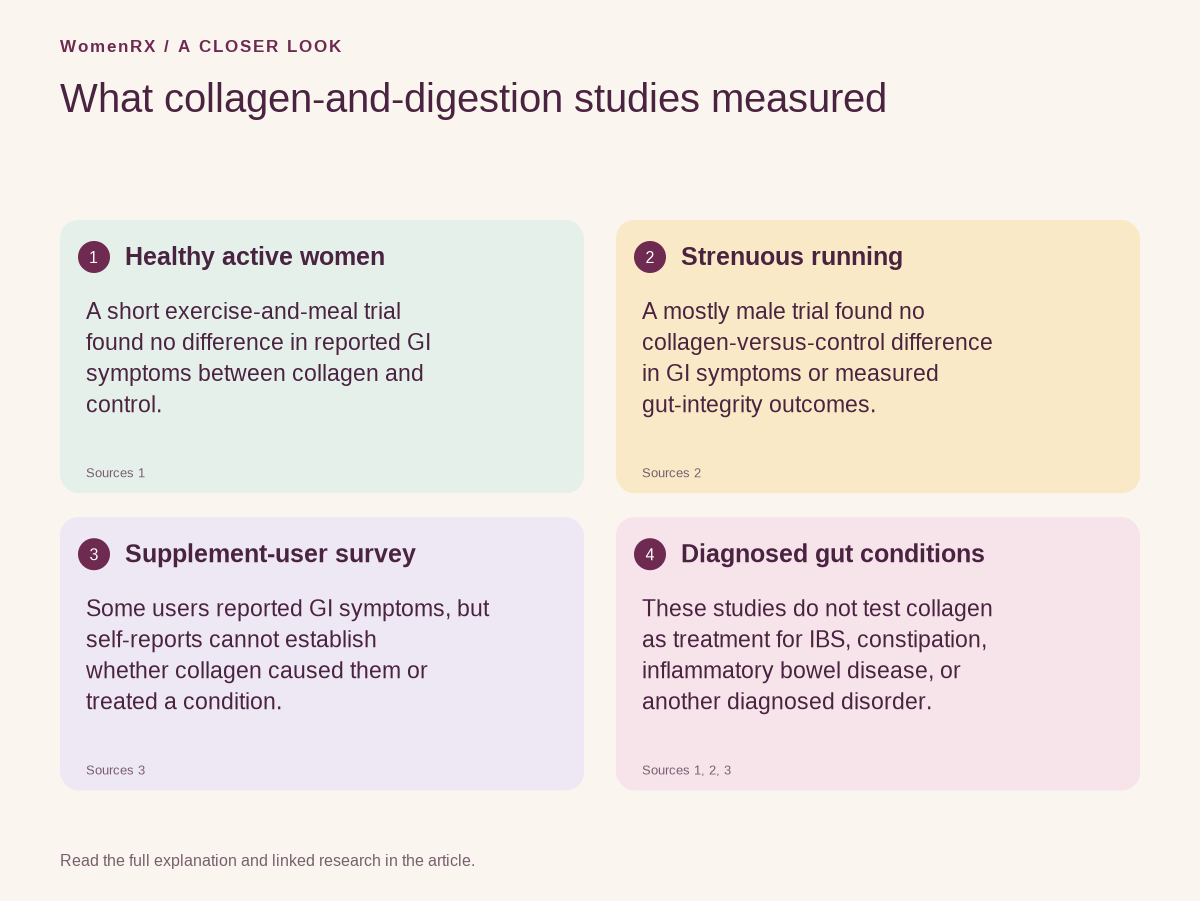
What collagen-and-digestion studies measured
Healthy active women: A short exercise-and-meal trial found no difference in reported GI symptoms between collagen and control.1
Strenuous running: A mostly male trial found no collagen-versus-control difference in GI symptoms or measured gut-integrity outcomes.2
Supplement-user survey: Some users reported GI symptoms, but self-reports cannot establish whether collagen caused them or treated a condition.3
Diagnosed gut conditions: These studies do not test collagen as treatment for IBS, constipation, inflammatory bowel disease, or another diagnosed disorder.123
Read the figure as text
The word “gut health” covers different outcomes. These study settings show what the human evidence can, and can’t, answer.- Healthy active women: A short exercise-and-meal trial found no difference in reported GI symptoms between collagen and control.1
- Strenuous running: A mostly male trial found no collagen-versus-control difference in GI symptoms or measured gut-integrity outcomes.2
- Supplement-user survey: Some users reported GI symptoms, but self-reports cannot establish whether collagen caused them or treated a condition.3
- Diagnosed gut conditions: These studies do not test collagen as treatment for IBS, constipation, inflammatory bowel disease, or another diagnosed disorder.123
More questions, answered
Does collagen repair the gut lining?
The human exercise trial measured markers related to intestinal integrity and found no improvement with collagen compared with control. It doesn’t establish that collagen repairs the gut lining in people with a digestive disorder. 2
Were women included in collagen studies on digestion?
Yes. One small trial studied 15 healthy, active women and found no difference in reported gastrointestinal symptoms during its exercise test. The other relevant trial was mostly male and didn’t report women’s results separately. Neither tested treatment of a diagnosed gut condition. 1 2
Sources you can check
- The effects of collagen peptide supplementation on appetite and post-exercise energy intake in females: a randomised controlled trial.Reynolds KM, Hansell EJ, Thorley J, Funnell MP, Thackray AE, Stensel DJ, Bailey SJ, James LJ, Prawitt J, Virgilio N, Clifford T. · The British journal of nutrition · 2025Return to first citation
- The effects of collagen peptides on exercise-induced gastrointestinal stress: a randomized, controlled trial.Taylor G, Leonard A, Tang JCY, Dunn R, Fraser WD, Virgilio N, Prawitt J, Stevenson E, Clifford T. · European journal of nutrition · 2023Return to first citation
- Assessing the Significance and Awareness of Oral Collagen in Enhancing Health and Beauty Among Consumers in Saudi Arabia: A Cross-Sectional Study.Goresh HK, Almarwani SH, Alhomidani F, Alharbi FA, Alharbi JS, Alkatheri N, Alamro NM, Al-Rasheedi M, Alkharisi B, Alwakr R. · Cureus · 2025Return to first citation