Collagen During Menopause: Which Benefits Have Been Studied?
Collagen supplements have shown some skin benefits in adult studies, but those results don’t establish a menopause-specific effect.
If you’re considering collagen during perimenopause or after menopause, skin hydration and elasticity are the claims with the most relevant human trial evidence. Reviews report improvements, but don’t provide results specifically for these life stages. Their skin findings can’t tell you whether collagen helps hot flashes, vaginal symptoms, or bone health. 2 3
The skin finding, and its limit
Menopause can change how your skin feels. Declining estrogen is associated with reduced skin collagen, elasticity, and moisture, although skin aging has other influences too. That makes collagen supplements an understandable thing to consider. It doesn’t, by itself, show that swallowing collagen replaces what your skin has lost. 7 8
The strongest relevant research is about measured skin qualities. A systematic review of 10 randomized trials involving 646 participants reported improvements in hydration and elasticity with oral collagen supplements. A separate review of 26 randomized trials involving 1,721 participants found improvements in those measures with hydrolyzed collagen compared with placebo. These reviews don’t provide results showing whether women in perimenopause or postmenopause benefit differently from other participants. 2 3
One placebo-controlled trial offers a more concrete picture of what a skin study can tell you: among 100 healthy adults, researchers measured wrinkles, hydration, and elasticity over 12 weeks and reported improvements in several measures with collagen peptides. The study summary doesn’t identify participants by menopausal status. It’s evidence about that product and those skin measures, not a test of whether collagen treats menopause-related skin changes. 4
There’s also uncertainty about how noticeable a change might be for you. The reviews brought together different products and study methods; one reported moderate variation across results and generally unclear risk of bias. A favorable average on a skin measurement isn’t a promise that you’ll see or feel a difference. 2 3
Don’t transfer a skin result to a different concern
Hot flashes and night sweats aren’t measures of skin hydration. The 2023 North American Menopause Society position statement does not recommend supplements and herbal remedies as a category for vasomotor symptoms. That guidance isn’t a collagen-specific trial, but the skin results offer no reason to rely on collagen for hot flashes. The statement identifies options with supporting evidence, including cognitive-behavioral therapy, clinical hypnosis, and certain prescription treatments. 3 6
Vaginal dryness or discomfort with sex is a different concern from dry facial skin. The collagen skin reviews do not report findings for vaginal symptoms, so their results cannot establish a benefit there. Menopause guidance discusses treatments for bothersome genitourinary symptoms that persist despite over-the-counter approaches, including low-dose vaginal estrogen and other options. 2 3 5
Bone strength needs its own evidence. Neither improved skin elasticity nor improved skin hydration shows that a supplement prevents bone loss or fractures. The collagen reviews cited above report skin outcomes, not a bone-protection finding. Menopause guidance identifies hormone therapy as an intervention shown to prevent bone loss and fracture for appropriately selected women, with the decision depending on individual risks and timing. That evidence cannot be transferred to collagen. 2 3 5
The useful distinction is your reason for considering collagen. For skin hydration or elasticity, there’s a clinical signal, with limits. For a symptom or health goal beyond skin, look for research that actually measures that outcome in the relevant population rather than a claim built around collagen’s role in the body.
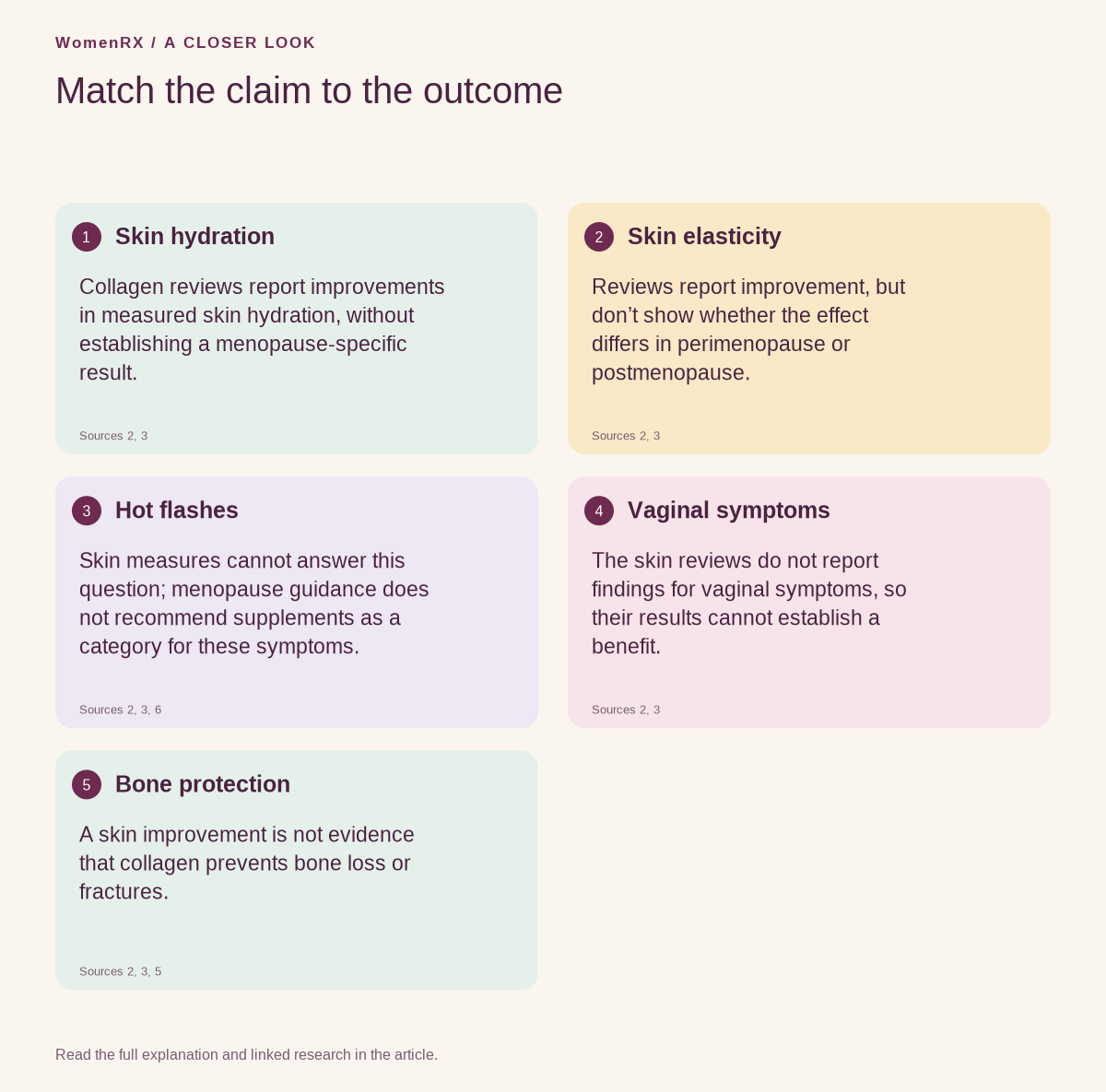
Match the claim to the outcome
Skin hydration: Collagen reviews report improvements in measured skin hydration, without establishing a menopause-specific result.23
Skin elasticity: Reviews report improvement, but don’t show whether the effect differs in perimenopause or postmenopause.23
Hot flashes: Skin measures cannot answer this question; menopause guidance does not recommend supplements as a category for these symptoms.236
Vaginal symptoms: The skin reviews do not report findings for vaginal symptoms, so their results cannot establish a benefit.23
Bone protection: A skin improvement is not evidence that collagen prevents bone loss or fractures.235
Read the figure as text
These distinctions show what the collagen skin research can help answer, and what requires different evidence.- Skin hydration: Collagen reviews report improvements in measured skin hydration, without establishing a menopause-specific result.23
- Skin elasticity: Reviews report improvement, but don’t show whether the effect differs in perimenopause or postmenopause.23
- Hot flashes: Skin measures cannot answer this question; menopause guidance does not recommend supplements as a category for these symptoms.236
- Vaginal symptoms: The skin reviews do not report findings for vaginal symptoms, so their results cannot establish a benefit.23
- Bone protection: A skin improvement is not evidence that collagen prevents bone loss or fractures.235
More questions, answered
Is a plant-based “collagen alternative” the same as collagen peptides?
No. For example, a 12-week trial tested a hibiscus extract marketed as a plant-based collagen alternative, not hydrolyzed collagen. Its skin results shouldn’t be counted as evidence that plant products and collagen peptides have the same effects. The trial summary also doesn’t report results by menopausal status. 1 3
Sources you can check
- Hibiscus Collagen Alternative (VC-H1) as an Oral Skin Rejuvenating Agent: A 12-Week Pilot Study.Baek Y, Nguyen NH, Lee YI, Jung MJ, Kim IA, Lee SJ, Kim HM, Lee JH. · International journal of molecular sciences · 2025Return to first citation
- Effects of collagen-based supplements on skin's hydration and elasticity: A systematic review and meta-analysis.Danessa G, Notario D, Regina R. · Indian journal of dermatology, venereology and leprology · 2025Return to first citation
- Effects of Oral Collagen for Skin Anti-Aging: A Systematic Review and Meta-Analysis.Pu SY, Huang YL, Pu CM, Kang YN, Hoang KD, Chen KH, Chen C. · Nutrients · 2023Return to first citation
- Low-molecular-weight collagen peptides supplement promotes a healthy skin: A randomized, double-blinded, placebo-controlled study.Seong SH, Lee YI, Lee J, Choi S, Kim IA, Suk J, Jung I, Baeg C, Kim J, Oh D, Lee JH. · Journal of cosmetic dermatology · 2024Return to first citation
- The 2022 hormone therapy position statement of The North American Menopause Society.“The 2022 Hormone Therapy Position Statement of The North American Menopause Society” Advisory Panel. · Menopause (New York, N.Y.) · 2022Return to first citation
- The 2023 nonhormone therapy position statement of The North American Menopause Society.Menopause (New York, N.Y.) · 2023Return to first citation
- Managing Menopausal Skin Changes: A Narrative Review of Skin Quality Changes, Their Aesthetic Impact, and the Actual Role of Hormone Replacement Therapy in Improvement.Viscomi B, Muniz M, Sattler S. · Journal of cosmetic dermatology · 2025Return to first citation
- The effect of menopause on the skin and other connective tissues.Calleja-Agius J, Brincat M. · Gynecological endocrinology : the official journal of the International Society of Gynecological Endocrinology · 2012Return to first citation