Collagen Supplements: What Skin and Joint Studies Show
Some collagen formulations have changed skin measurements or reduced knee pain in trials, but the result depends on what was tested and who took it.
Collagen peptides have shown some promising results, but “works” depends on your goal. Skin trials have reported changes in hydration and sometimes elasticity; knee trials have measured pain, not cartilage repair. The formulations and participants differ, and the knee osteoarthritis trials have substantial bias concerns. A result for one product isn’t a promise for another. 2 4 5
For skin, start with the outcome you care about
A skin study might measure hydration with an instrument, test elasticity, or ask participants how their skin looks. Those are different results. A change in water content, for example, may be relevant if dryness bothers you, but it doesn’t establish that a supplement will visibly reduce wrinkles.
In a 12-week randomized trial, 99 healthy Japanese women ages 35 to 50 received collagen peptides or placebo. The researchers reported increased skin water content and natural moisturizing factor, along with reduced water loss through the skin. Elasticity and skin thickness did not change. If firmer skin is the reason you’re considering collagen, that distinction matters. 5
Other formulations have produced different findings. In an eight-week trial of 72 women, tuna-derived collagen peptides performed differently from placebo on several measures, including hydration, elasticity, and skin density. Facial water loss was the exception: the groups did not differ significantly on that measure. This supports a finding for the tuna preparation tested, not for every collagen powder or drink. 4
A further 12-week trial in 60 healthy women tested a drink containing collagen peptides plus acerola extract, vitamins C and E, biotin, and zinc. Researchers reported an improvement in an imaging measure of facial skin structure. Because participants took the ingredients together, the trial cannot tell you whether collagen alone produced that result. 6
These studies give more useful information than a broad “anti-aging” claim, but they leave a practical question open: will a particular product make a difference you can notice? They tested specific preparations over weeks, measured different endpoints, and do not establish a dependable long-term change in appearance for every user. 4 5 6
For joints, the kind of knee problem matters
The strongest distinction is between diagnosed knee osteoarthritis and knee discomfort during activity. They aren’t interchangeable reasons to take a supplement.
A meta-analysis pooled four randomized trials involving 507 people with knee osteoarthritis. Pain scores favored collagen peptides over placebo, but all four trials were judged at high risk of bias, and results varied across studies. The authors rated the pain evidence as moderate quality. That leaves a possible symptom benefit, with less confidence than the positive pooled result alone might suggest. The trials assessed pain; they did not establish that collagen repairs cartilage. 2
A separate 12-week trial studied 180 physically active men and women ages 18 to 30 with exercise-related knee pain but no diagnosed joint disease. With a specific preparation of type I collagen peptides, pain during or after exercise fell by an average of 21.9 mm, compared with 15.6 mm with placebo, on a 100-mm pain scale. Pain at rest and after squats did not differ significantly between groups, and knee mobility did not significantly change. Both groups improved; the relevant finding is the smaller additional reduction in activity-related pain with the tested preparation. 3
Neither pain result is evidence of tissue rebuilding. A narrative review of nutraceuticals in knee osteoarthritis, including collagen peptides, found no consistent evidence that they change the structure of the disease. 1
How to compare a study with a product
First, check what the collagen is made from and what else is in it. Trials here tested, among other things, tuna-derived peptides, a specific type I peptide preparation, and a multi-ingredient skin drink. Collagen peptides can also come from bovine, fish, or chicken sources. If you avoid a source ingredient, check the product’s ingredient information rather than assuming all collagen is the same. A multi-ingredient product also cannot borrow the result of a collagen-only trial without qualification. 2 3 4 6
Next, match the participants and outcome to your question. An eight-week skin-elasticity result won’t answer whether a product eases knee pain. A trial in young adults with exercise-related discomfort won’t answer what to expect with osteoarthritis. And a pain-scale change, even when statistically significant, is not a demonstrated improvement in mobility. 3 4
Finally, keep the timeframe attached to the claim. The skin trials described above ran for eight or 12 weeks, and the activity-related knee trial ran for 12 weeks. The tuna study reported that measured skin effects remained two weeks after participants stopped, but that brief follow-up cannot establish lasting benefit. 3 4 5 6
Several skin trials enrolled women, while the young-adult knee trial enrolled both men and women. The reported results do not separate participants by menopause stage. So these studies can inform a woman considering collagen, but they cannot tell her whether it works differently during perimenopause or after menopause. 3 4 5 6
What Different Collagen Trials Tested
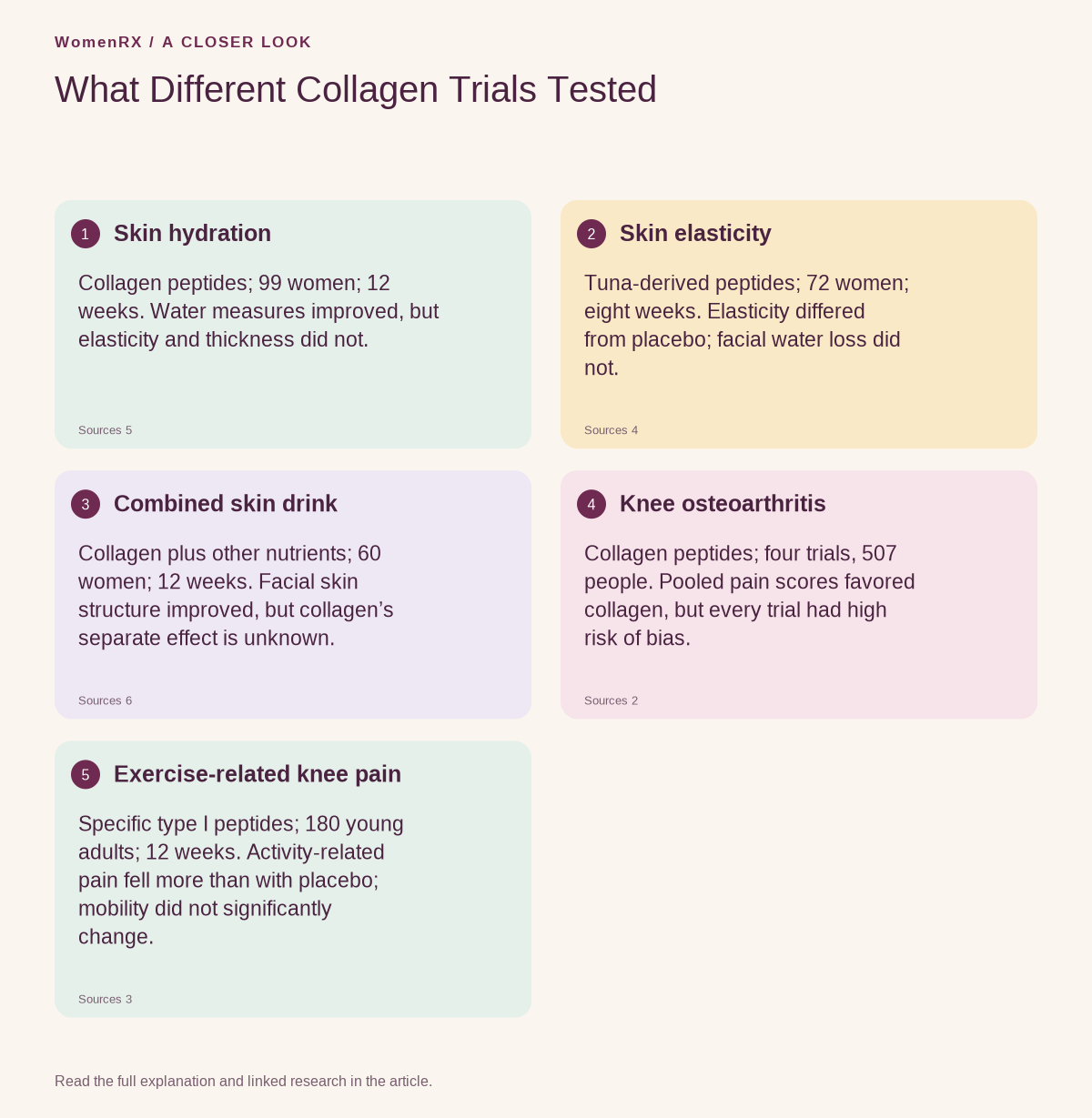
Skin hydration: Collagen peptides; 99 women; 12 weeks. Water measures improved, but elasticity and thickness did not.5
Skin elasticity: Tuna-derived peptides; 72 women; eight weeks. Elasticity differed from placebo; facial water loss did not.4
Combined skin drink: Collagen plus other nutrients; 60 women; 12 weeks. Facial skin structure improved, but collagen’s separate effect is unknown.6
Knee osteoarthritis: Collagen peptides; four trials, 507 people. Pooled pain scores favored collagen, but every trial had high risk of bias.2
Exercise-related knee pain: Specific type I peptides; 180 young adults; 12 weeks. Activity-related pain fell more than with placebo; mobility did not significantly change.3
Read the figure as text
The study closest to your goal is the one that tested a relevant formulation, group, and outcome.- Skin hydration: Collagen peptides; 99 women; 12 weeks. Water measures improved, but elasticity and thickness did not.5
- Skin elasticity: Tuna-derived peptides; 72 women; eight weeks. Elasticity differed from placebo; facial water loss did not.4
- Combined skin drink: Collagen plus other nutrients; 60 women; 12 weeks. Facial skin structure improved, but collagen’s separate effect is unknown.6
- Knee osteoarthritis: Collagen peptides; four trials, 507 people. Pooled pain scores favored collagen, but every trial had high risk of bias.2
- Exercise-related knee pain: Specific type I peptides; 180 young adults; 12 weeks. Activity-related pain fell more than with placebo; mobility did not significantly change.3
Sources you can check
- Reframing Nutraceuticals in Knee Osteoarthritis with Sarcopenia: A Muscle-Joint-Centered Narrative Review.Park D, Koh HS, Choi YH, Moon JW, Park I. · Nutrients · 2026Return to first citation
- Analgesic efficacy of collagen peptide in knee osteoarthritis: a meta-analysis of randomized controlled trials.Lin CR, Tsai SHL, Huang KY, Tsai PA, Chou H, Chang SH. · Journal of orthopaedic surgery and research · 2023Return to first citation
- The Influence of Specific Bioactive Collagen Peptides on Knee Joint Discomfort in Young Physically Active Adults: A Randomized Controlled Trial.Zdzieblik D, Brame J, Oesser S, Gollhofer A, König D, König D. · Nutrients · 2021Return to first citation
- The evidence from in vitro primary fibroblasts and a randomized, double-blind, placebo-controlled clinical trial of tuna collagen peptides intake on skin health.Morakul B, Teeranachaideekul V, Wongrakpanich A, Leanpolchareanchai J. · Journal of cosmetic dermatology · 2024Return to first citation
- Oral Supplementation of Collagen Peptides Improves Skin Hydration by Increasing the Natural Moisturizing Factor Content in the Stratum Corneum: A Randomized, Double-Blind, Placebo-Controlled Clinical Trial.Miyanaga M, Uchiyama T, Motoyama A, Ochiai N, Ueda O, Ogo M. · Skin pharmacology and physiology · 2021Return to first citation
- A Dermonutrient Containing Special Collagen Peptides Improves Skin Structure and Function: A Randomized, Placebo-Controlled, Triple-Blind Trial Using Confocal Laser Scanning Microscopy on the Cosmetic Effects and Tolerance of a Drinkable Collagen Supplement.Laing S, Bielfeldt S, Ehrenberg C, Wilhelm KP. · Journal of medicinal food · 2020Return to first citation