Collagen Supplements: Match the Product to Your Goal
Some collagen peptide trials in women report changes in measured skin hydration, but findings differ by outcome and product.
If you’re considering oral collagen for your skin, start with the specific change you want: hydration, elasticity, density, or wrinkles. Small trials of particular peptide products report changes in some of these measures, but not consistently across outcomes. These skin studies don’t answer whether collagen helps joint symptoms, and they don’t establish a women-specific benefit across products. 1 2 3 4
Decide by the outcome, not the label
“Collagen for skin” can mean less dryness, improved elasticity, or fewer visible wrinkles. Those are separate outcomes: a change in hydration doesn’t automatically mean a change in elasticity or wrinkles. The trials below tested specific collagen peptide products, so their results shouldn’t be treated as proof that every supplement works the same way.
For example, a 12-week placebo-controlled trial in 99 healthy Japanese women aged 35 to 50 found increased skin water content and reduced water loss through the skin, but no change in elasticity or thickness. 2
What the skin trials found
| Your goal | What specific trials reported | What remains unanswered |
|---|---|---|
| Skin hydration | Trials in women reported improvements in measured hydration. 1 2 3 | Whether you’ll notice a meaningful difference yourself. |
| Elasticity | Some trials reported improvement; the 12-week Japanese women’s trial found no change. 1 2 3 | Whether the result carries over to other products. |
| Skin density | Improvements were reported in trials of particular peptide products. 1 3 | Whether products with different sources or formulations have the same effect. |
| Wrinkles | One low-molecular-weight peptide trial reported improvements in several wrinkle measures. 4 | Whether that result applies to women specifically or to other products. |
| Joint symptoms | The skin trials measured skin outcomes, not joint pain or function. 1 2 3 4 | Whether collagen helps your joint concern. |
The women-only trials are relevant to the women who participated, including Japanese women aged 35 to 50 in one study and East Asian women aged 43 to 65 in another. They don’t show that women respond differently from men. The cited findings from a separate wrinkle trial also don’t establish a women-specific effect. 2 3 4
The wrinkle trial enrolled 100 people and analyzed results from 84. After 12 weeks, it reported improvements in several wrinkle measures, skin hydration, and elasticity compared with placebo. Those are findings for that study’s product and participants, not a guarantee of a visible change for you. 4
A practical check before trying one
Name the outcome you want to assess. Hydration, elasticity, density, and wrinkles aren’t interchangeable. A trial may find a change in one while finding no change in another. 2
Compare the product with the one studied. An 8-week trial in 72 women tested tuna-derived collagen peptides; it reported improvements in hydration, elasticity, and density compared with placebo. That result is about the product tested, not proof that all collagen sources or formulations have the same effect. 1
Keep expectations tied to what was measured. These studies report changes in skin measurements over several weeks. They don’t establish how noticeable the changes will be to an individual or show that collagen reverses skin aging. 1 2 3 4
Separate skin evidence from safety questions. One 12-week trial reported no adverse events associated with its test material during the study, but that finding doesn’t establish the safety of every product. The skin results discussed here don’t answer questions about medicine interactions, allergies, or use during pregnancy or breastfeeding. If one of those questions applies to you, ask a clinician or pharmacist about the specific product before using it. 4
If joint symptoms are your reason for considering collagen, these skin findings can’t tell you whether it will help. Look for evidence that directly measures the joint outcome you care about rather than using skin results as a stand-in. 1 2 3 4
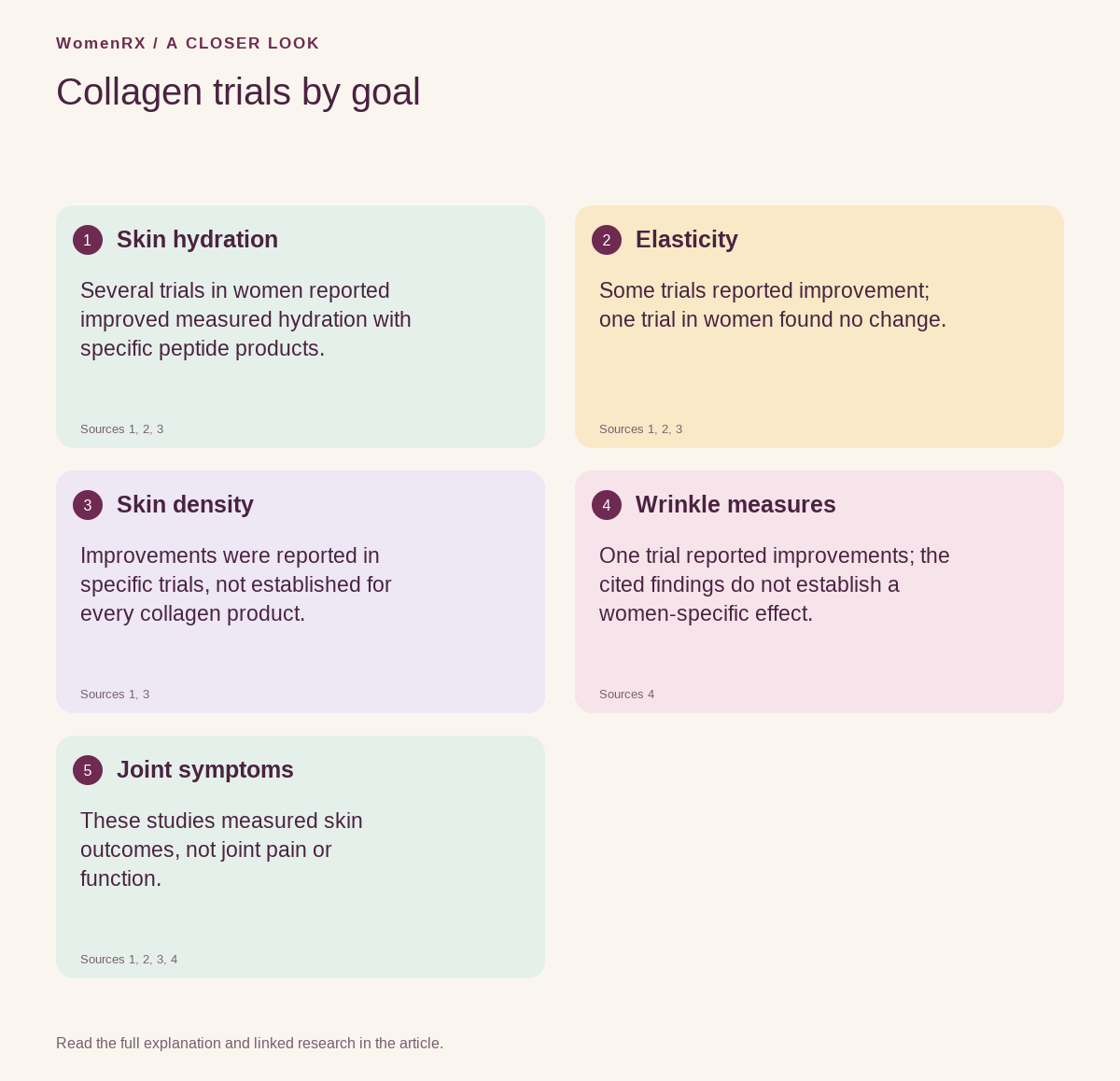
Collagen trials by goal
Skin hydration: Several trials in women reported improved measured hydration with specific peptide products.123
Elasticity: Some trials reported improvement; one trial in women found no change.123
Skin density: Improvements were reported in specific trials, not established for every collagen product.13
Wrinkle measures: One trial reported improvements; the cited findings do not establish a women-specific effect.4
Joint symptoms: These studies measured skin outcomes, not joint pain or function.1234
Read the figure as text
The findings differ by skin measure, and results for a specific product do not establish the same effect for other products or goals.- Skin hydration: Several trials in women reported improved measured hydration with specific peptide products.123
- Elasticity: Some trials reported improvement; one trial in women found no change.123
- Skin density: Improvements were reported in specific trials, not established for every collagen product.13
- Wrinkle measures: One trial reported improvements; the cited findings do not establish a women-specific effect.4
- Joint symptoms: These studies measured skin outcomes, not joint pain or function.1234
More questions, answered
Do collagen skin studies show that collagen helps joint symptoms?
No. The trials discussed here measured skin outcomes such as hydration, elasticity, density, or wrinkles, not joint pain or function. They can’t answer whether collagen helps a joint concern. 1 2 3 4
Sources you can check
- The evidence from in vitro primary fibroblasts and a randomized, double-blind, placebo-controlled clinical trial of tuna collagen peptides intake on skin health.Morakul B, Teeranachaideekul V, Wongrakpanich A, Leanpolchareanchai J. · Journal of cosmetic dermatology · 2024Return to first citation
- Oral Supplementation of Collagen Peptides Improves Skin Hydration by Increasing the Natural Moisturizing Factor Content in the Stratum Corneum: A Randomized, Double-Blind, Placebo-Controlled Clinical Trial.Miyanaga M, Uchiyama T, Motoyama A, Ochiai N, Ueda O, Ogo M. · Skin pharmacology and physiology · 2021Return to first citation
- Influence of collagen peptide supplementation on visible signs of skin and nail health and -aging in an East Asian population: A double blind, randomized, placebo-controlled trial.Vleminckx S, Virgilio N, Asserin J, Prawitt J, Silva CIF. · Journal of cosmetic dermatology · 2024Return to first citation
- Oral Supplementation of Low-Molecular-Weight Collagen Peptides Reduces Skin Wrinkles and Improves Biophysical Properties of Skin: A Randomized, Double-Blinded, Placebo-Controlled Study.Kim J, Lee SG, Lee J, Choi S, Suk J, Lee JH, Yang JH, Yang JS, Kim J. · Journal of medicinal food · 2022Return to first citation