Collagen Supplements: Match the Product to the Outcome
Collagen studies measure specific skin changes and joint outcomes, so the label alone can’t tell you whether a product fits your goal.
For skin, human trials have measured hydration, elasticity, wrinkles, and skin-barrier measures, mainly with hydrolyzed collagen products. For joints, the evidence is harder to match to collagen alone: one trial reporting less pain and better mobility used collagen alongside several other ingredients. Check the exact formulation and measured outcome, and don’t assume results for one product apply to another. 1 2
Start with the change you want to measure
“Better skin” can mean more than one thing. Researchers have measured skin hydration, elasticity, wrinkle depth or volume, water loss through the skin barrier, and features of skin structure. These are distinct outcomes: a change in an instrument-measured hydration reading is not the same as a visible reduction in wrinkles, and neither automatically means a product will address every concern you have.
A 2026 systematic review of 25 randomized trials of hydrolyzed collagen found improvements over placebo in hydration in 10 of 15 trials, elasticity in 10 of 13, and wrinkle depth or volume in 9 of 10. Results for water loss through the skin were less consistent. Most trials were judged at high risk of bias, so the number of positive trials doesn’t tell you how large or dependable a benefit is for a particular product. 2
For a joint goal, name the outcome too: pain, mobility, function, or a measure of joint structure. These aren’t interchangeable. A change in a questionnaire score, for example, doesn’t by itself show that cartilage has been repaired.
Read the formulation, not just “collagen”
The studies don’t test one uniform product. They include hydrolyzed collagen, also called collagen peptides, and products that combine collagen with other ingredients. The distinction matters when you’re trying to work out what a result says about the product you’re considering.
For example, one randomized trial tested a liquid product containing hydrolyzed fish collagen along with chondroitin sulfate, glucosamine, L-carnitine, vitamins, and minerals. The researchers reported increased skin elasticity compared with placebo. They also reported reduced joint pain and improved joint mobility, but the abstract doesn’t specify whether those joint changes were compared with placebo. Because the ingredients were combined, the results cannot establish that collagen alone produced the changes. 1
A separate randomized trial studied a specific bovine type I collagen-peptide product in healthy women aged 35 to 55. It measured skin hydration, water loss, and skin structure; reported benefits at 12 weeks remained at the study’s 16-week assessment after a four-week period without the product. That’s a result for one formulation and a small, specific study population, not a schedule or promise for other collagen products. 3
So when a label says “peptides,” “hydrolyzed,” or names an animal source or collagen type, treat that as a description to compare with the study product, not proof of equivalent effects. A shared ingredient category doesn’t mean two products have the same formulation or have been tested for the same outcome. 2 3
Joint claims need an extra check
A broad umbrella review reported generally favorable findings across collagen research on musculoskeletal health. But that kind of summary doesn’t tell you whether the exact product on a shelf has been tested for your particular joint concern or outcome. 4
In a systematic review of skin trials, quality-of-life outcomes came from seven studies, primarily involving people with osteoarthritis or rheumatoid arthritis, and varied by study population and measurement tool. That doesn’t provide a clear, product-specific answer about joint pain or function. 2
When a joint product claim points to a trial, check whether the trial tested collagen by itself or a blend, and whether it measured the outcome you care about. The multi-ingredient fish-collagen trial, for instance, reported changes in pain and mobility. Its results are relevant to that tested blend, but can’t isolate collagen’s contribution. 1
What the women’s results do, and don’t, tell you
Some skin evidence is specifically from women. The bovine peptide trial included healthy women aged 35 to 55, and a separate open-label study of a collagen-and-micronutrient product enrolled women aged 45 to 65 and measured wrinkles and other skin features. The latter had no placebo comparison, which makes it harder to know how much of the observed change was due to the product. 3 5
That doesn’t establish a different response by sex, age, or menopause status. The review summaries don’t provide a clear comparison of outcomes across those groups, and the cited women-only skin trials don’t answer whether results differ by menopause status. If a product’s marketing makes a women-specific or menopause-specific promise, look for a trial that actually reports that group and outcome.
A quick product-to-study comparison
Before treating a study as a reason to choose a product, compare three things: the formulation, the people studied, and the measured outcome. A close match on all three gives you a more relevant comparison than a headline that simply says “collagen supports skin and joints.” Even then, study findings are not a guarantee of a noticeable change for an individual. The skin-trial literature includes varied designs and many studies with high risk of bias. 2
The practical bottom line: skin hydration, elasticity, and wrinkle measures have been studied with hydrolyzed collagen, but confidence is limited by study quality and product differences. Joint findings are less straightforward to attribute to collagen alone when products combine ingredients. Match the evidence to your specific goal rather than relying on a broad collagen claim. 1 2
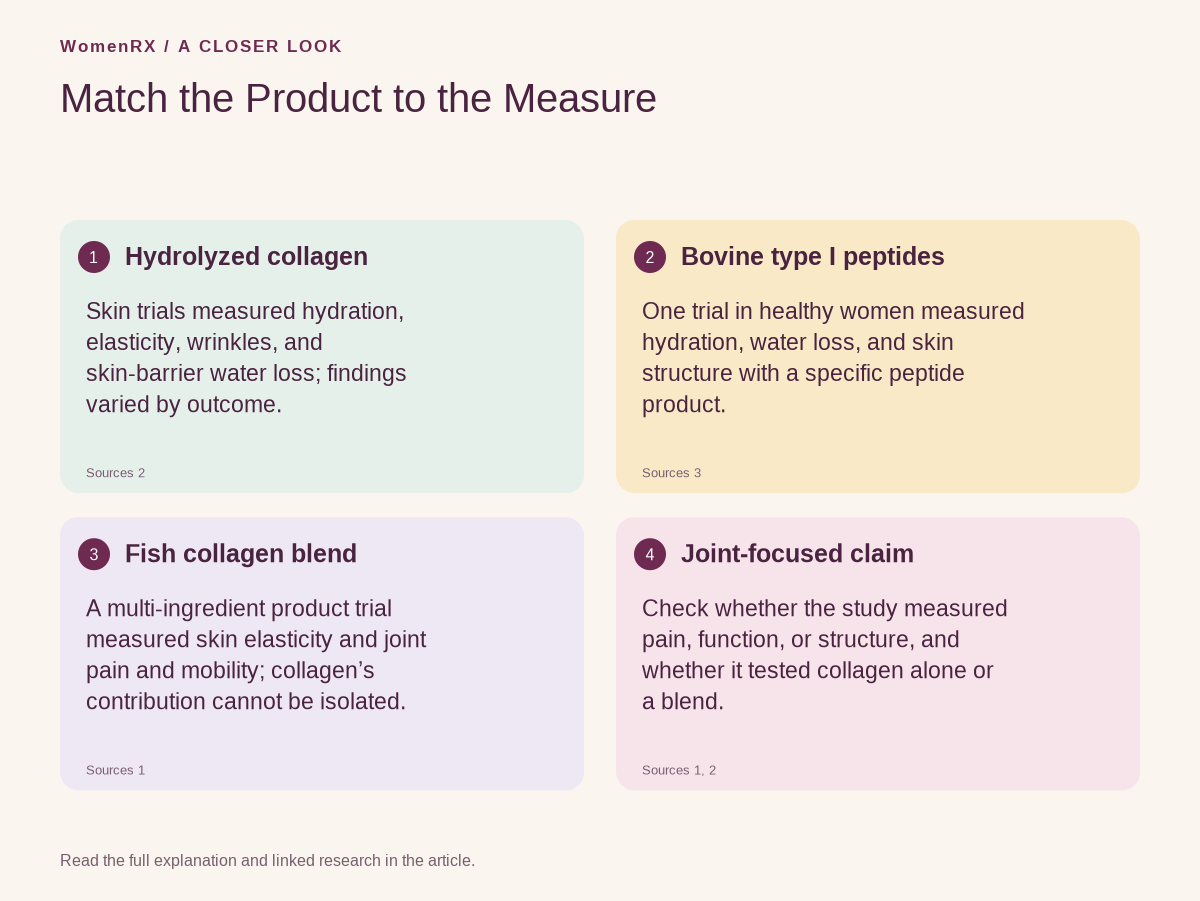
Match the Product to the Measure
Hydrolyzed collagen: Skin trials measured hydration, elasticity, wrinkles, and skin-barrier water loss; findings varied by outcome.2
Bovine type I peptides: One trial in healthy women measured hydration, water loss, and skin structure with a specific peptide product.3
Fish collagen blend: A multi-ingredient product trial measured skin elasticity and joint pain and mobility; collagen’s contribution cannot be isolated.1
Joint-focused claim: Check whether the study measured pain, function, or structure, and whether it tested collagen alone or a blend.12
Read the figure as text
These examples show why a collagen label, the tested formulation, and the measured outcome all matter when judging a claim.- Hydrolyzed collagen: Skin trials measured hydration, elasticity, wrinkles, and skin-barrier water loss; findings varied by outcome.2
- Bovine type I peptides: One trial in healthy women measured hydration, water loss, and skin structure with a specific peptide product.3
- Fish collagen blend: A multi-ingredient product trial measured skin elasticity and joint pain and mobility; collagen’s contribution cannot be isolated.1
- Joint-focused claim: Check whether the study measured pain, function, or structure, and whether it tested collagen alone or a blend.12
More questions, answered
Does a study of collagen peptides apply to every collagen supplement?
Not necessarily. Studies test particular formulations, and some products include other active ingredients. A result for one peptide product or blend doesn’t establish the same effect for every product described as collagen. 1 2 3
Have collagen studies shown a different effect after menopause?
The cited skin evidence doesn’t establish that. Some trials enrolled women in particular age ranges, but those findings don’t show that effects differ by menopause status. 3 5
Sources you can check
- Daily oral supplementation with collagen peptides combined with vitamins and other bioactive compounds improves skin elasticity and has a beneficial effect on joint and general wellbeing.Czajka A, Kania EM, Genovese L, Corbo A, Merone G, Luci C, Sibilla S. · Nutrition research (New York, N.Y.) · 2018Return to first citation
- Efficacy and safety of hydrolyzed collagen supplementation on skin health outcomes: a systematic literature review of randomized controlled trials.Bassila C, Bassila JC, Slim M. · European journal of clinical nutrition · 2026Return to first citation
- The Sustained Effects of Bioactive Collagen Peptides on Skin Health: A Randomized, Double-Blind, Placebo-Controlled Clinical Study.Wang Y, Zhu W, Luo W, Ma Y, Zhou Y. · Journal of cosmetic dermatology · 2025Return to first citation
- Collagen Supplementation for Skin and Musculoskeletal Health: An Umbrella Review of Meta-Analyses on Elasticity, Hydration, and Structural Outcomes.Ravindran R, Pizzol D, López-Gil JF, Rahmati M, Boyer L, Fond G, Butler L, Stellato A, Gawronska J, Barnett Y, Keyes H, Soysal P, Eren R, Onal B, Yon DK, Smith L. · Aesthetic surgery journal. Open forum · 2026Return to first citation
- Beneficial Effects of Multi-Micronutrient Supplementation with Collagen Peptides on Global Wrinkles, Skin Elasticity and Appearance in Healthy Female Subjects.Gibson R, Krug L, Ramsey DL, Safaei A, Aspley S. · Dermatology and therapy · 2024Return to first citation