Do Collagen Supplements Work? Judge the Outcome, Not the Hype
Some collagen products have shown changes in specific skin measures, but evidence for joints, bones, hair, and nails is more limited or mixed.
Collagen supplements aren’t one proven treatment with one predictable benefit. Trials have reported improvements in skin hydration and elasticity, while a small knee osteoarthritis trial found no advantage over placebo for a combined collagen product. Bone findings are preliminary, and hair and nail results are less certain. The product, outcome measured, and study quality all matter. 4312
A collagen label can make a broad promise, but a study usually tests something much narrower: one formulation, in a particular group, for a specific outcome. A change in a skin instrument reading, for example, doesn’t show that the same product relieves joint pain or prevents bone loss.
A useful way to assess a claim is to ask: What type of collagen was tested, what changed, and compared with what? Results from one product shouldn’t automatically be applied to every powder, capsule, or collagen claim.
Skin: the clearest signal is in measured skin outcomes
A meta-analysis of 14 randomized trials included 967 participants and examined hydrolyzed collagen. Across the studies, which lasted four to 12 weeks, the review reported improved skin hydration and elasticity compared with placebo. These are specific measured outcomes, not proof of a lasting change in appearance or a benefit for every person who takes collagen. 4
A separate review of human studies described reported improvements in hydration, elasticity, and wrinkle appearance. But it highlighted reasons to be cautious about how consistent or large the effects are: trials were often short, used varied designs, and sometimes combined collagen with other ingredients; industry funding was also a concern. 2
So the grounded version of the claim is that some studies found changes in certain skin measures over a limited period. That’s different from showing that collagen reverses skin aging, works equally across products, or produces a visible result that lasts after supplementation ends.
Joints: one formulation did not beat placebo
A randomized, double-blind trial tested a combination of hydrolyzed collagen and undenatured type II collagen in 68 people with knee osteoarthritis. After 12 weeks, pain and function improved in both the collagen and placebo groups, but there were no significant differences between groups in pain, function, use of rescue medication, or satisfaction. The result applies to that combination and study, not every collagen product or every joint condition. 3
That distinction matters when a claim says collagen “supports joints.” A study of symptoms in people with knee osteoarthritis asks a different question from a study of joint structure or prevention. Improvement within a group also doesn’t establish that the supplement worked better than placebo.
Bones: promising does not mean proven prevention
A review of fish collagen hydrolysates describes early clinical findings related to bone turnover and bone mineral density, alongside laboratory and animal research. The review says larger, robust randomized studies are still needed. That makes bone health an area of investigation, not established evidence that collagen prevents or treats osteoporosis. 1
Bone density is also a different endpoint from a fracture. A finding involving fish-derived collagen shouldn’t be taken as evidence that collagen supplements generally protect bones.
Hair and nails: encouraging reports, thinner evidence
A review of human studies reports possible improvements in hair thickness or strength and modest changes in nail growth. It also describes the evidence as heterogeneous and limited by issues including short study duration, varied designs, combination products, and industry funding. Those findings aren’t enough to promise that a collagen supplement will improve hair loss or brittle nails. 2
A reported change in thickness, strength, or growth is not automatically evidence that a supplement treats the underlying cause of a hair or nail problem.
What the evidence can say about women
These findings don’t establish whether collagen works differently across the cycling years, perimenopause, or postmenopause, or what to expect during pregnancy. A review mentions a skin trial involving 128 middle-aged women, but that detail alone cannot establish a menopause-specific benefit or show that its results apply to all women. 2
When a product is marketed specifically to women, look for the study population and any reported subgroup results behind that claim. Including women in a study is not, by itself, proof of a women-specific effect.
Match the claim to the test
Before treating a collagen promise as evidence, pin it to the study: Was it hydrolyzed collagen, undenatured type II collagen, or a combination? Was the outcome hydration, pain, or bone density? Was there a placebo comparison?
Then keep the conclusion at the same scale as the finding. A short-term skin measurement is a skin measurement; a preliminary bone signal is not proof of osteoporosis prevention. The evidence for collagen depends on the product and the outcome, not the word collagen on the label.
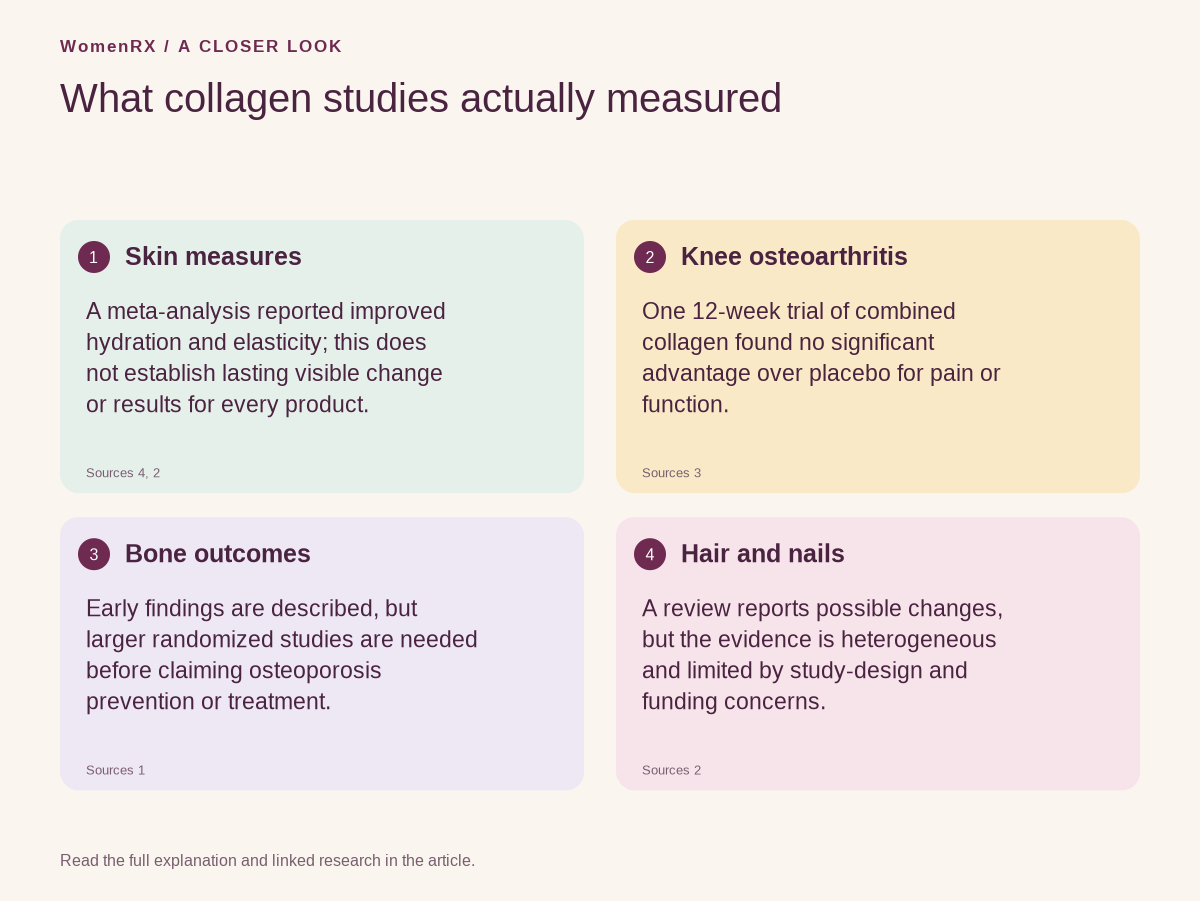
What collagen studies actually measured
Skin measures: A meta-analysis reported improved hydration and elasticity; this does not establish lasting visible change or results for every product.42
Knee osteoarthritis: One 12-week trial of combined collagen found no significant advantage over placebo for pain or function.3
Bone outcomes: Early findings are described, but larger randomized studies are needed before claiming osteoporosis prevention or treatment.1
Hair and nails: A review reports possible changes, but the evidence is heterogeneous and limited by study-design and funding concerns.2
Read the figure as text
Each outcome answers a different question. The finding for one does not establish a benefit for another.- Skin measures: A meta-analysis reported improved hydration and elasticity; this does not establish lasting visible change or results for every product.42
- Knee osteoarthritis: One 12-week trial of combined collagen found no significant advantage over placebo for pain or function.3
- Bone outcomes: Early findings are described, but larger randomized studies are needed before claiming osteoporosis prevention or treatment.1
- Hair and nails: A review reports possible changes, but the evidence is heterogeneous and limited by study-design and funding concerns.2
Sources you can check
- Therapeutic potential of fish collagen hydrolysates in osteoporosis prevention: a narrative review based on cellular, molecular, and clinical evidence.Alvi A, Parashar K, Siddiqui S, Arshad M. · Osteoporosis international : a journal established as result of cooperation between the European Foundation for Osteoporosis and the National Osteoporosis Foundation of the USA · 2026Return to first citation
- Dietary Collagen Supplementation as a Strategy for Skin Health: A Narrative Review of Clinical Effects on Skin, Hair, Nails, and Wound Healing.Biełach-Bazyluk A, Jurga M, Flisiak I, Zbroch E. · Nutrients · 2026Return to first citation
- Efficacy of combined undenatured type II collagen and hydrolysed collagen supplementation in knee osteoarthritis: a randomised controlled trial.Yuenyongviwat V, Anusitviwat C, Tuntarattanapong P, Hongnaparak T, Iamthanaporn K. · Scientific reports · 2025Return to first citation
- Exploring the Impact of Hydrolyzed Collagen Oral Supplementation on Skin Rejuvenation: A Systematic Review and Meta-Analysis.Dewi DAR, Arimuko A, Norawati L, Yenny SW, Setiasih NL, Perdiyana A, Arkania N, Nadhira F, Wiliantari N. · Cureus · 2023Return to first citation