Can Magnesium Supplements Ease Anxiety?
Magnesium may help some people with anxiety symptoms, but current evidence doesn’t show that it treats anxiety disorders.
Magnesium is worth discussing if you have a reason to suspect low magnesium or want to understand how a supplement fits with your medications. But studies of anxiety symptoms have been small or limited to particular groups, and the evidence is poor. Magnesium hasn’t been established as a treatment for a diagnosed anxiety disorder, so don’t let trying it postpone care when anxiety is disrupting daily life. 3 2
Magnesium is sometimes promoted as a calming supplement. The more useful question is what kind of evidence supports that idea. Studies have looked at people with subjective anxiety, premenstrual symptoms, postpartum anxiety, and other health concerns. Those findings don’t establish magnesium as a treatment for an anxiety disorder, and they don’t show that women need extra magnesium because of hormones. 3
What the anxiety studies actually tested
A 2017 systematic review included 18 human intervention studies in adults who were considered more vulnerable to anxiety. The groups included people with mild anxiety, premenstrual symptoms, postpartum status, and hypertension. The studies used subjective anxiety measures, and the reviewers described the overall evidence as poor quality. 3
Results weren’t consistent. Four of eight studies in anxious samples and four of seven studies in premenstrual-symptom samples reported a positive effect on subjective anxiety. Magnesium had no effect on postpartum anxiety in the two studies reviewed. The review found no study using a validated measure of subjective stress as an outcome. 3
These results leave room for a possible benefit in some groups, but they don’t show that magnesium reliably reduces anxiety. Nor is a change in a symptom rating the same as showing that a supplement treats a diagnosed condition. Anxiety disorders can involve persistent, hard-to-control fear or worry that interferes with everyday activities; diagnosis involves assessing symptoms and medical history, and sometimes checking for other causes. 3 2
What’s known about women’s life stages
The review included studies involving premenstrual symptoms and postpartum status, but the findings don’t support a general claim that magnesium helps anxiety across women’s reproductive stages. In particular, the review found no effect on postpartum anxiety. Its results don’t establish a benefit for pregnancy-related anxiety. 3
A small trial offers a limited menopause-related data point, not a general answer. In a pilot study of women with postmenopausal osteoporosis, 35 participants completed analysis of a comparison involving standard osteoporosis treatment, zoledronate, with or without magnesium. Anxiety and other outcomes did not change significantly. Because magnesium was added to another treatment and the participants had osteoporosis, this study can’t tell us whether magnesium alone helps anxiety in postmenopausal women generally. 6
Low magnesium and anxiety aren’t the same question
A suspected deficiency is a separate reason to talk about magnesium. In otherwise healthy people, symptomatic deficiency from low dietary intake alone is uncommon; certain health conditions, excessive losses, chronic alcoholism, or some medications can raise the risk. That doesn’t mean a supplement will ease anxiety in someone whose magnesium status is normal. 1
If you’re considering a supplement, include your medications in the conversation. Magnesium-containing products can affect absorption of some oral medicines: evidence describes interactions with levothyroxine tablets and fluoroquinolone antibiotics. Ask a pharmacist how a product fits with your specific medication rather than guessing about timing. 4 5
Don’t make a supplement a reason to wait
If anxiety keeps coming back, is getting worse, or is affecting work, relationships, sleep, or ordinary decisions, it deserves attention in its own right. Magnesium has not been established as a substitute for assessment or care for persistent anxiety. You can discuss a supplement while also seeking help for the anxiety itself. 2 3
A practical way to frame the discussion is: “Could I have a reason to be low in magnesium, and would a supplement interact with anything I take?” That keeps the decision focused on your health and medications, not on an assumption that anxiety is a magnesium problem.
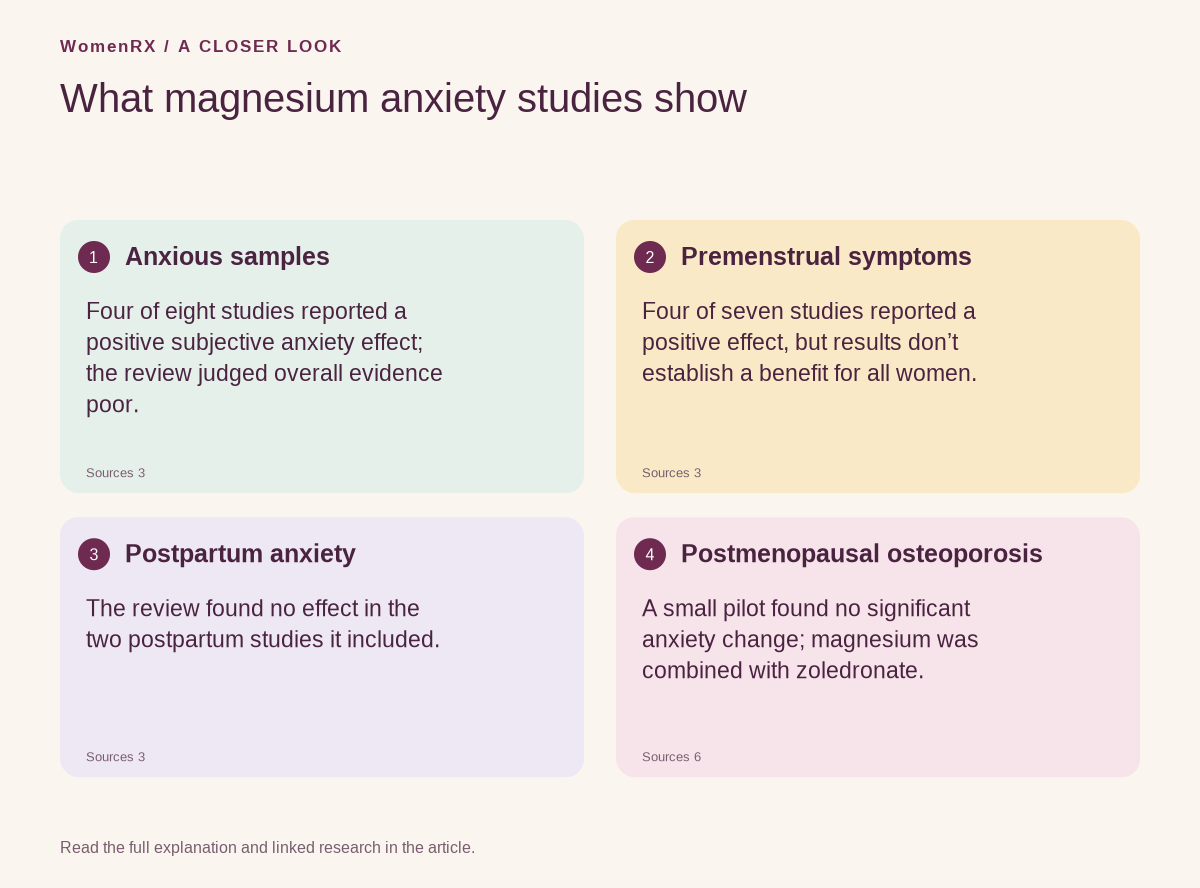
What magnesium anxiety studies show
Anxious samples: Four of eight studies reported a positive subjective anxiety effect; the review judged overall evidence poor.3
Premenstrual symptoms: Four of seven studies reported a positive effect, but results don’t establish a benefit for all women.3
Postpartum anxiety: The review found no effect in the two postpartum studies it included.3
Postmenopausal osteoporosis: A small pilot found no significant anxiety change; magnesium was combined with zoledronate.6
Read the figure as text
The findings differ by group, and symptom-rating results don’t establish treatment for an anxiety disorder.- Anxious samples: Four of eight studies reported a positive subjective anxiety effect; the review judged overall evidence poor.3
- Premenstrual symptoms: Four of seven studies reported a positive effect, but results don’t establish a benefit for all women.3
- Postpartum anxiety: The review found no effect in the two postpartum studies it included.3
- Postmenopausal osteoporosis: A small pilot found no significant anxiety change; magnesium was combined with zoledronate.6
More questions, answered
Does a study showing lower stress prove magnesium treats anxiety?
No. Stress and anxiety are related but distinct outcomes, and a stress result doesn’t establish that magnesium treats an anxiety disorder. The 2017 review of magnesium interventions found no study using a validated subjective-stress measure. 3
Sources you can check
- Magnesium - Health Professional Fact SheetAccessed 2026-09-25Return to first citation
- Anxiety: MedlinePlusAccessed 2026-09-25Return to first citation
- The Effects of Magnesium Supplementation on Subjective Anxiety and Stress-A Systematic Review.Boyle NB, Lawton C, Dye L. · Nutrients · 2017Return to first citation
- Liquid levothyroxine formulations in patients taking drugs interfering with L-T4 absorption.Gatta E, Bambini F, Buoso C, Gava M, Maltese V, Anelli V, Delbarba A, Pirola I, Cappelli C. · Frontiers in endocrinology · 2022Return to first citation
- Effects of Magnesium, Calcium, and Aluminum Chelation on Fluoroquinolone Absorption Rate and Bioavailability: A Computational Study.Walden DM, Khotimchenko M, Hou H, Chakravarty K, Varshney J. · Pharmaceutics · 2021Return to first citation
- Quantitative sensory testing of pain in osteoporosis: a pilot randomized clinical trial with magnesium supplementation.Pickering ME, Morel V, Nicolas M, Dualé C, Sortais E, Graven-Nielsen T, Pereira B, Pickering G. · Aging clinical and experimental research · 2026Return to first citation