Anxiety Supplements in Midlife: Evidence and Safety
A supplement studied for stress in adults isn’t automatically proven for menopause-related anxiety, and its ingredients can matter as much as its promise.
Ashwagandha has shown possible anxiety and stress benefits in short trials of adults, while magnesium studies are mixed and varied. Neither set of findings establishes a menopause-specific benefit. Before trying either, check the exact ingredient and form, and review medication interactions: ashwagandha can affect thyroid function and interact with several medicines, while magnesium can interfere with some antibiotics and osteoporosis drugs. 124
Anxiety can show up during the menopause years, but that doesn’t prove hormones are the cause or that a supplement is the right answer. The useful question is more specific: what was studied, in whom, using which preparation, and what could it interact with?
The available human research on ashwagandha and magnesium offers some signals, but neither provides a clear menopause-specific answer. A supplement’s name on the front of a bottle also doesn’t guarantee that it matches the product used in a study.
What the research can and can’t tell you
Ashwagandha: A review of seven randomized trials included 491 adults in India who reported high stress or anxiety, or had an anxiety diagnosis. Trials lasted six to eight weeks and used root-only extracts, root-and-leaf extracts, an extract with unspecified plant parts, or dried-root granules. Overall, they found improvements in self-reported stress and anxiety compared with placebo. But the trials were fairly small, short, and used varied products. The participants weren’t described as a menopause group, so these results don’t establish a specific benefit for anxiety during perimenopause or postmenopause. 1
Magnesium: A systematic review included seven studies measuring anxiety outcomes. Five reported improvement on at least one self-reported anxiety measure; the studies differed in formulation, duration, and participants, and many were small. The review noted that two studies with negative results involved premenstrual symptoms and postpartum women. Those findings concern different life stages and don’t answer whether magnesium helps menopause-related anxiety. 4
These findings are reasons to be curious, not proof that either supplement treats anxiety for every person. A result from one extract or study population may not carry over to a different product or to midlife anxiety.
Look closely at the product, not just the ingredient name
With ashwagandha, studies have used root alone, root and leaf, or preparations where the plant part wasn’t specified. Extraction and standardization also varied. That makes it difficult to assume two products are equivalent just because both say “ashwagandha.” If comparing a product with a study, check whether the label identifies the plant part and extract; a matching name alone doesn’t show that it’s the same preparation. 1
Magnesium labels list the amount of elemental magnesium, not the weight of the whole magnesium compound. Forms also differ in absorption. That information helps you understand what a product contains, but it doesn’t establish that it will relieve anxiety. 2
A practical label check is to find the precise ingredient, plant part or mineral form, and stated amount. If the product combines several active ingredients, it may be harder to tell which one is responsible for a benefit or side effect. The studies summarized here don’t establish that a particular commercial product is equivalent to a tested preparation.
There’s a second question the label can’t answer on its own: has anyone independently checked what’s in this finished product? You can ask the manufacturer whether independent testing verified the product’s identity and ingredient amounts, and whether it applies to the exact product you’re considering. If that can’t be confirmed, treat the label as a description, not verification. Even verified contents wouldn’t show that the product relieves anxiety or is safe for long-term use. Reports of liver injury associated with ashwagandha illustrate why this distinction matters: the contents of the products used weren’t independently verified in every case. 1
Check interactions before using a supplement
Ashwagandha may affect thyroid function. The NIH Office of Dietary Supplements also notes possible interactions with thyroid hormone medicines, sedatives, medicines for diabetes or high blood pressure, and immunosuppressants. There have been a few reports of liver injury associated with ashwagandha use; signs reported in those cases included jaundice, itching, nausea, and abdominal discomfort. 1
Magnesium can reduce absorption of oral bisphosphonates used for osteoporosis and can bind to tetracycline or quinolone antibiotics, reducing their absorption. Some diuretics and long-term use of proton pump inhibitors can also affect magnesium status. Ask a pharmacist to check the timing and interaction details for your specific medicines rather than guessing. High supplemental amounts can cause diarrhea, nausea, or cramping; the risk of magnesium building up is greater with impaired kidney function. 2
When anxiety deserves a closer look
If worry is hard to control, is getting worse, or is interfering with work, sleep, relationships, or other daily activities, an assessment can help clarify what’s going on. Anxiety can have more than one contributing factor, and some physical conditions, including thyroid problems and arrhythmia, can be relevant. A clinician may ask about symptoms and medical history and, when appropriate, check for another health cause. 3
Psychotherapy, medicines, or both are established treatment options for anxiety disorders. A supplement shouldn’t be treated as a substitute for that assessment or care. If you’re weighing a supplement, bring the product label and a complete medication list to a pharmacist or clinician; that makes it easier to discuss the actual formulation and specific interaction risks. 3
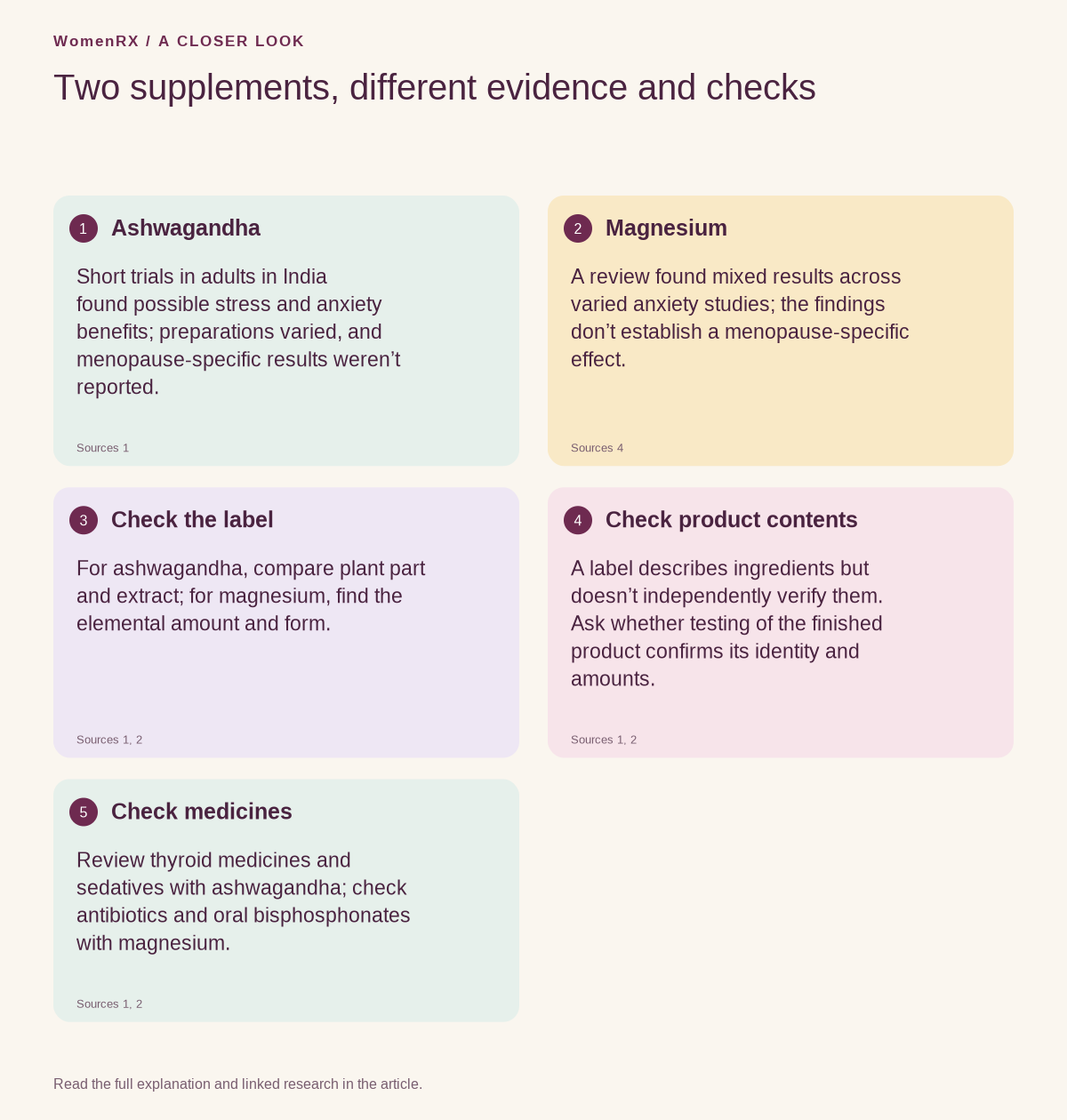
Two supplements, different evidence and checks
Ashwagandha: Short trials in adults in India found possible stress and anxiety benefits; preparations varied, and menopause-specific results weren’t reported.1
Magnesium: A review found mixed results across varied anxiety studies; the findings don’t establish a menopause-specific effect.4
Check the label: For ashwagandha, compare plant part and extract; for magnesium, find the elemental amount and form.12
Check product contents: A label describes ingredients but doesn’t independently verify them. Ask whether testing of the finished product confirms its identity and amounts.12
Check medicines: Review thyroid medicines and sedatives with ashwagandha; check antibiotics and oral bisphosphonates with magnesium.12
Read the figure as text
Compare the populations and preparations studied with the product and safety checks that matter before considering either supplement.- Ashwagandha: Short trials in adults in India found possible stress and anxiety benefits; preparations varied, and menopause-specific results weren’t reported.1
- Magnesium: A review found mixed results across varied anxiety studies; the findings don’t establish a menopause-specific effect.4
- Check the label: For ashwagandha, compare plant part and extract; for magnesium, find the elemental amount and form.12
- Check product contents: A label describes ingredients but doesn’t independently verify them. Ask whether testing of the finished product confirms its identity and amounts.12
- Check medicines: Review thyroid medicines and sedatives with ashwagandha; check antibiotics and oral bisphosphonates with magnesium.12
More questions, answered
Does magnesium help with menopause-related anxiety?
The studies summarized in a systematic review reported mixed results across varied groups and formulations. They don’t establish a menopause-specific effect, so a general magnesium finding shouldn’t be treated as proof that it will help midlife anxiety. 4
Can I take ashwagandha with thyroid medicine?
Ashwagandha may affect thyroid function, and the NIH Office of Dietary Supplements notes a potential interaction with thyroid hormone medicines. Have a pharmacist or clinician review the specific product and your medicines before using it. 1
Sources you can check
- Ashwagandha: Is it helpful for stress, anxiety, or sleep? - Health Professional Fact SheetAccessed 2026-09-25Return to first citation
- Magnesium - Health Professional Fact SheetAccessed 2026-09-25Return to first citation
- Anxiety: MedlinePlusAccessed 2026-09-25Return to first citation
- Examining the Effects of Supplemental Magnesium on Self-Reported Anxiety and Sleep Quality: A Systematic Review.Rawji A, Peltier MR, Mourtzanakis K, Awan S, Rana J, Pothen NJ, Afzal S. · Cureus · 2024Return to first citation