Anxiety Supplements: What Women Should Check First
Some herbs show promising anxiety results, but the outcome studied, your medicines, and your life stage matter more than a “calming” claim.
Ashwagandha has a preliminary signal from short trials measuring stress and anxiety, but those results don’t establish how well it treats anxiety disorders or whether benefits differ for women. Other herbs can’t be reliably ranked from the available comparisons. Before trying one, check what it was studied for, whether it could interact with your medicines, and whether pregnancy, breastfeeding, or a health condition changes the safety question. 135
What kind of anxiety are you trying to ease?
A product promoted for “calm” might have been studied for everyday stress, trouble sleeping, anxiety before a procedure, or an anxiety disorder. Those aren’t interchangeable. For example, feeling keyed up during a difficult week is different from worry that persists and interferes with work or relationships. Talk therapy, medicines, or both are the main treatments for anxiety disorders; cognitive behavioral therapy is one option. A supplement shouldn’t delay that care when anxiety is disrupting your life. 2
Ashwagandha: a signal, with limits
Ashwagandha has relatively detailed human evidence for stress and anxiety. A systematic review summarized by the NIH Office of Dietary Supplements identified seven randomized trials involving 491 adults in India. Participants had high self-reported stress or anxiety, or a diagnosed anxiety disorder. Over 6 to 8 weeks, those assigned ashwagandha generally reported lower stress and anxiety scores than those assigned placebo. An international taskforce’s recommendation for ashwagandha in generalized anxiety disorder was provisional because stronger evidence is still needed. 1
That’s a reason to take the findings seriously, not a reason to treat every ashwagandha product as proven therapy. The trials brought together people with different concerns, and the NIH summary doesn’t report results separately for women. It can’t tell you whether the benefit differs during the cycling years, perimenopause, or postmenopause. 1
The outcome can change the picture, too. In sleep findings reported by NIH, participants with insomnia reported better sleep and less perceived anxiety with ashwagandha than with placebo. Participants without insomnia reported better sleep but not less perceived anxiety. If your goal is relief from persistent worry, a sleep result alone doesn’t answer your question. 1
Kava, St. John’s wort, and the problem with “best” lists
A scoping review found 69 papers evaluating over-the-counter products in adults aged 18 to 60 with anxiety symptoms or a diagnosis. Studies most often examined kava, lavender, saffron, probiotics, Galphimia glauca, and valerian. Its summary identifies where research exists, but doesn’t give comparable benefit estimates that would justify ranking these products for you. It also names St. John’s wort as a commonly used product needing more anxiety research. That’s not proof it cannot work; it’s not a demonstrated anxiety benefit, either. 5
Study setting matters as much as an ingredient name. For example, a trial described in a clinical review measured passionflower’s effect on anxiety shortly before outpatient surgery. A result in that setting wouldn’t, by itself, show that passionflower treats months of persistent anxiety. 4
Make safety a product-specific check
“Natural” doesn’t tell you whether an herb is compatible with your medication. Herbal products include teas, powders, capsules, and extracts, and some herbs interact with prescription or over-the-counter medicines. A clinical review of botanicals used for mental health also describes drug-metabolism interactions, excessive sedation, and serotonin syndrome as concerns across the products it examined. It doesn’t establish that every herb has every one of those risks. 34
If you take medication, show a pharmacist or the clinician managing it the exact product and ingredient list, rather than asking whether supplements in general are safe. That gives them something specific to check for interactions. Don’t swap out an anxiety treatment that’s helping you to make room for an unproven supplement. 23
Pregnancy and breastfeeding deserve their own decision. NIH reports that a French food-safety agency recommended against ashwagandha use during pregnancy and breastfeeding, and for people with endocrine disorders. That recommendation is specific to ashwagandha; it doesn’t establish the safety of other herbs. If any of those circumstances applies, get advice about the particular product before using it. 13
A useful way to narrow the choice is to ask three things: Was the ingredient studied for my concern, such as persistent anxiety rather than sleep? Were the results compared with placebo or an established treatment? And has someone checked this actual product against my medicines and health circumstances? Those questions are more useful than a list of supposedly universal “best” supplements. 1235
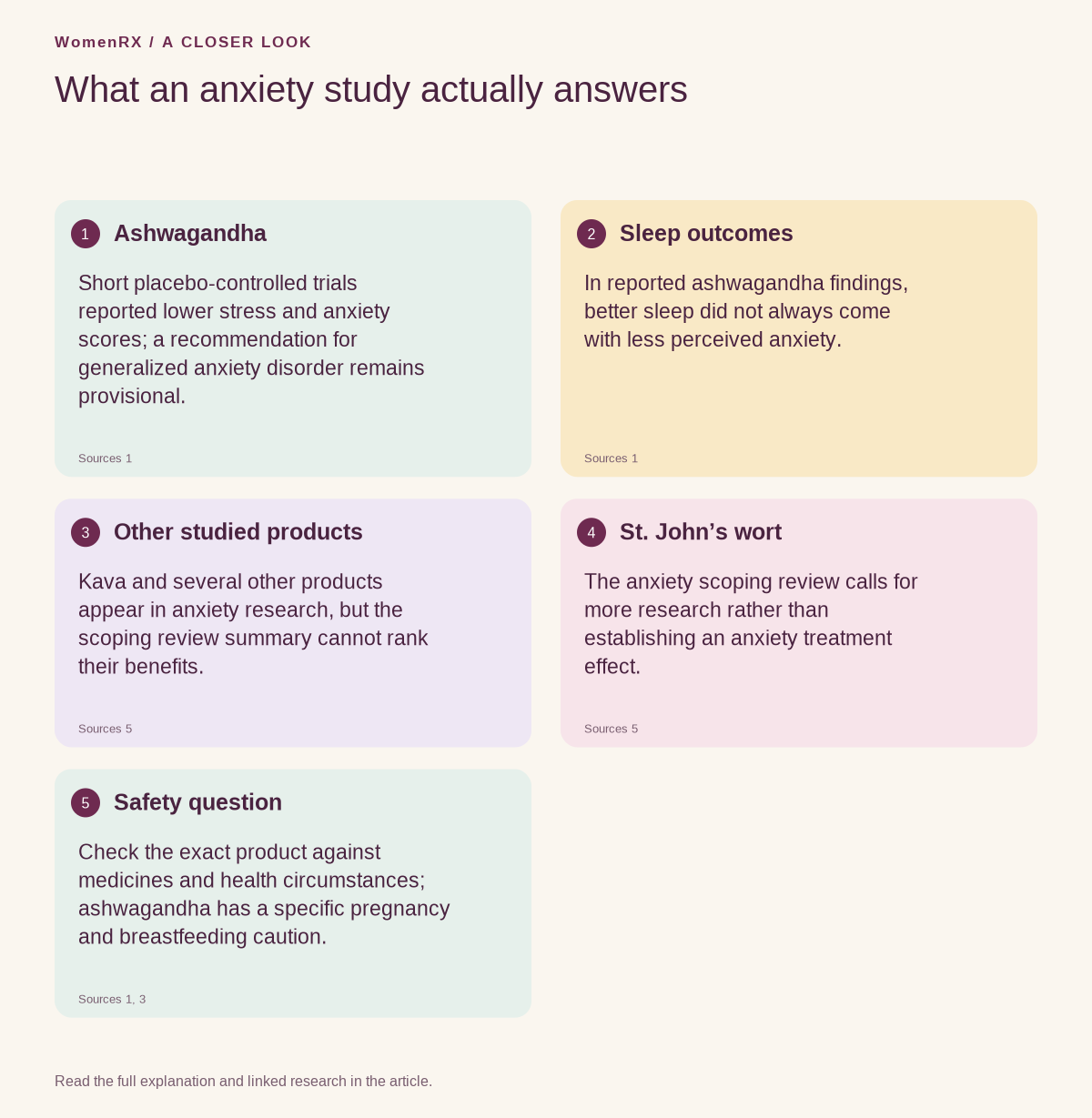
What an anxiety study actually answers
Ashwagandha: Short placebo-controlled trials reported lower stress and anxiety scores; a recommendation for generalized anxiety disorder remains provisional.1
Sleep outcomes: In reported ashwagandha findings, better sleep did not always come with less perceived anxiety.1
Other studied products: Kava and several other products appear in anxiety research, but the scoping review summary cannot rank their benefits.5
St. John’s wort: The anxiety scoping review calls for more research rather than establishing an anxiety treatment effect.5
Safety question: Check the exact product against medicines and health circumstances; ashwagandha has a specific pregnancy and breastfeeding caution.13
Read the figure as text
The ingredient, the people studied, and the outcome measured all affect how useful a finding is for your decision.- Ashwagandha: Short placebo-controlled trials reported lower stress and anxiety scores; a recommendation for generalized anxiety disorder remains provisional.1
- Sleep outcomes: In reported ashwagandha findings, better sleep did not always come with less perceived anxiety.1
- Other studied products: Kava and several other products appear in anxiety research, but the scoping review summary cannot rank their benefits.5
- St. John’s wort: The anxiety scoping review calls for more research rather than establishing an anxiety treatment effect.5
- Safety question: Check the exact product against medicines and health circumstances; ashwagandha has a specific pregnancy and breastfeeding caution.13
Sources you can check
- Ashwagandha: Is it helpful for stress, anxiety, or sleep? - Health Professional Fact SheetAccessed 2026-09-25Return to first citation
- Anxiety: MedlinePlusAccessed 2026-09-25Return to first citation
- Herbal Medicine: MedlinePlusAccessed 2026-09-25Return to first citation
- Efficacy and Safety of Herbal Supplements with Anxiolytic, Antidepressant, and Sedative Action: A Review of Clinical Data and Toxicological Risks.Căuș MN, Lupoae M, Chițescu CL. · Pharmaceuticals (Basel, Switzerland) · 2026Return to first citation
- What over the counter (OTC) products have been evaluated for anxiety in adults aged 18-60? A scoping review.Frost R, Uddin S, Mathew S, Thomas V, Salame A, Bhamra SK, Bazo-Alvarez JC, Bhanu C, Heinrich M, Walters K. · Journal of mental health (Abingdon, England) · 2025Return to first citation