Ashwagandha for Stress: What to Check First
Some short trials found less perceived stress with specific ashwagandha products, but your goal, the product, and your health history all matter.
Ashwagandha may be worth considering for stress, but short trials of particular products don’t promise relief or show a special benefit for women. Check the full ingredient list before treating one trial’s results as a reason to buy another product. Pregnancy, breastfeeding, thyroid disease, medicines, and liver disease also change what the research can tell you about suitability. 3 4 5 6
First, name the result you want
If you’re hoping to feel less stressed, there’s a reason ashwagandha gets attention. In a randomized trial of 135 stressed adults, people assigned to either of two sustained-release root-extract groups reported greater improvements in perceived stress and sleep quality than those assigned to placebo after 60 days. That’s encouraging, but it’s a finding about the tested formulation over a short period, not a promise about every ashwagandha product. 4
The goal makes a difference. For example, if hot flashes brought you to the supplement aisle, a stress trial isn’t the closest match. A separate randomized trial of 60 women aged 45 to 55 found better menopause symptom scores with a root extract than with placebo after 56 days. It’s an early, small finding, not enough to establish ashwagandha as a menopause treatment or a way to “balance hormones.” 7
Nor should a result in adults be read as a result specifically in women. An eight-week stress trial included men and women, but its reported results did not break out a women-only effect. 3
Read past the word “ashwagandha” on the label
The products studied aren’t interchangeable. One stress trial tested a sustained-release root extract. Another tested a proprietary product that contained ashwagandha plus Triphala and Trikatu. Improvement with that blend can’t be credited to ashwagandha alone. 3 4
If you’re comparing products, look for what the label actually identifies: a root extract, a blend with other herbs, or a sustained-release preparation. Then ask whether the finding you’ve heard about came from that preparation. These trials don’t identify a single best supplement, and a similar-looking label doesn’t establish the same benefit or safety.
Check where the safety research stops
Pregnant or breastfeeding? One stress trial excluded pregnant and lactating women. Its results can’t tell you whether the tested product is safe in either situation. That gap matters more than a general claim that an herb is “natural.” 3
Have a thyroid condition? A 12-week study measured thyroid laboratory values in healthy adults taking a root extract, but it didn’t study people with thyroid disease. It therefore doesn’t settle whether the product is suitable for someone with a thyroid condition or taking thyroid treatment. 5
Take medicine for stress or anxiety? People taking medicines that affect stress or anxiety were excluded from one trial. That doesn’t demonstrate an interaction, but it does mean the trial can’t answer how its product performs alongside those medicines. If this applies to you, the exact supplement ingredients and your medicine list are more useful to discuss with a clinician or pharmacist than the word “ashwagandha” alone. 3
Have advanced chronic liver disease? A review of published case reports and case series advises avoiding ashwagandha in that situation. It identified 25 people with ashwagandha-associated liver injury across 13 publications. Those reports can’t show how often injury occurs, but they shouldn’t be dismissed because a short trial found few problems. Yellowing of the eyes or skin and new itching were common features in the reported cases; if these appear while you’re using ashwagandha, stop taking it and seek prompt medical assessment, mentioning the supplement. 6
In a larger eight-week safety trial involving 1,002 adults with stress or anxiety, no serious adverse events were reported with the tested root extract. That is reassuring for that extract and study period. It cannot establish long-term safety or erase concerns seen in different people and settings. 2 6
Make the choice fit the problem
If your aim is everyday stress, weigh a possible short-term benefit from a specific preparation against what you don’t yet know about the product you’re considering. You can also address stress without adding a supplement: regular activity, relaxing practices such as breathing or meditation, and enough sleep are among the approaches MedlinePlus recommends for long-term stress. 1
If stress is keeping you from your usual activities, give that problem attention in its own right rather than relying on a supplement to carry the whole load. 1
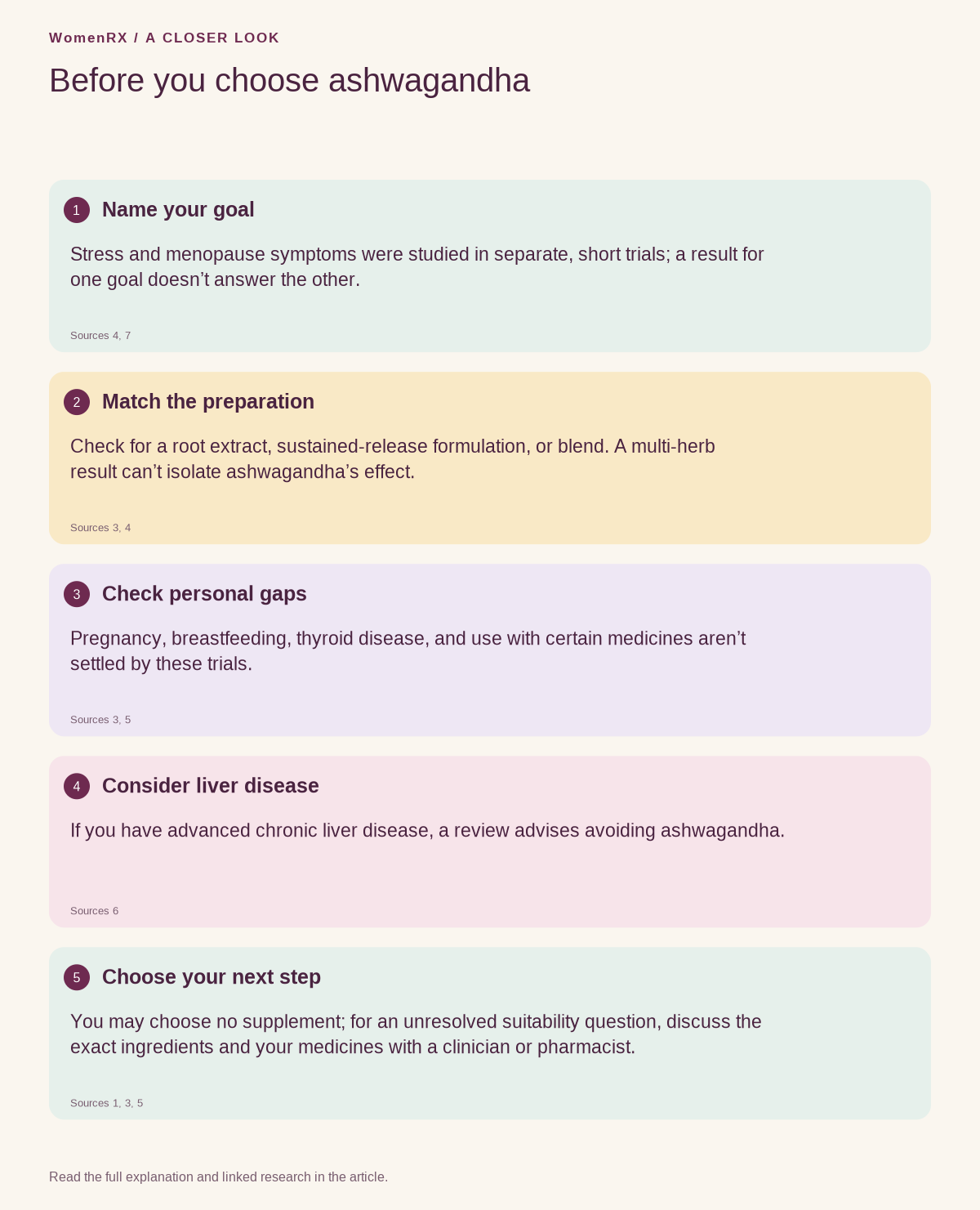
Before you choose ashwagandha
Name your goal: Stress and menopause symptoms were studied in separate, short trials; a result for one goal doesn’t answer the other.47
Match the preparation: Check for a root extract, sustained-release formulation, or blend. A multi-herb result can’t isolate ashwagandha’s effect.34
Check personal gaps: Pregnancy, breastfeeding, thyroid disease, and use with certain medicines aren’t settled by these trials.35
Consider liver disease: If you have advanced chronic liver disease, a review advises avoiding ashwagandha.6
Choose your next step: You may choose no supplement; for an unresolved suitability question, discuss the exact ingredients and your medicines with a clinician or pharmacist.135
Read the figure as text
Move from the outcome you want to what was actually studied, then check whether your health situation changes the decision.- Name your goal: Stress and menopause symptoms were studied in separate, short trials; a result for one goal doesn’t answer the other.47
- Match the preparation: Check for a root extract, sustained-release formulation, or blend. A multi-herb result can’t isolate ashwagandha’s effect.34
- Check personal gaps: Pregnancy, breastfeeding, thyroid disease, and use with certain medicines aren’t settled by these trials.35
- Consider liver disease: If you have advanced chronic liver disease, a review advises avoiding ashwagandha.6
- Choose your next step: You may choose no supplement; for an unresolved suitability question, discuss the exact ingredients and your medicines with a clinician or pharmacist.135
More questions, answered
Do short trials prove ashwagandha is safe for long-term use?
No. An eight-week randomized safety trial reported no serious adverse events with its tested root extract, but that result doesn’t establish safety with longer use, other formulations, or every health condition. 2 6
Sources you can check
- Stress: MedlinePlusAccessed 2026-09-25Return to first citation
- Safety of 8-Week Administration With Ashwagandha (Withania somnifera) Root Extract in Adults With Stress and Anxiety: Findings From a Prospective, Randomized, Multi-Center, Double-Blinded, Placebo-Controlled Study.Pakhale K, Salve J, Ademola J, Parraca J, Langade D. · Phytotherapy research : PTR · 2026Return to first citation
- A proprietary herbal extract of ashwagandha root for stress and anxiety in healthy adults: a randomized, double-blind, three-arm, placebo-controlled efficacy and safety study.West RE, Biswas A, Rao R, Tayade H, Ademola J. · Journal of medicine and life · 2026Return to first citation
- Efficacy and safety of Ashwagandha root extract sustained-release (AshwaSR) capsules in healthy adult, stressed subjects: A randomized, double-blind, placebo-controlled, parallel-group, 3-arm clinical trial.Thanawala S, Shah R, Alluri KV, Bhupathiraju K, Desomayanandanam P, Bhuvenendran A. · Medicine · 2026Return to first citation
- Safety and tolerability of Ashwagandha (Withania somnifera) root extract in healthy adults: a prospective, non-comparative study.Movva N, Salve J, Debnath K, Thakare V, Langade D. · Frontiers in nutrition · 2026Return to first citation
- Ashwagandha (Withania somnifera)-Associated Liver Injury: A Scoping Review of Clinical Characteristics and Safety Considerations.McIntyre D, Nguyen P, Kim Y, Meyer B, Salloum M. · Cureus · 2026Return to first citation
- A prospective, randomized, double-blind, placebo-controlled study on efficacy and safety of Ashwagandha root extract (Withania somnifera) for managing menopausal symptoms in women.Vani I, Muralidhar G, Rao BS. · Frontiers in reproductive health · 2025Return to first citation