Stress, Cortisol, and Supplements: What Women Should Know
Some ashwagandha trials found lower cortisol and stress ratings, but those are different outcomes, and neither makes cortisol a simple target to lower.
Ashwagandha has the most directly relevant findings discussed here: several small, short trials reported lower cortisol and perceived stress, but results varied and the studies used different extracts. Cortisol measurements, stress ratings, and sleep ratings answer different questions. The findings don’t establish a women-specific effect or show that a supplement treats an endocrine disorder. If ongoing stress is affecting daily life, seek clinical assessment. 1 2
Cortisol is part of the body’s response to a challenge. That doesn’t make it a toxin to “detox” or a number that should always be lower. A cortisol sample measures a biological marker; a stress questionnaire measures how someone reports feeling; and a sleep rating measures another experience. A study can find a change in one without finding a change in the others. 1 2 4
What ashwagandha studies measured
Ashwagandha has been studied for stress and anxiety, with some trials also measuring cortisol and sleep. A 2021 review summarized seven randomized studies involving 491 adults in India. Participants had self-reported high stress or anxiety, or an anxiety disorder, and took ashwagandha or placebo for six to eight weeks. Across those studies, the review reported lower stress and anxiety ratings, less sleeplessness and fatigue, and lower serum cortisol in the ashwagandha groups. 1
Those results are encouraging, but they aren’t a promise that any ashwagandha product will help. The trials were generally small and short, and used different extracts and preparations. The NIH Office of Dietary Supplements says those differences make it difficult to identify a specific extract or amount from the research. 1
Results also weren’t uniform. In a trial involving 120 men and women experiencing fatigue, one ashwagandha extract reduced fatigue but did not reduce perceived stress compared with placebo. Other studies described by the NIH reported improvements in stress ratings and cortisol. This is why “lowers cortisol” doesn’t automatically mean “you’ll feel less stressed.” 1
A cortisol result isn’t a stress score
The studies measured cortisol in different ways, including serum, saliva, and cortisol awakening response. They also used rating scales to ask people about stress or sleep. These measures are not interchangeable. For example, a randomized trial of a multi-ingredient supplement in 56 college students found that cortisol awakening response differed between groups, while reported stress did not. Because the product had several ingredients, the result also can’t show which ingredient, if any, was responsible. 1 4
Cortisol normally rises as part of the body’s response to stress. So a lower result in a particular study is not, on its own, proof that someone felt better or that a supplement corrected a health problem. A group-level finding from a trial also doesn’t tell you what an individual cortisol test means. 2 4
What these findings say about women
Some ashwagandha studies included both men and women, but the findings described here don’t report a women-only benefit or show whether effects differ by menstrual or menopausal stage. They also don’t establish how hormonal contraception affects results. That’s an evidence boundary, not proof that these factors make no difference. 1
Pregnancy deserves separate consideration. In a randomized trial among women in rural Malawi, lipid-based nutrient supplements did not change average salivary cortisol compared with other nutritional supplement groups at 28 or 36 weeks of pregnancy. That was a study of nutrition supplements, not ashwagandha or a product intended to lower stress; it cannot establish the effects or safety of those products during pregnancy. 3
These studies don’t establish effects or safety during pregnancy or lactation. If you’re pregnant, breastfeeding, or planning pregnancy, don’t assume results from studies of other adults apply to you.
A practical way to evaluate a cortisol claim
When a product promises to lower cortisol, check what the study actually measured: a cortisol sample, a stress rating, a sleep rating, or more than one. Then see whether those outcomes changed together. If a study tested a specific extract, that result doesn’t automatically apply to products made with different preparations. 1 4
Also ask whether the finding was a change in a biological measure or an improvement in something you care about in daily life. One isn’t a substitute for the other. A cortisol result from a supplement study does not diagnose or treat an endocrine disorder. 1 4
Stress can be short-term or persist for weeks, months, or longer. If it’s ongoing or interfering with your daily life, it’s reasonable to seek clinical assessment rather than trying to diagnose the problem from a cortisol number or relying on a supplement alone. 2
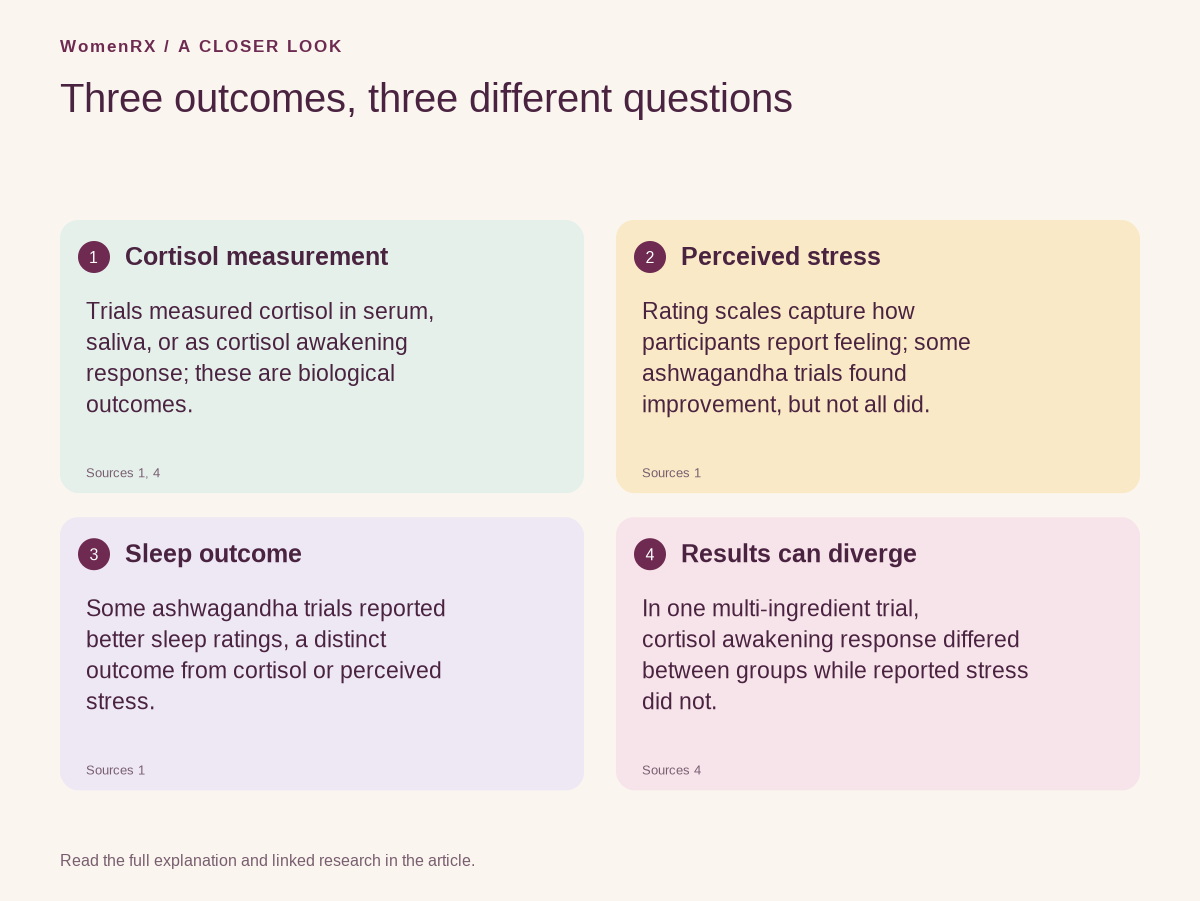
Three outcomes, three different questions
Cortisol measurement: Trials measured cortisol in serum, saliva, or as cortisol awakening response; these are biological outcomes.14
Perceived stress: Rating scales capture how participants report feeling; some ashwagandha trials found improvement, but not all did.1
Sleep outcome: Some ashwagandha trials reported better sleep ratings, a distinct outcome from cortisol or perceived stress.1
Results can diverge: In one multi-ingredient trial, cortisol awakening response differed between groups while reported stress did not.4
Read the figure as text
A supplement study may measure a biological marker, reported experience, or sleep. Seeing which outcomes changed helps keep a cortisol result in perspective.- Cortisol measurement: Trials measured cortisol in serum, saliva, or as cortisol awakening response; these are biological outcomes.14
- Perceived stress: Rating scales capture how participants report feeling; some ashwagandha trials found improvement, but not all did.1
- Sleep outcome: Some ashwagandha trials reported better sleep ratings, a distinct outcome from cortisol or perceived stress.1
- Results can diverge: In one multi-ingredient trial, cortisol awakening response differed between groups while reported stress did not.4
More questions, answered
Does a lower cortisol result mean a supplement reduced stress?
Not necessarily. Cortisol is a biological measurement, while perceived stress is usually recorded with a rating scale. In one trial of a multi-ingredient supplement, cortisol awakening response differed between groups, but reported stress did not. 4
Does ashwagandha have proven benefits specifically for women?
The studies described include mixed-sex groups, but don’t report a women-only benefit or clarify whether results differ by menstrual or menopausal stage. That leaves an important question unanswered; it doesn’t prove that effects are identical for everyone. 1
Sources you can check
- Ashwagandha: Is it helpful for stress, anxiety, or sleep? - Health Professional Fact SheetAccessed 2026-09-25Return to first citation
- Stress: MedlinePlusAccessed 2026-09-25Return to first citation
- Maternal cortisol and stress are associated with birth outcomes, but are not affected by lipid-based nutrient supplements during pregnancy: an analysis of data from a randomized controlled trial in rural Malawi.Stewart CP, Oaks BM, Laugero KD, Ashorn U, Harjunmaa U, Kumwenda C, Chaima D, Maleta K, Ashorn P, Dewey KG. · BMC pregnancy and childbirth · 2015Return to first citation
- Effect of a Multi-Ingredient Supplement Designed to Regulate Mood on Physiological and Psychological Outcomes: A Randomized, Double-Blind, Placebo-Controlled Trial.Brown AF, Richardson CME, Newby N, Pulsipher S, Hoene T. · Journal of dietary supplements · 2023Return to first citation