Do Stress and Cortisol Supplements Actually Work?
Ashwagandha has some short-term evidence for perceived stress, but results for other ingredients and for cortisol tell a different story.
It depends on the ingredient and what you mean by “work.” Some short-term ashwagandha trials found improvements in perceived stress and lower cortisol compared with placebo. Evidence is less convincing for rhodiola. Phosphatidylserine combinations have changed cortisol responses in studies of men, but that didn’t consistently mean they felt less stressed. None of these findings establishes a women-specific benefit. 1456
Start with the outcome you care about
A bottle promising “cortisol support” may sound appealing when you’re exhausted and stretched thin. But the number on a hormone test and your experience of stress answer different questions. Cortisol is a stress hormone, and the body’s response to demands can help you react when you need to. Stress can also come from pressures that keep going, such as work, caregiving or money worries. 12
So read a supplement claim in two parts: Did people report feeling less stressed? And did researchers measure a change in cortisol? A study finding one outcome doesn’t automatically prove the other. Neither outcome, on its own, shows that a supplement has solved the demands causing ongoing stress. 12
What ashwagandha trials found
In a review of seven randomized studies, 491 adults in India who had high stress or anxiety, or an anxiety disorder, received ashwagandha or placebo for six to eight weeks. Taken together, the studies found improvements on stress and anxiety rating scales and lower serum cortisol with ashwagandha than with placebo. Later trials have generally reported benefits for perceived stress, though not uniformly: a 12-week trial in adults with low energy and fatigue found less fatigue but no reduction in perceived stress compared with placebo. 1
That’s a reason to consider ashwagandha a possibility for short-term stress relief, not a reason to buy any product labeled “cortisol support.” Trials used different plant parts, extracts and preparations. Some measured cortisol in blood, another in saliva, and the findings don’t identify one interchangeable formula or establish what happens with long-term use. The trials described included men and women, but the reported results don’t establish a distinct benefit for women. 1
Safety may change the decision. Ashwagandha can cause stomach upset, loose stools, nausea or drowsiness. Liver injury has been reported, although the contents of products in some reports weren’t independently verified. It may affect thyroid function and may interact with thyroid hormone medicines, diabetes or blood-pressure medicines, immunosuppressants and sedatives. If you’re pregnant or breastfeeding, avoid ashwagandha. Pregnancy concerns have been disputed, but that dispute doesn’t establish safety. 13
How rhodiola and phosphatidylserine compare
Rhodiola: It’s marketed for stress, but the National Center for Complementary and Integrative Health says there isn’t enough reliable evidence to determine whether it helps with any health-related purpose. In one four-week placebo-controlled trial of 26 healthy male students, rhodiola improved some reaction-time test results but didn’t change the measured hormonal profile, which included cortisol. A reaction-time finding in men isn’t evidence that women will feel less stressed or have lower cortisol. Rhodiola can cause dizziness, headache or insomnia; an interaction with the blood-pressure medicine losartan has been reported. Little is known about its safety during pregnancy or breastfeeding. 47
Phosphatidylserine: Here, the formulation matters especially. In a six-week placebo-controlled study of 75 healthy men, researchers tested phosphatidylserine combined with phosphatidic acid. The higher-strength combination reduced cortisol responses to a laboratory stress test in the subgroup reporting high chronic stress, but not in the lower-stress subgroup. It didn’t improve the measured psychological stress response. That result doesn’t show that phosphatidylserine alone relieves day-to-day stress, or that it works the same way in women. 5
Even the direction of a cortisol change isn’t a universal scorecard. In a separate 12-week trial of 60 men, an omega-3 phosphatidylserine preparation had no significant overall effect on stress measures. Researchers reported effects only in a high-chronic-stress subgroup, where it appeared to restore a blunted cortisol response to an acute stress test rather than simply lower cortisol. These are different combinations studied in men, not proof that a product bearing the word “phosphatidylserine” will improve how you feel. 6
Three questions worth asking before you try one
What result am I hoping for? If it’s better sleep, less fatigue or feeling less overwhelmed, look for research on that outcome rather than treating a cortisol claim as a substitute. Ashwagandha trials have measured several of these outcomes, and their results aren’t identical. The phosphatidylserine combination study is a particularly clear example of a cortisol response changing without a matching improvement in reported stress. 15
Does the label identify the ingredient and preparation? “Ashwagandha” alone doesn’t tell you whether a product resembles an extract studied in a trial. Likewise, a phosphatidylserine study involving phosphatidic acid or omega-3s doesn’t test phosphatidylserine alone. A blend makes it harder still to tell which ingredient, if any, is responsible for a claimed effect. 156
Is there a safety reason to pause? Pregnancy, breastfeeding, thyroid concerns, liver concerns or medicines that may interact with ashwagandha deserve attention before trying it. Rhodiola has a reported interaction with losartan, and its safety in pregnancy and breastfeeding is poorly understood. Don’t assume that an ingredient sold for stress has been shown safe during pregnancy or breastfeeding. 134
If stress symptoms are severe and have lasted for two weeks or more, getting help offers a way to address the symptoms themselves, whether or not you’re considering a supplement. 2
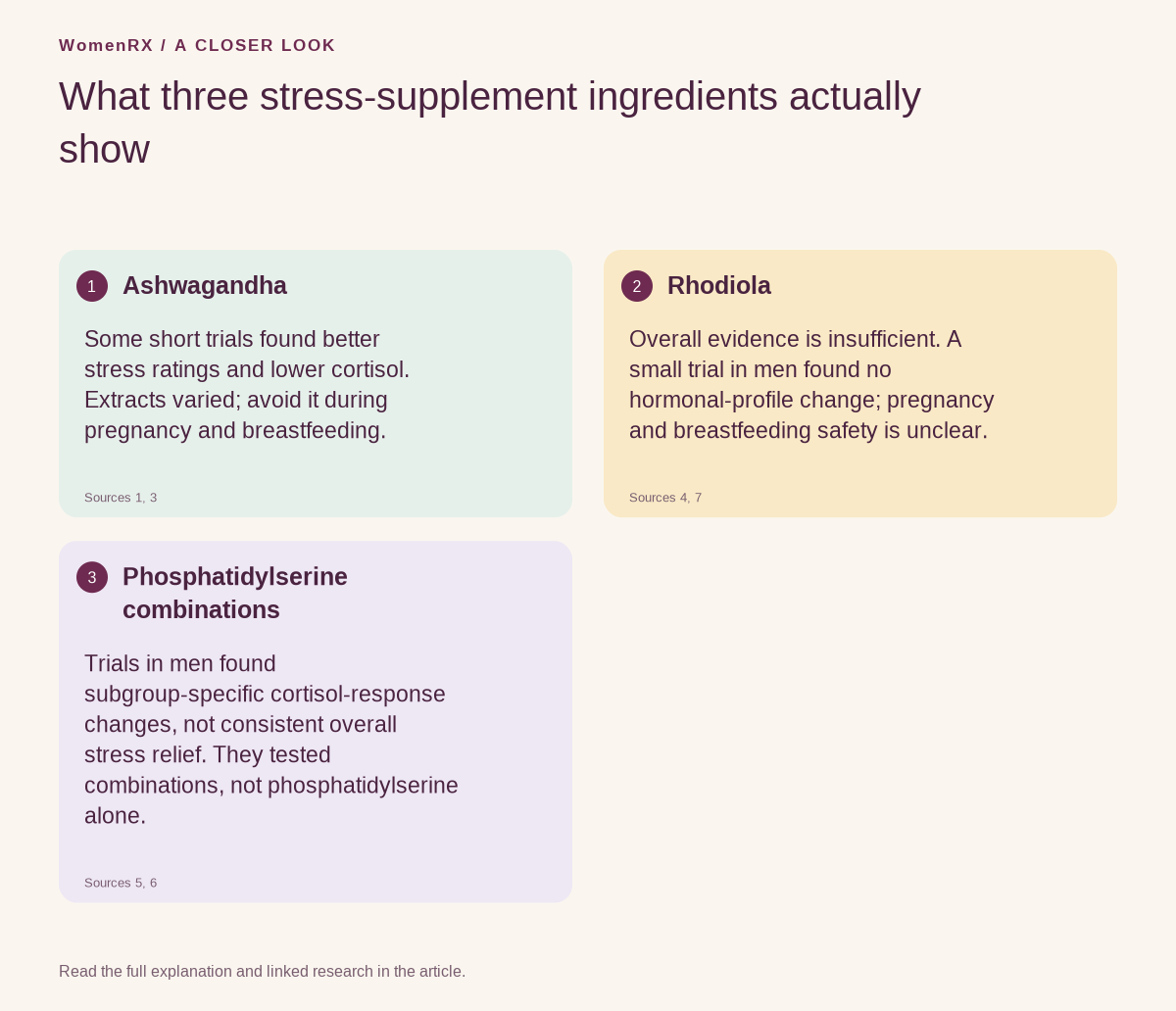
What three stress-supplement ingredients actually show
Ashwagandha: Some short trials found better stress ratings and lower cortisol. Extracts varied; avoid it during pregnancy and breastfeeding.13
Rhodiola: Overall evidence is insufficient. A small trial in men found no hormonal-profile change; pregnancy and breastfeeding safety is unclear.47
Phosphatidylserine combinations: Trials in men found subgroup-specific cortisol-response changes, not consistent overall stress relief. They tested combinations, not phosphatidylserine alone.56
Read the figure as text
A cortisol measurement, a stress rating and a reaction-time test are different outcomes. The formulation and study population matter too.- Ashwagandha: Some short trials found better stress ratings and lower cortisol. Extracts varied; avoid it during pregnancy and breastfeeding.13
- Rhodiola: Overall evidence is insufficient. A small trial in men found no hormonal-profile change; pregnancy and breastfeeding safety is unclear.47
- Phosphatidylserine combinations: Trials in men found subgroup-specific cortisol-response changes, not consistent overall stress relief. They tested combinations, not phosphatidylserine alone.56
More questions, answered
Does a lower cortisol result mean a supplement is working?
Not necessarily for the outcome you care about. Some ashwagandha studies found both lower cortisol and better stress ratings compared with placebo. But a phosphatidylserine-phosphatidic acid trial found a changed cortisol response in a subgroup of men without an improvement in their reported stress response. Check which outcome a claim actually rests on. 15
Sources you can check
- Ashwagandha: Is it helpful for stress, anxiety, or sleep? - Health Professional Fact SheetAccessed 2026-09-25Return to first citation
- Stress: MedlinePlusAccessed 2026-09-25Return to first citation
- Ashwagandha: Usefulness and Safety | NCCIHAccessed 2026-09-25Return to first citation
- Rhodiola: Usefulness and Safety | NCCIHAccessed 2026-09-25Return to first citation
- A soy-based phosphatidylserine/ phosphatidic acid complex (PAS) normalizes the stress reactivity of hypothalamus-pituitary-adrenal-axis in chronically stressed male subjects: a randomized, placebo-controlled study.Hellhammer J, Vogt D, Franz N, Freitas U, Rutenberg D. · Lipids in health and disease · 2014Return to first citation
- Omega-3 fatty acids administered in phosphatidylserine improved certain aspects of high chronic stress in men.Hellhammer J, Hero T, Franz N, Contreras C, Schubert M. · Nutrition research (New York, N.Y.) · 2012Return to first citation
- Effects of Rhodiola rosea supplementation on mental performance, physical capacity, and oxidative stress biomarkers in healthy men.Jówko E, Sadowski J, Długołęcka B, Gierczuk D, Opaszowski B, Cieśliński I. · Journal of sport and health science · 2018Return to first citation