Stress Supplements: What Studies Show and Safety Questions
A supplement’s evidence depends on the exact ingredient, outcome, and study length, while safety can hinge on your medicines and life stage.
Some short-term trials suggest ashwagandha may improve self-reported stress, but the studies used different extracts and don’t establish a best product or long-term benefit. 1 A small trial of vitamins B1 and B2 found a stress-score change worth further study. 5 Kava research focused on diagnosed anxiety. 4 Magnesium’s safety and medication interactions may matter more than claims that it calms stress. 3 These are comparisons, not dosing recommendations.
If you’re comparing a shelf of “calming” supplements, start with the outcome a study actually measured. Feeling less stressed, sleeping better, and treating diagnosed anxiety are different claims. A result for one doesn’t automatically prove the others.
This is a focused comparison, not a ranking of every ingredient marketed for stress. It doesn’t assess every product, including L-theanine. The useful question is whether a study tested the same ingredient, preparation, outcome, and timeframe as the claim on the label.
Ashwagandha: a short-term signal, not a universal formula
Several randomized trials suggest that ashwagandha extracts may reduce perceived stress. A 2021 review described seven studies involving 491 adults in India who took ashwagandha or placebo for six to eight weeks. The participants had self-reported high stress or anxiety, or a diagnosed anxiety disorder. Extracts, plant parts, and amounts varied, which makes it hard to carry the result over to a different product. 1
One example helps show why the product details matter: a 30-day trial in 60 adults who reported stress tested a particular root-and-leaf extract at 225 mg or 400 mg daily. Both groups taking the extract reported better scores on measures including stress than the placebo group. That’s evidence about that extract, in that small trial, over one month. It isn’t a general dose recommendation or proof that any ashwagandha product will have the same effect. 1
Safety deserves a separate check. In studies, common reported effects include stomach upset, loose stools, nausea, and drowsiness. There are also reports of liver injury, and ashwagandha may affect thyroid function. It may interact with thyroid hormone medicines, sedatives, and some medicines for diabetes, blood pressure, or immune suppression. Long-term safety is not established. Some experts advise against ashwagandha during pregnancy; the basis for this concern is uncertain, and the American Herbal Pharmacopoeia has disputed claims that ashwagandha root causes abortion. The NIH reference also relays advice against use while breastfeeding. 1
B vitamins: an early result from a very small trial
A double-blind trial randomized 43 participants to a combination of vitamin B1 and B2 or placebo for four weeks. The supplement group took 100 mg of each vitamin daily. Their average perceived-stress score fell from 21.5 to 15.5; the placebo group’s average changed from 20.3 to 19.8. The study did not find a significant effect on anxiety. With only 43 participants and four weeks of follow-up, this is a preliminary signal, not a reliable basis for treating stress or choosing a product. The reported results don’t establish a women-specific response. 5
The trial tested the two vitamins together. It doesn’t tell you whether B1 alone, B2 alone, or a different B-complex product would have the same result. 5
Kava: studied for diagnosed anxiety, with uncertainty
The review discussed here examined adults diagnosed with generalized anxiety disorder, not everyday stress. A systematic review found four placebo-comparison trials with 233 participants, and their results were highly inconsistent. An adjusted estimate suggested a possible modest benefit, but its confidence interval included no effect. Safety reporting across the review was poor. That leaves too much uncertainty to treat the finding as a clear answer for everyday stress or to make a confident safety comparison. 4
Magnesium: check the reason and the medicine list
The NIH magnesium fact sheet provides intake and safety information, but it doesn’t establish magnesium supplements as a treatment for everyday stress. Magnesium from foods such as legumes, nuts, seeds, leafy greens, and whole grains is different from taking a supplement for a calming effect. 3
Supplemental magnesium can cause diarrhea, nausea, and abdominal cramping at high intakes. For adults, the tolerable upper intake level is 350 mg a day from supplements and medicines; magnesium naturally present in food doesn’t count toward that limit. This is a safety threshold, not a stress-treatment target. The risk of toxicity is higher with impaired kidney function. 3
Magnesium can also interfere with absorption of oral bisphosphonates, tetracycline antibiotics, and quinolone antibiotics. Some diuretics and long-term use of proton pump inhibitors can affect magnesium status. If you take one of these medicines, ask a pharmacist about your specific schedule and whether magnesium is appropriate rather than trying to work out spacing from a label. 3
A practical way to compare a label
Before choosing a product, check four things: the specific outcome studied, the exact extract or ingredient, the amount and length of the trial, and whether the safety information fits your situation. A study lasting a few weeks can’t answer questions about years of use. And a study of one extract doesn’t establish that a different product is equivalent. 1 5
If you’re pregnant, breastfeeding, taking prescription medicines, or considering a supplement alongside treatment for anxiety or sleep, bring the exact label to a pharmacist or clinician. That makes it easier to check the full ingredient list and relevant interactions, not just the headline ingredient. For persistent stress that is affecting daily life, MedlinePlus also suggests practical steps such as limiting excess caffeine, prioritizing what needs doing now, and asking trusted people for support. 1 2 3
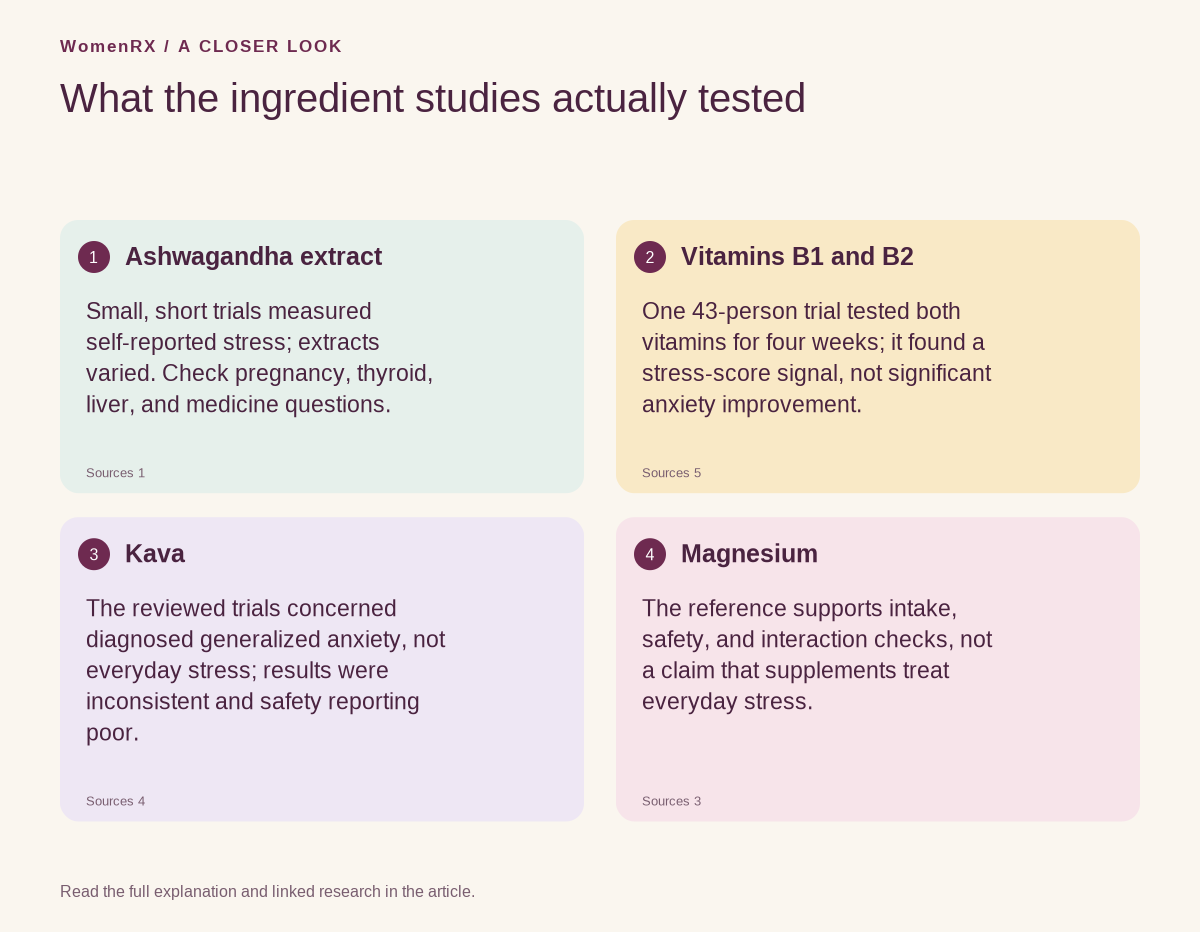
What the ingredient studies actually tested
Ashwagandha extract: Small, short trials measured self-reported stress; extracts varied. Check pregnancy, thyroid, liver, and medicine questions.1
Vitamins B1 and B2: One 43-person trial tested both vitamins for four weeks; it found a stress-score signal, not significant anxiety improvement.5
Kava: The reviewed trials concerned diagnosed generalized anxiety, not everyday stress; results were inconsistent and safety reporting poor.4
Magnesium: The reference supports intake, safety, and interaction checks, not a claim that supplements treat everyday stress.3
Read the figure as text
Compare the outcome and evidence boundary before treating a supplement label as a promise. This is a focused comparison, not a ranking of every marketed ingredient.- Ashwagandha extract: Small, short trials measured self-reported stress; extracts varied. Check pregnancy, thyroid, liver, and medicine questions.1
- Vitamins B1 and B2: One 43-person trial tested both vitamins for four weeks; it found a stress-score signal, not significant anxiety improvement.5
- Kava: The reviewed trials concerned diagnosed generalized anxiety, not everyday stress; results were inconsistent and safety reporting poor.4
- Magnesium: The reference supports intake, safety, and interaction checks, not a claim that supplements treat everyday stress.3
More questions, answered
Does a lower stress score mean a supplement treats anxiety?
Not necessarily. The small B1-and-B2 trial reported a change in perceived stress but did not find a significant effect on anxiety. Stress and diagnosed anxiety are distinct outcomes, so check which one a study actually measured. 5
What should I check if I take magnesium with a prescription medicine?
Ask a pharmacist about oral bisphosphonates, tetracycline or quinolone antibiotics, diuretics, and proton pump inhibitors. Magnesium can interfere with absorption of some medicines, while some of these medicines can affect magnesium status. 3
Sources you can check
- Ashwagandha: Is it helpful for stress, anxiety, or sleep? - Health Professional Fact SheetAccessed 2026-09-25Return to first citation
- Stress: MedlinePlusAccessed 2026-09-25Return to first citation
- Magnesium - Health Professional Fact SheetAccessed 2026-09-25Return to first citation
- Complementary and Alternative Medicine Treatments for Generalized Anxiety Disorder: Systematic Review and Meta-analysis of Randomized Controlled Trials.Barić H, Đorđević V, Cerovečki I, Trkulja V. · Advances in therapy · 2018Return to first citation
- Impact of Vitamin B1 and Vitamin B2 Supplementation on Anxiety, Stress, and Sleep Quality: A Randomized, Double-Blind, Placebo-Controlled Trial.Tao Y, Wu M, Su B, Lin H, Li Q, Zhong T, Xiao Y, Yu X. · Nutrients · 2025Return to first citation