Do Women Need Calcium or Vitamin D for Bone Health?
Supplements can fill a nutrient gap, but they aren’t automatic fracture prevention.
Not every woman needs calcium or vitamin D supplements. Start by checking how much calcium you get from food, especially after age 50, when the recommended amount rises. For vitamin D, consider foods and fortified products, and raise a possible deficiency concern separately from taking a supplement just to prevent fractures. Menopause and fracture history can change the conversation, but neither makes supplements a substitute for assessing bone risk. 1 3 4
The decision starts with two different nutrients
Calcium supplies much of the mineral stored in your bones. Vitamin D helps your body absorb calcium and supports normal bone mineralization. They work together, but that doesn’t mean every woman needs a pill containing both. The useful first question is whether your usual intake is adequate, followed by whether you have a reason to think your fracture risk is higher. 1 3
For calcium, the recommended daily amount is 1,000 mg for younger women and 1,200 mg for women older than 50. That’s the total from food and supplements combined, not a target for a supplement alone. Calcium can come from dairy, some leafy greens, fish with edible bones, and fortified foods such as certain plant drinks or tofu. Check labels on fortified products, since their calcium content can vary. 1 2
Vitamin D is a separate intake question. Few foods naturally contain much of it; fatty fish are among the better natural sources, while fortified foods such as milk and some cereals contribute vitamin D to many US diets. If these foods rarely appear in your routine, that’s a practical reason to bring up your intake and possible inadequacy. A concern about deficiency is different from taking vitamin D simply as fracture insurance. 3 4
Menopause changes bone loss, not everyone’s supplement needs
As estrogen falls around menopause, bone remodeling increases. This makes bone health more relevant in midlife, but menopause by itself doesn’t show that you need calcium or vitamin D supplements. A study following 1,490 women who were 42 to 52 at the start found that calcium supplement users had less bone-density loss over 10 to 12 years, but their fracture risk did not significantly differ from that of nonusers. Better bone-density results do not automatically mean fewer fractures. 1
After age 50, the calcium recommendation is higher. That’s a prompt to take stock of your total intake, not proof that a supplement is needed if food already covers it. In postmenopausal women and other older adults, a history of fracture or known osteoporosis makes the question broader than nutrient intake alone. A guideline for postmenopausal women and men over 50 recommends assessing fracture risk and says calcium and vitamin D supplements are more effective for reducing fracture risk in people with deficiencies than in healthy, community-dwelling people. 1 4
Supplements don’t have one clear fracture result
The fracture-prevention findings for combined calcium and vitamin D are mixed. One meta-analysis of eight randomized trials in 30,970 adults over 50 reported 15% lower total-fracture risk and 30% lower hip-fracture risk with supplementation. Another review of 11 trials in 51,419 adults aged 50 and older found no reduction in total or hip fractures. The summaries don’t establish that baseline intake explains the different findings, so they can’t support a promise that supplements prevent fractures for a particular woman based on age alone. 1
Vitamin D alone also isn’t established as universal fracture prevention. In a five-year Finnish trial of 2,495 older adults, vitamin D supplementation did not reduce fractures in a population described as largely vitamin D-sufficient. Women aged 65 and older were included, but the study abstract doesn’t give a women-only result. This finding doesn’t answer whether correcting a deficiency helps someone who has one. 5
Match the next step to the question
If calcium-rich foods are limited: Estimate what you regularly get from meals and fortified products. If there seems to be a gap, a supplement discussion can focus on filling that gap rather than adding an automatic full amount on top of your diet. 1 2
If vitamin D sources are scarce, or deficiency is a concern: Fatty fish and fortified foods are relevant sources, but food habits alone don’t establish your vitamin D status. Ask whether the concern warrants an evaluation or a change in intake. Don’t assume that a supplement taken without a known shortfall will prevent a fracture. 3 4 5
If you’ve had a fracture or have osteoporosis: Nutrient intake still matters, but it is only part of the picture. A fracture-risk assessment can help determine whether you need broader osteoporosis care, rather than relying on calcium and vitamin D alone. 4
The practical distinction is simple: use supplements as a way to address a likely shortfall, not as a guarantee against fractures. Before adding either one, consider what you eat, your life stage, and whether your bone-health history calls for a broader risk assessment.
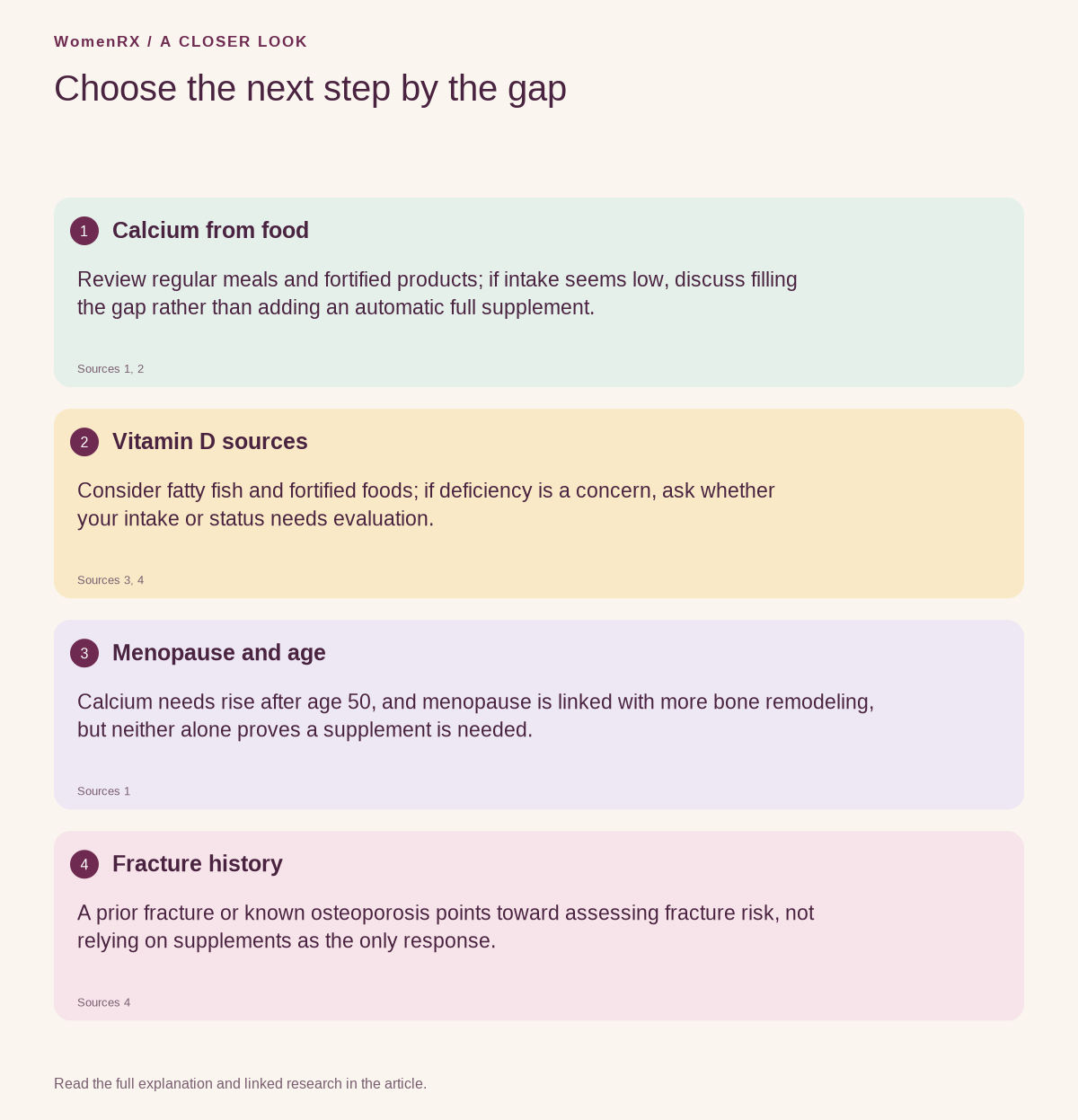
Choose the next step by the gap
Calcium from food: Review regular meals and fortified products; if intake seems low, discuss filling the gap rather than adding an automatic full supplement.12
Vitamin D sources: Consider fatty fish and fortified foods; if deficiency is a concern, ask whether your intake or status needs evaluation.34
Menopause and age: Calcium needs rise after age 50, and menopause is linked with more bone remodeling, but neither alone proves a supplement is needed.1
Fracture history: A prior fracture or known osteoporosis points toward assessing fracture risk, not relying on supplements as the only response.4
Read the figure as text
Separate a possible calcium shortfall, a vitamin D concern, and fracture risk; each points to a different next question.- Calcium from food: Review regular meals and fortified products; if intake seems low, discuss filling the gap rather than adding an automatic full supplement.12
- Vitamin D sources: Consider fatty fish and fortified foods; if deficiency is a concern, ask whether your intake or status needs evaluation.34
- Menopause and age: Calcium needs rise after age 50, and menopause is linked with more bone remodeling, but neither alone proves a supplement is needed.1
- Fracture history: A prior fracture or known osteoporosis points toward assessing fracture risk, not relying on supplements as the only response.4
Sources you can check
- Calcium - Health Professional Fact SheetAccessed 2026-09-25Return to first citation
- Calcium | MedlinePlusAccessed 2026-09-25Return to first citation
- Vitamin D - Health Professional Fact SheetAccessed 2026-09-25Return to first citation
- 2024 Royal Australian College of General Practitioners and Healthy Bones Australia guideline for osteoporosis management and fracture prevention in postmenopausal women and men over 50 years of age.Wong P, Chen W, Ewald D, Girgis C, Rawlin M, Tsingos J, Waters J. · The Medical journal of Australia · 2025Return to first citation
- The effect of vitamin D3 supplementation on fracture incidence in an aging population - The Finnish vitamin D trial.Rikkonen T, Hantunen S, Kröger H, Lamberg-Allardt C, Manson JE, Nurmi T, Tuppurainen M, Voutilainen A, Tuomainen TP, Virtanen JK. · Bone · 2026Return to first citation