Vitamin K2: What the Bone and Heart Evidence Shows
K2 has a plausible role in bone biology, but a change in a blood marker isn’t the same as stronger bones or fewer fractures.
K2 helps activate proteins involved in bone and other body functions, but evidence that a K2 supplement prevents fractures or heart disease isn’t settled. Bone studies in postmenopausal women report mixed outcomes, and a marker change isn’t proof of fewer fractures. Most adults don’t have clinically significant vitamin K deficiency; people with malabsorption or certain gut conditions may need assessment, though that doesn’t establish a need for K2 specifically. If you take a blood thinner, check before adding K2. 2 3 4
What K2 does, and what a product claim leaves out
Vitamin K is needed to activate proteins involved in blood clotting and bone. K2, also called menaquinone, comes in different forms, including MK-4 and MK-7. Those forms aren’t interchangeable evidence: a study of one doesn’t establish that another form, dose, or supplement blend works the same way. 2 3
For bone, a useful distinction is between a biological effect and a health outcome. Vitamin K can change how much osteocalcin is carboxylated, a marker related to vitamin K activity. But a change in that marker doesn’t by itself show that bone density improves or fractures become less likely. 2 4
Postmenopausal bone studies: mixed results
Some K2 findings in postmenopausal women are encouraging, but they don’t add up to a clear recommendation for a typical retail product. A 12-month report from a placebo-controlled trial described 148 women with osteopenia taking calcium and vitamin D and assigned to MK-7 or placebo. The MK-7 group had a change in a measure of bone structure at the tibia, but there was no significant difference in bone density at any measured site. 6
The three-year report was from that same trial, not an independent study: it refers to the one-year microarchitecture finding as previously reported. In the later report, which describes 142 postmenopausal women with osteopenia receiving calcium and vitamin D, MK-7 changed the osteocalcin marker, but the groups did not differ in bone density, bone turnover markers, or bone microarchitecture at the end of three years. 4 6
A separate three-year MK-7 trial in postmenopausal women, summarized by NIH, reported improved bone strength and less loss of vertebral height in the lower thoracic spine. Those are encouraging findings, but they measure different outcomes from bone density or fractures. They don’t establish that MK-7 prevents fractures. 2
Vitamin K2 evidence for MK-4 is different. An NIH review describes a meta-analysis of 13 trials, most conducted in Japan and involving postmenopausal women. Seven reported fracture data, and all used MK-4 at pharmacological doses of 15 or 45 milligrams per day. The review reports reduced fracture rates in those trials, but this evidence doesn’t establish that lower-dose MK-4 or an MK-7 product prevents fractures. The review also notes that later trials have not consistently found improvements in bone density. 2
So when you’re assessing a label, check whether it names MK-4 or MK-7, then ask whether the claim matches the form and outcome studied. A claim about “bone support” may reflect a marker or a limited bone-structure result, not proven fracture prevention. And a formula with several active ingredients can’t show which ingredient caused a reported benefit: one trial of a combination containing melatonin, strontium, vitamin D3, and MK-7 cannot isolate K2’s effect. 2 6 7
Heart claims are even less settled
K2’s role in proteins involved in blood vessels has prompted interest in arterial calcification and cardiovascular health. But an association between dietary menaquinone and less calcification is not proof that a K2 supplement prevents calcification or heart disease. NIH describes observational associations, while concluding that the role of different vitamin K forms in arterial calcification and coronary disease remains unclear. 2
A randomized trial in 68 people with type 2 diabetes and a history of cardiovascular disease found that six months of K2 supplementation did not reduce the progression of arterial calcification or slow the measured decline in bone density compared with placebo. That study applies to a specific group and timeframe; it doesn’t answer every question about K2, but it doesn’t support a broad heart-protection claim either. 5
The safety check that matters most
If you take a blood thinner, ask your prescriber or pharmacist before starting, stopping, or changing a K2 supplement. Vitamin K can affect how blood thinners work. 3
Clinically significant vitamin K deficiency is rare in adults, but people with malabsorption disorders or certain gastrointestinal conditions, including celiac disease, cystic fibrosis, ulcerative colitis, and short bowel syndrome, may not absorb vitamin K properly. People who have had bariatric surgery may also have low vitamin K status. These situations can warrant monitoring and, in some cases, supplementation; they don’t establish that K2 specifically is the right form or that everyone in these groups needs a supplement. 2
For pregnancy, the intake reference is for total vitamin K, not a K2-specific supplement benefit. The postmenopausal bone trials described above don’t answer whether K2 supplements help during pregnancy or postpartum. If you’re pregnant or breastfeeding, don’t assume a product marketed for bone health is appropriate based on those studies. 2 4 6
A practical way to judge a K2 product
Before buying, match the claim to the evidence: Is the product MK-4 or MK-7? Is the claim about a marker, bone density, fractures, or cardiovascular outcomes? Are the study participants similar to you? A product claim that jumps from a marker change to “prevents fractures” or “protects your heart” goes beyond what these findings establish. If you have osteopenia or osteoporosis, bone density testing can measure bone health and help assess fracture risk. 1 2 4 5
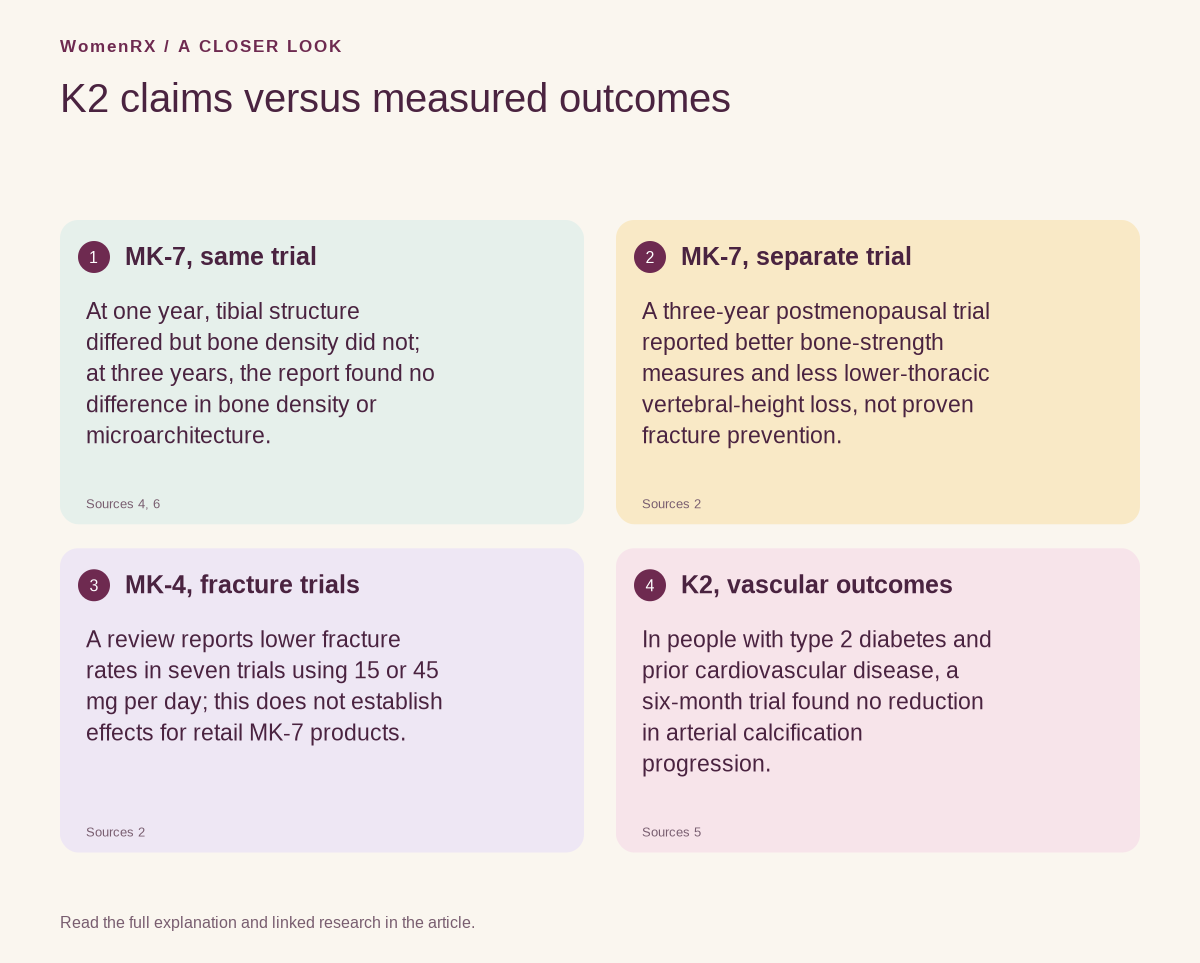
K2 claims versus measured outcomes
MK-7, same trial: At one year, tibial structure differed but bone density did not; at three years, the report found no difference in bone density or microarchitecture.46
MK-7, separate trial: A three-year postmenopausal trial reported better bone-strength measures and less lower-thoracic vertebral-height loss, not proven fracture prevention.2
MK-4, fracture trials: A review reports lower fracture rates in seven trials using 15 or 45 mg per day; this does not establish effects for retail MK-7 products.2
K2, vascular outcomes: In people with type 2 diabetes and prior cardiovascular disease, a six-month trial found no reduction in arterial calcification progression.5
Read the figure as text
Compare what was studied with what a product claim might promise. The outcomes differ by K2 form, population, and study design.- MK-7, same trial: At one year, tibial structure differed but bone density did not; at three years, the report found no difference in bone density or microarchitecture.46
- MK-7, separate trial: A three-year postmenopausal trial reported better bone-strength measures and less lower-thoracic vertebral-height loss, not proven fracture prevention.2
- MK-4, fracture trials: A review reports lower fracture rates in seven trials using 15 or 45 mg per day; this does not establish effects for retail MK-7 products.2
- K2, vascular outcomes: In people with type 2 diabetes and prior cardiovascular disease, a six-month trial found no reduction in arterial calcification progression.5
More questions, answered
Is the vitamin K intake recommendation the same as a K2 dose?
No. The adequate intake figures are for vitamin K overall, not a recommended K2 supplement dose. The NIH fact sheet lists an adequate intake of 90 micrograms per day for adult women, including during pregnancy and lactation, but that number doesn’t establish a separate K2 target or a bone-health benefit from taking K2. 2
Sources you can check
- Bone Density | Bone Mineral Density | BMD | MedlinePlusAccessed 2026-09-25Return to first citation
- Vitamin K - Health Professional Fact SheetAccessed 2026-09-25Return to first citation
- Vitamin K: MedlinePlusAccessed 2026-09-25Return to first citation
- The effect of vitamin MK-7 on bone mineral density and microarchitecture in postmenopausal women with osteopenia, a 3-year randomized, placebo-controlled clinical trial.Rønn SH, Harsløf T, Oei L, Pedersen SB, Langdahl BL. · Osteoporosis international : a journal established as result of cooperation between the European Foundation for Osteoporosis and the National Osteoporosis Foundation of the USA · 2021Return to first citation
- Six months vitamin K treatment does not affect systemic arterial calcification or bone mineral density in diabetes mellitus 2.Bartstra JW, Draaisma F, Zwakenberg SR, Lessmann N, Wolterink JM, van der Schouw YT, de Jong PA, Beulens JWJ. · European journal of nutrition · 2021Return to first citation
- Vitamin K2 (menaquinone-7) prevents age-related deterioration of trabecular bone microarchitecture at the tibia in postmenopausal women.Rønn SH, Harsløf T, Pedersen SB, Langdahl BL. · European journal of endocrinology · 2016Return to first citation
- Melatonin-micronutrients Osteopenia Treatment Study (MOTS): a translational study assessing melatonin, strontium (citrate), vitamin D3 and vitamin K2 (MK7) on bone density, bone marker turnover and health related quality of life in postmenopausal osteopenic women following a one-year double-blind RCT and on osteoblast-osteoclast co-cultures.Maria S, Swanson MH, Enderby LT, D'Amico F, Enderby B, Samsonraj RM, Dudakovic A, van Wijnen AJ, Witt-Enderby PA. · Aging · 2017Return to first citation