Vitamin K2 Timing, Bone Claims, and Medication Safety
The bone studies described by NIH don’t establish a best time of day for K2, and findings vary by form and outcome.
The bone studies described by NIH don’t establish a best time of day for K2 or compare morning with evening. 1 For bone health, small postmenopausal MK-4 trials reported changes in osteocalcin markers, and one reported a forearm-density finding. 34 An older review found fewer fractures in trials using specific MK-4 doses, but that doesn’t establish that an over-the-counter K2 supplement prevents fractures. If you take warfarin, don’t change your vitamin K intake without guidance. 1
Timing is a smaller question than the goal
The bone studies described by NIH don’t establish a preferred time of day for vitamin K2 or compare morning with evening. Information about the relative absorption of different vitamin K supplements is limited; one study found MK-7 has a longer half-life than vitamin K1. That finding doesn’t establish an ideal time of day. 1
So if you’re considering K2, start by asking what you want it to do. A schedule can’t make an uncertain benefit certain, and the evidence for bone health varies by form and outcome.
What postmenopausal bone studies can tell you
Vitamin K helps activate proteins involved in bone, including osteocalcin. That biological role makes K2 plausible as a bone-health supplement, but it doesn’t prove that taking it prevents osteoporosis or fractures. NIH’s review describes the overall supplementation evidence as unclear, with positive and null findings across studies. 1
Some results are encouraging but narrow. In a randomized trial of 48 postmenopausal Japanese women, 1.5 mg of MK-4 daily for 12 months lowered a marker of undercarboxylated osteocalcin. The control group’s forearm bone mineral density (BMD) fell between months 6 and 12, while the MK-4 group had no significant decrease in BMD during the study. These marker and BMD findings don’t establish fracture prevention. 3
A second small randomized trial assigned 40 postmenopausal Japanese women to 1.5 mg of MK-4 daily or placebo for four weeks. It found changes in osteocalcin measures, which indicate vitamin K activity in the body. Those biomarker changes aren’t the same as showing stronger bones or fewer fractures. 4
The fracture findings deserve a closer look. NIH summarizes an older review of 13 trials, seven of which contributed fracture data to a meta-analysis. All seven fracture trials used MK-4: one used 15 mg per day and six used 45 mg per day. The review reported significantly lower rates of hip, vertebral, and all nonvertebral fractures with supplementation. That is a positive finding, but it came from trials using those specific doses and does not establish that a typical over-the-counter K2 supplement prevents fractures. Later studies have not consistently found improvements in BMD, and one trial in postmenopausal women found no difference in spine or hip BMD after 12 months of MK-4 or vitamin K1 compared with placebo. NIH says it remains unclear whether supplementation with any form of vitamin K reduces osteoporosis risk. 1
MK-7 has also been studied in postmenopausal women. NIH reports that one trial using daily MK-7 for three years found improved bone strength and less loss of vertebral height in the lower thoracic region of the spine. That is a specific finding, not proof that K2 prevents fractures generally or works for every woman after menopause. 1
The medicine interaction that changes the decision
If you take warfarin (Coumadin), or another vitamin K antagonist, check with the clinician managing that treatment before changing your vitamin K intake. Vitamin K can affect how these medicines work, and sudden changes from food or supplements can increase or decrease their anticoagulant effect. Don’t start, stop, or change a K2 supplement on your own; aim for a consistent intake with guidance from your care team. 12
Some other medicines can affect vitamin K absorption. Orlistat and bile acid sequestrants such as cholestyramine can reduce absorption of fat-soluble vitamins, including vitamin K. The clinical significance can vary, but it’s worth raising a planned K2 supplement with the prescriber or pharmacist who knows your medication list. 1
Identify the K2 form and check warfarin interactions
If your goal is bone health, don’t treat “K2” as one proven intervention: MK-4 and MK-7 are different forms, and evidence from one can’t automatically be applied to the other. Ask what outcome matters to you, such as BMD or fracture risk, and whether there’s evidence for that outcome with the particular form being considered. If you take warfarin, medication safety comes first. The evidence described by NIH doesn’t establish a preferred K2 time of day or show that everyone taking vitamin D needs to pair it with K2. 1
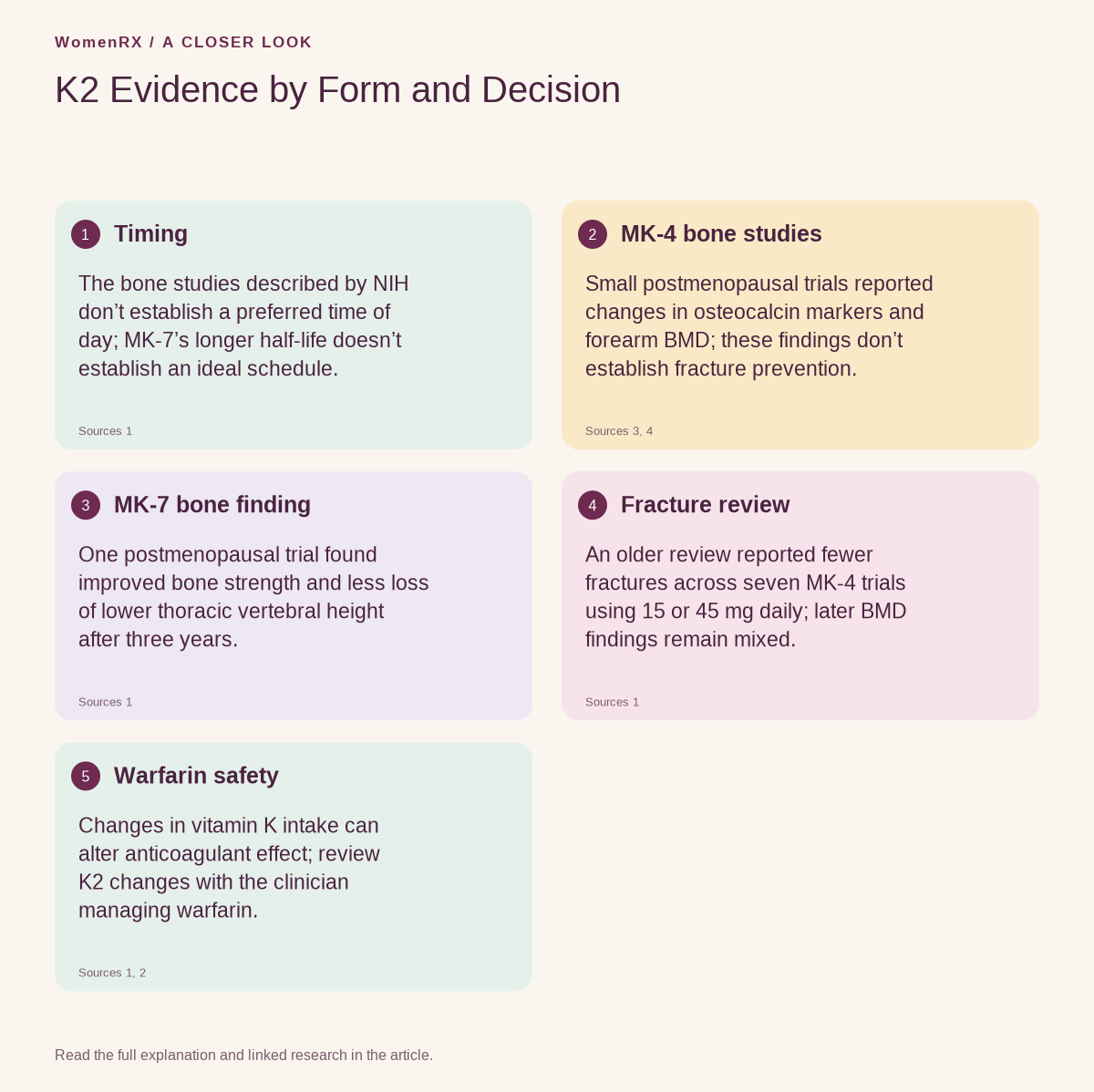
K2 Evidence by Form and Decision
Timing: The bone studies described by NIH don’t establish a preferred time of day; MK-7’s longer half-life doesn’t establish an ideal schedule.1
MK-4 bone studies: Small postmenopausal trials reported changes in osteocalcin markers and forearm BMD; these findings don’t establish fracture prevention.34
MK-7 bone finding: One postmenopausal trial found improved bone strength and less loss of lower thoracic vertebral height after three years.1
Fracture review: An older review reported fewer fractures across seven MK-4 trials using 15 or 45 mg daily; later BMD findings remain mixed.1
Warfarin safety: Changes in vitamin K intake can alter anticoagulant effect; review K2 changes with the clinician managing warfarin.12
Read the figure as text
The findings depend on which form and outcome were studied; medication safety is a separate decision from bone-health evidence.- Timing: The bone studies described by NIH don’t establish a preferred time of day; MK-7’s longer half-life doesn’t establish an ideal schedule.1
- MK-4 bone studies: Small postmenopausal trials reported changes in osteocalcin markers and forearm BMD; these findings don’t establish fracture prevention.34
- MK-7 bone finding: One postmenopausal trial found improved bone strength and less loss of lower thoracic vertebral height after three years.1
- Fracture review: An older review reported fewer fractures across seven MK-4 trials using 15 or 45 mg daily; later BMD findings remain mixed.1
- Warfarin safety: Changes in vitamin K intake can alter anticoagulant effect; review K2 changes with the clinician managing warfarin.12
More questions, answered
Does a change in an osteocalcin marker mean bones are stronger?
Not by itself. Osteocalcin measures can show that vitamin K is affecting a bone-related process, but a change in a marker doesn’t establish improved bone mineral density or fewer fractures. One 12-month MK-4 trial reported forearm BMD findings as well as marker changes; a four-week trial reported changes in osteocalcin measures. Neither result demonstrates fracture prevention. 134
Do I need to take K2 with vitamin D?
Current evidence doesn’t establish that everyone taking vitamin D needs K2. Some studies combined vitamin K with calcium or vitamin D, which can make it harder to isolate vitamin K’s contribution; that isn’t the same as demonstrating that the combination is necessary. 1
Sources you can check
- Vitamin K - Health Professional Fact SheetAccessed 2026-09-25Return to first citation
- Vitamin K: MedlinePlusAccessed 2026-09-25Return to first citation
- Low-dose vitamin K2 (MK-4) supplementation for 12 months improves bone metabolism and prevents forearm bone loss in postmenopausal Japanese women.Koitaya N, Sekiguchi M, Tousen Y, Nishide Y, Morita A, Yamauchi J, Gando Y, Miyachi M, Aoki M, Komatsu M, Watanabe F, Morishita K, Ishimi Y. · Journal of bone and mineral metabolism · 2014Return to first citation
- Effect of low dose vitamin K2 (MK-4) supplementation on bio-indices in postmenopausal Japanese women.Koitaya N, Ezaki J, Nishimuta M, Yamauchi J, Hashizume E, Morishita K, Miyachi M, Sasaki S, Ishimi Y. · Journal of nutritional science and vitaminology · 2009Return to first citation