How to Compare Vitamin K2 Supplements and Their Labels
The most useful K2 comparison starts with your reason for taking it and your medicines, not a brand’s bone-health promise.
Check why you want K2 before comparing bottles. Look for the named form, usually MK-4 or MK-7, and its amount per serving. If you take warfarin or another vitamin K antagonist, check with the team managing that medicine before changing your vitamin K intake: MK-7 can reduce anticoagulation. Vitamin K has a role in bone health, but that doesn’t establish that a K2 supplement prevents fractures. 1 2
First, separate your goal from the label’s promise
If you’re considering K2 for bone health after menopause, it’s reasonable to ask what the supplement would add. Vitamin K helps the body make proteins involved in healthy bones and tissues, as well as blood clotting. That role explains interest in K2, but it doesn’t establish that taking a K2 supplement prevents osteoporosis or fractures, or that menopause itself creates a need for one. 1 2
Keep your reason for shopping in view. If someone recommended a particular K2 product, ask what goal they had in mind and why that form and amount were chosen. A bottle’s “bone health” language can’t answer those questions for you.
Read past “K2” to the actual form
Vitamin K2 refers to compounds called menaquinones. MK-4 and MK-7 are two common forms; the number identifies a difference in the length of their chemical side chains. Check the Supplement Facts panel for the form instead of assuming two products labeled “K2” contain the same thing. 2
The distinction is real, but it isn’t a simple winner-and-loser comparison. A study described in a review found that, after a single dose in healthy female volunteers, MK-7 was absorbed to a greater extent and remained in the body longer than the same dose of MK-4. That tells you how the forms behaved in that study, not which one produces better fracture or osteoporosis outcomes. 2
Next, compare the amount per serving, not just the number printed prominently on the front. Check how many capsules or drops the label counts as a serving. If the product combines K2 with other ingredients, find the amount of the named K2 form rather than treating a blend’s total as its K2 amount. These checks make the labels comparable; a larger amount isn’t automatically a better choice.
Make the medication check before you buy
Vitamin K participates in blood clotting. MedlinePlus advises people taking blood thinners to be careful about their vitamin K intake. The interaction is particularly relevant to warfarin and other vitamin K antagonist medicines: research reviewed for MK-7 found that it reduced the anticoagulant effect of a related medicine, acenocoumarol, as measured by INR. 1 2
If you take warfarin or another vitamin K antagonist, check with the team managing that treatment before starting, stopping, or switching a K2 supplement. Consistent vitamin K intake matters in warfarin management. Don’t assume that every medicine called a blood thinner interacts with K2 in the same way; the name of your medication matters. 2
Ask what a quality claim actually verifies
A claim about ingredient quality isn’t the same as evidence about the bottle in your hand. U.S. Pharmacopeia monographs have been developed to set standards for MK-7 as a dietary ingredient and in supplement dosage forms. The existence of those standards does not show that a particular product meets them. 3
If a brand invokes USP or says its K2 is tested, look for an explanation of exactly what was checked. You can ask for documentation tied to the product or lot you’re considering: Does it identify the named K2 form and measured amount? Who performed the testing? Is the claim about an ingredient, or the finished supplement? A brand’s statement and a test report are different levels of substantiation; neither turns a quality check into proof of a bone-health benefit.
A brand ranking can’t replace those checks. For your decision, the useful comparison is whether the product names its form, states an understandable amount per serving, fits with your medication, and backs up its quality language with specific documentation.
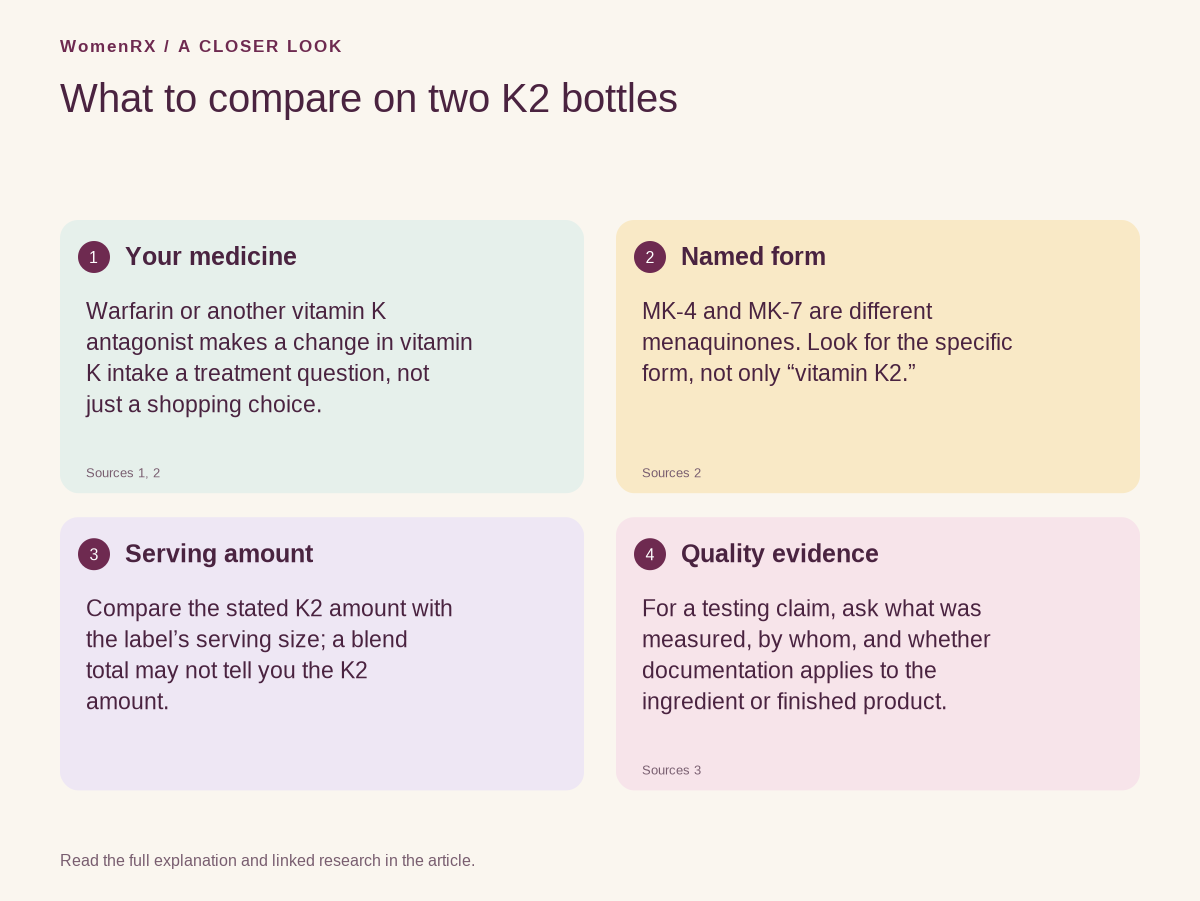
What to compare on two K2 bottles
Your medicine: Warfarin or another vitamin K antagonist makes a change in vitamin K intake a treatment question, not just a shopping choice.12
Named form: MK-4 and MK-7 are different menaquinones. Look for the specific form, not only “vitamin K2.”2
Serving amount: Compare the stated K2 amount with the label’s serving size; a blend total may not tell you the K2 amount.
Quality evidence: For a testing claim, ask what was measured, by whom, and whether documentation applies to the ingredient or finished product.3
Read the figure as text
Use these distinctions to separate a relevant product detail from a claim that still needs checking.- Your medicine: Warfarin or another vitamin K antagonist makes a change in vitamin K intake a treatment question, not just a shopping choice.12
- Named form: MK-4 and MK-7 are different menaquinones. Look for the specific form, not only “vitamin K2.”2
- Serving amount: Compare the stated K2 amount with the label’s serving size; a blend total may not tell you the K2 amount.
- Quality evidence: For a testing claim, ask what was measured, by whom, and whether documentation applies to the ingredient or finished product.3
More questions, answered
Does “more bioavailable” mean MK-7 is better for my bones?
Not necessarily. A comparison in healthy female volunteers found differences in how MK-7 and MK-4 were absorbed and remained in the body after a single dose. That study did not establish which form leads to better bone outcomes. 2
Sources you can check
- Vitamin K: MedlinePlusAccessed 2026-09-25Return to first citation
- A Unique Formulation of Cardioprotective Bio-Actives: An Overview of Their Safety Profile.Salminen W, Agbaje-Williams M, Ajayi FO. · Medicines (Basel, Switzerland) · 2019Return to first citation
- US Pharmacopeial Convention safety evaluation of menaquinone-7, a form of vitamin K.Marles RJ, Roe AL, Oketch-Rabah HA. · Nutrition reviews · 2017Return to first citation