Vitamin K2 Safety: Interactions, Side Effects, and Who Needs Advice
The main established reason to check before taking K2 is treatment with warfarin or another vitamin K antagonist.
If you take warfarin or another vitamin K antagonist, ask your prescriber or pharmacist before starting, stopping, or changing a K2 supplement. K2 can counteract these medicines and affect blood-clotting measurements. For other medicines, health conditions, pregnancy, or breastfeeding, review the specific product rather than assuming K2 is either needed or unsafe. Serious risks have not emerged in a safety review, but that does not mean every product or situation is settled. 1 2 3
The key question is whether you take a vitamin K antagonist
Vitamin K helps the body make proteins involved in blood clotting. That’s why vitamin K intake matters for people taking warfarin, a vitamin K antagonist: more vitamin K can weaken the medicine’s anticoagulant effect and change the INR, a blood test used to assess clotting. Vitamin K2, also called menaquinone, is a form of vitamin K. 1 2
The interaction isn’t just theoretical. A human study reviewed in a safety paper found that MK-7, a form of K2, reduced the anticoagulant effect of acenocoumarol, another vitamin K antagonist. The review also describes the interaction between MK-7 and coumarin anticoagulants such as warfarin as something that can be managed in clinical practice, with treatment adjusted around a consistent vitamin K intake. 2
If you take warfarin or another vitamin K antagonist, don’t start, stop, or change a K2 supplement on your own. Ask your prescriber or pharmacist how the specific product fits with your treatment. Include K2 in a multivitamin or combination supplement when you tell them what you take. Keeping vitamin K intake consistent is a more useful goal than trying to avoid all vitamin K foods. 1 2
What about other medicines or health conditions?
The clearest interaction in the evidence is with vitamin K antagonist medicines. It doesn’t establish that K2 interacts with every blood thinner or with every prescription medicine. If you take other medicines or have a health condition, bring the product label to a pharmacist or prescriber for a specific check rather than assuming there’s a known interaction, or assuming there can’t be one.
Check the label for the form of K2, such as MK-7 or MK-4, and whether the product includes other ingredients. A combination product may raise separate questions about its other components. Reviews of a particular multi-ingredient formula, for example, can’t establish the safety of every K2-only supplement or every product sold under the same general category. 2 3
What’s known about side effects?
A US Pharmacopeial Convention review concluded that supplemental MK-7 was not associated with serious health risks or other public-health concerns in the evidence it reviewed. That’s reassuring, but it isn’t a guarantee that no one experiences an unwanted effect, or that every formulation has been studied equally. 3
The most decision-relevant concern is the interaction with vitamin K antagonist treatment, not a well-established list of K2-specific side effects. One review of a multi-ingredient supplement reported mild gastrointestinal effects among the ingredients it considered, but that finding does not show that K2 by itself caused them. 2
Pregnancy and breastfeeding call for product-specific advice
The general safety picture for adults doesn’t settle whether a K2 supplement is appropriate for you during pregnancy or breastfeeding. These stages are a reason to review the exact product with your prenatal or postpartum care team, particularly if you take prescription medicine or the supplement combines K2 with other ingredients. Don’t assume you need K2 because you’re pregnant or breastfeeding, and don’t assume it’s automatically harmful.
A quick check before you buy or begin
- Taking warfarin or another vitamin K antagonist? Check with your prescriber or pharmacist before making any change to K2 or your medicine. 1 2
- Considering K2 for a particular goal? Ask whether a supplement is appropriate for that goal; a general safety review does not establish that you need one. 3
- Pregnant or breastfeeding, or taking other medicines? Share the exact label so the advice can account for the product’s ingredients and your situation.
If you’re already taking K2 with a vitamin K antagonist, contact the clinician managing that medicine before changing your supplement routine. The point is not to avoid K2 automatically, but to make any change with the interaction in view. 2
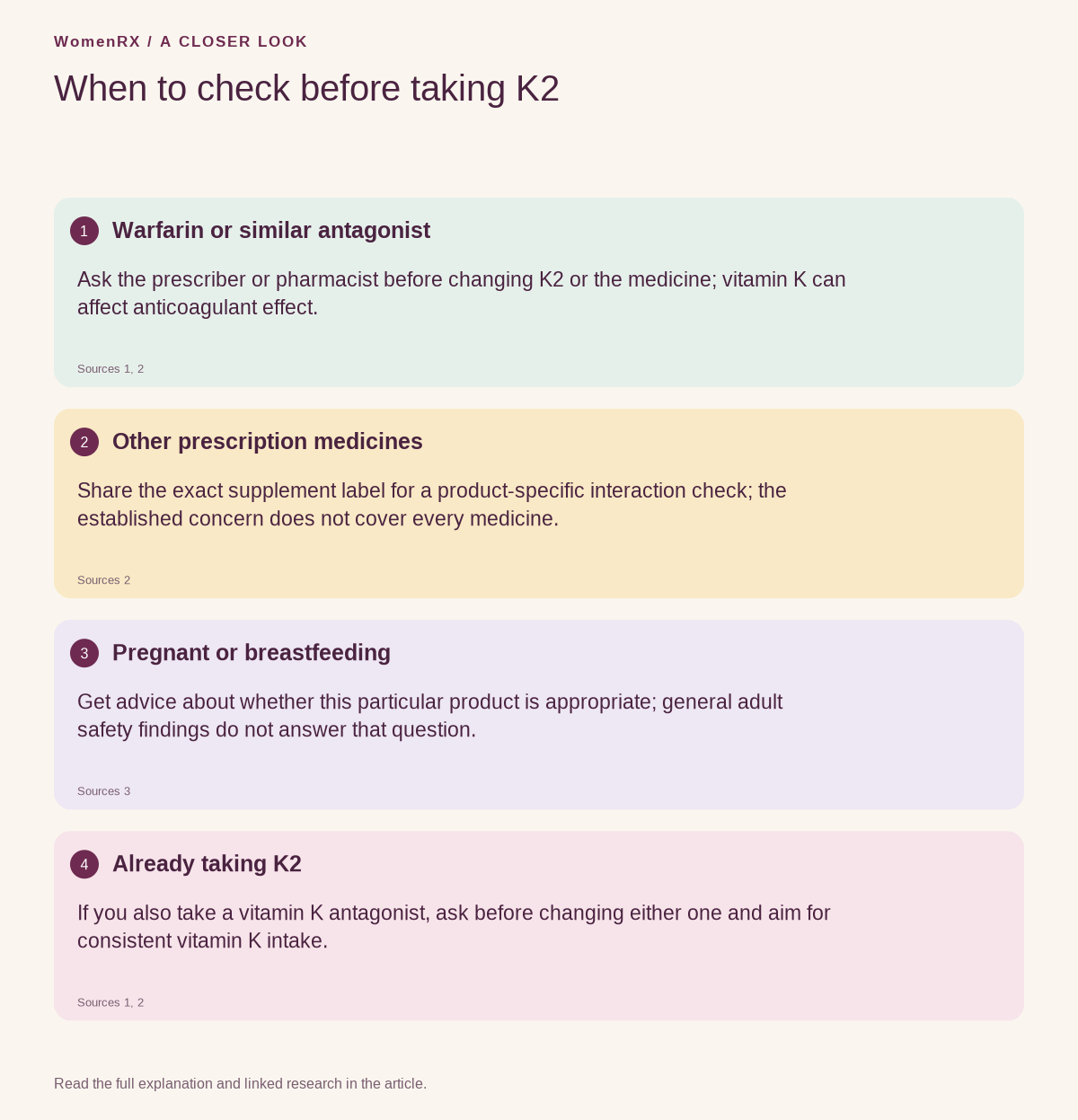
When to check before taking K2
Warfarin or similar antagonist: Ask the prescriber or pharmacist before changing K2 or the medicine; vitamin K can affect anticoagulant effect.12
Other prescription medicines: Share the exact supplement label for a product-specific interaction check; the established concern does not cover every medicine.2
Pregnant or breastfeeding: Get advice about whether this particular product is appropriate; general adult safety findings do not answer that question.3
Already taking K2: If you also take a vitamin K antagonist, ask before changing either one and aim for consistent vitamin K intake.12
Read the figure as text
Start with the medicine that has the clearest established interaction, then consider the product and your life stage.- Warfarin or similar antagonist: Ask the prescriber or pharmacist before changing K2 or the medicine; vitamin K can affect anticoagulant effect.12
- Other prescription medicines: Share the exact supplement label for a product-specific interaction check; the established concern does not cover every medicine.2
- Pregnant or breastfeeding: Get advice about whether this particular product is appropriate; general adult safety findings do not answer that question.3
- Already taking K2: If you also take a vitamin K antagonist, ask before changing either one and aim for consistent vitamin K intake.12
More questions, answered
Is K2 the same as vitamin K?
K2, or menaquinone, is one form of vitamin K. MK-4 and MK-7 are common forms of K2. The concern with warfarin applies because K2 is part of the vitamin K family. 1 2
Should I avoid vitamin K foods if I take warfarin?
The safety review describes warfarin treatment as being managed with a consistent intake of vitamin K, not by eliminating vitamin K from food. Ask your care team about changes to your diet or supplements. 1 2
Sources you can check
- Vitamin K: MedlinePlusAccessed 2026-09-25Return to first citation
- A Unique Formulation of Cardioprotective Bio-Actives: An Overview of Their Safety Profile.Salminen W, Agbaje-Williams M, Ajayi FO. · Medicines (Basel, Switzerland) · 2019Return to first citation
- US Pharmacopeial Convention safety evaluation of menaquinone-7, a form of vitamin K.Marles RJ, Roe AL, Oketch-Rabah HA. · Nutrition reviews · 2017Return to first citation