Vitamin K2 Supplements: Read the Form Before the Dose
A K2 amount only makes sense alongside its form, intended use, and medication context.
There isn’t one established K2 dose for every purpose. MK-4 and MK-7 are different forms, and a dose studied for one form or group of women shouldn’t be treated as a universal target. Before choosing a product, match its form and stated amount to a specific reason for taking it, then check for interactions, especially if you take warfarin or another vitamin K antagonist. 1 2 3
Start with the reason, not the bottle
Vitamin K helps the body make proteins involved in blood clotting and bone and tissue health. K2 is a family of vitamin K compounds called menaquinones, not one single ingredient. Labels may name forms such as MK-4 or MK-7. 1 3
That distinction matters because a study dose is not automatically transferable from one form to another, or from one goal to another. A useful first question is: What specific outcome am I hoping this supplement will support? “Bone health” is a reason to look at the evidence, but it doesn’t establish that a supplement will prevent fractures or treat bone loss.
What a dose label can, and can’t, tell you
Read the form and amount together. MK-4 and MK-7 differ in their chemical side chains; research also describes differences in how long they remain in the body. Those differences make it unwise to assume that the same number of micrograms of each form has the same effect. 3
For example, one three-year randomized trial gave 244 healthy postmenopausal women either a placebo or 180 micrograms of MK-7 daily. The study reported less decline in bone mineral measures at the lumbar spine and femoral neck, but not the total hip. These findings apply to that form, amount, study population, and timeframe. They don’t establish a dose for other women, other life stages, or fracture prevention. 2
The bone evidence isn’t uniform across groups. A 2026 narrative review describes a trial in early menopausal women in which MK-7 did not reduce bone loss. Together, these results are a reason to avoid treating one postmenopausal study as a general recommendation for all women. 4
A label tells you what the product states it contains; it doesn’t show that the amount has been proven for your intended outcome. If a product combines K2 with other ingredients, consider those ingredients separately rather than assuming the combination has the same evidence as K2 alone.
Check medication interactions before choosing a product
Vitamin K can interfere with medicines that work by blocking vitamin K, including warfarin. This is the key safety check to make before adding K2. 1 3
Don’t start, stop, or change a K2 supplement or make a deliberate change to your vitamin K intake without guidance from the clinician managing your anticoagulant. Keeping vitamin K intake consistent is part of managing these medicines; a supplement can change that pattern. 1 3
The interaction evidence is especially relevant to vitamin K antagonist medicines. Don’t assume a dose is harmless because it looks small: a review reports that MK-7 affected anticoagulation in people taking the related coumarin medicine acenocoumarol. That result isn’t a dosing instruction for warfarin, but it reinforces why people taking these medicines need an individual review rather than a self-selected threshold. 3
Pregnancy and breastfeeding need a separate answer
The bone trial described above studied postmenopausal women, not people who are pregnant or breastfeeding. It can’t establish a useful or appropriate K2 supplement dose for those life stages. If you’re pregnant or breastfeeding and considering a K2 product, bring the exact label to your prenatal or postpartum care clinician before adding it. 2
A five-part label check
Before buying or starting a product, check:
- Form: Does the label name MK-4, MK-7, or another form?
- Amount: What amount is stated for that form, and is it the same form and amount studied for your goal?
- Purpose: Is the claim about a measured outcome, such as a change in bone mineral density, or a broader promise the study didn’t test?
- Evidence match: Does the research population resemble you in life stage and health context?
- Medication context: Do you take warfarin or another vitamin K antagonist, or are you pregnant or breastfeeding? If so, get individual guidance before starting.
The practical takeaway: choose a product only after you can explain what form it contains, why you’re considering it, and whether the evidence actually matches that purpose. For K2, medication review belongs before product selection.
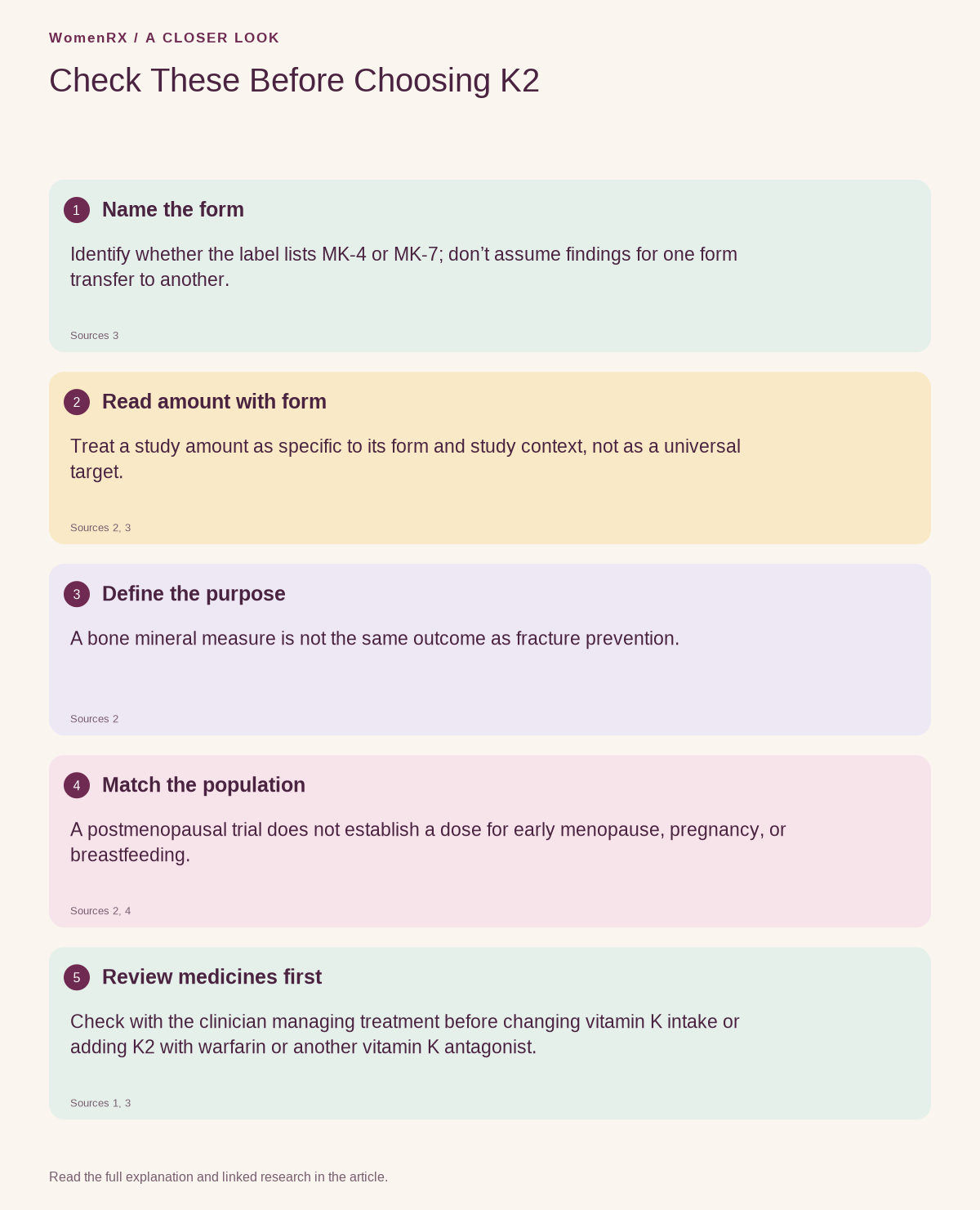
Check These Before Choosing K2
Name the form: Identify whether the label lists MK-4 or MK-7; don’t assume findings for one form transfer to another.3
Read amount with form: Treat a study amount as specific to its form and study context, not as a universal target.23
Define the purpose: A bone mineral measure is not the same outcome as fracture prevention.2
Match the population: A postmenopausal trial does not establish a dose for early menopause, pregnancy, or breastfeeding.24
Review medicines first: Check with the clinician managing treatment before changing vitamin K intake or adding K2 with warfarin or another vitamin K antagonist.13
Read the figure as text
Use the form, purpose, evidence, and medication context together; a dose number alone can’t show whether a product is a good match.- Name the form: Identify whether the label lists MK-4 or MK-7; don’t assume findings for one form transfer to another.3
- Read amount with form: Treat a study amount as specific to its form and study context, not as a universal target.23
- Define the purpose: A bone mineral measure is not the same outcome as fracture prevention.2
- Match the population: A postmenopausal trial does not establish a dose for early menopause, pregnancy, or breastfeeding.24
- Review medicines first: Check with the clinician managing treatment before changing vitamin K intake or adding K2 with warfarin or another vitamin K antagonist.13
More questions, answered
Does a study of MK-7 establish a dose for MK-4?
No. MK-4 and MK-7 are different menaquinone forms, and the evidence for one form shouldn’t be treated as a dose recommendation for the other. Match the form on a label to the form studied for the outcome you care about. 2 3
Does the postmenopausal bone study show that K2 prevents fractures?
No. It reported changes in bone mineral measures and other bone-related outcomes over three years. Those findings don’t by themselves establish that MK-7 prevents fractures. 2
Sources you can check
- Vitamin K: MedlinePlusAccessed 2026-09-25Return to first citation
- Three-year low-dose menaquinone-7 supplementation helps decrease bone loss in healthy postmenopausal women.Knapen MH, Drummen NE, Smit E, Vermeer C, Theuwissen E. · Osteoporosis international : a journal established as result of cooperation between the European Foundation for Osteoporosis and the National Osteoporosis Foundation of the USA · 2013Return to first citation
- A Unique Formulation of Cardioprotective Bio-Actives: An Overview of Their Safety Profile.Salminen W, Agbaje-Williams M, Ajayi FO. · Medicines (Basel, Switzerland) · 2019Return to first citation
- Beyond Bone Health: Exploring the "Heart-Brain-Bone" Axis Modulated by Lipid-Soluble Nutrients (Omega-3, Vitamin D3, and Vitamin K2).Fang SC, Huang MK, Shen HE, Zhang BB, Chao TC, Wu CC. · Nutrients · 2026Return to first citation